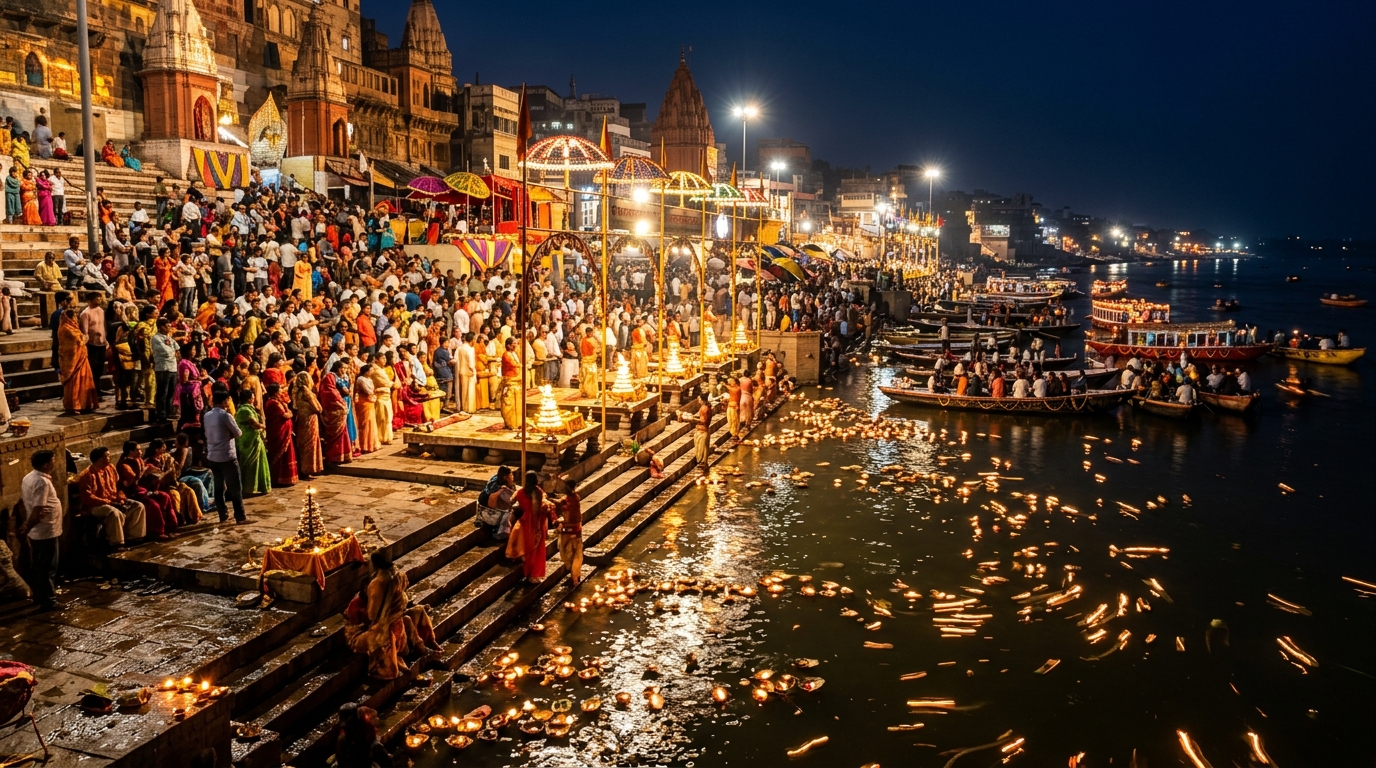
Come here before sunrise and the city looks completely different from the Varanasi you may have seen the previous evening. The sky is still pale, wooden rowboats glide quietly through morning mist, priests prepare for dawn rituals, devotees step into the holy river, and somewhere in the distance a bronze temple bell breaks the silence. Return after sunset and the riverfront transforms again: brass lamps glow on high pedestals, rhythmic chants rise over the water, hundreds of floating flower diyas illuminate the dark river, and the ancient stone palaces stand as dark silhouettes against the starry sky.
This perpetual rhythm is what makes the ghats of Varanasi so much more than a sightseeing attraction: they are sacred places of worship, ritual bathing, silent meditation, cremation, classical music, friendly conversation, commerce, photography, and everyday life—all existing seamlessly side by side.
According to the official District Varanasi tourism administration, the city features 88 distinct ghats along the Ganga. A large number of the monumental stone ghats visible today were rebuilt or substantially patronized after the 18th century by Maratha, Holkar, Scindia, Peshwa, and Bhonsle royal dynasties. Every ghat possesses its own unique soul, architectural character, and spiritual rhythm.
Why Are the Ghats of Varanasi So Important?
In Varanasi, a ghat is far more than a set of stone steps leading down to water—it is the direct gateway to spiritual liberation (Moksha). The sacred river Ganga is the lifeblood of Kashi. Pilgrims journey thousands of miles for ritual cleansing, ancestral offerings (Tarpan and Pind Daan), and evening prayer.
The riverfront is a living sacred landscape. You will witness someone performing deep Vedic meditation just a few meters away from children playing gully cricket, a sadhu reading scriptures beside a clay chai stall, and an ancient funeral procession chanting "Ram Naam Satya Hai" passing steps away from a joyous wedding party. The ghats are not an open-air museum—they are an active spiritual ecosystem that has functioned continuously for thousands of years.
1. Dashashwamedh Ghat – The Ceremonial Heart of Varanasi
If you have time to see only one ghat in Varanasi, it will inevitably be Dashashwamedh Ghat. Positioned right at the center of the riverfront near Godowlia and Kashi Vishwanath Temple, it is the most energetic, historic, and photographed ghat in the city.
It is universally celebrated for the world-famous Evening Ganga Aarti, performed at dusk by seven white-and-saffron robed Brahmin priests. Hundreds of boats gather in front of the stone steps, filling the night with conch shells, incense, and roaring multi-tiered brass flames.
Visitor Tip: Arrive by 5:15 PM in winter (5:45 PM in summer) to secure free stone steps directly facing the center platform, or rent a seat on a moored wooden boat.
2. Assi Ghat – The Best Place to Begin Your Morning
Anchoring the southernmost end of the main riverfront, Assi Ghat is beloved by travelers, students, and yogis who prefer a spacious, soulful, and relaxed atmosphere. Situated where the sacred river Assi meets the Ganga, this ghat is world-renowned for Subah-e-Banaras—an inspiring dawn program featuring Vedic yajnas, morning Ganga Aarti, live classical Indian music (Dhrupad & Shehnai), and free open-air sunrise yoga.
Unlike the congested lanes of the central old city, Assi has direct vehicular road access for autos and cabs. It is lined with charming Italian pizzerias, traditional tea stalls, and peaceful reading spots, making it the finest starting base for your journey.
3. Manikarnika Ghat – Where Varanasi Confronts Life & Death
Manikarnika Ghat is the primary, most sacred cremation ground in Hinduism. Believed to be blessed by Lord Shiva such that anyone cremated here attains instant Moksha (release from the eternal cycle of rebirth), its sacred funeral pyres have burned without interruption for thousands of years.
According to legend, Goddess Parvati lost her jeweled earring (Manikarnika) in the sacred well (Chakrapushkarini Kund) dug by Lord Vishnu, prompting Lord Shiva to grant the site supreme sanctity.
Strict Code of Ethics at Manikarnika Ghat
Manikarnika is an active, solemn place of bereavement—not a staged spectacle. Never take photographs or video of active cremation pyres or grieving families. Respect mourning relatives by maintaining distance and quiet decorum. Be alert to aggressive touts who attempt to lure foreigners to private terraces claiming to demand money for "cremation firewood donations."
4. Harishchandra Ghat – The Historic Cremation Ghat
Located further south, Harishchandra Ghat is the second sacred cremation ghat of Varanasi, named after legendary King Harishchandra who served as an attendant at this cremation ground to uphold his unyielding vow of truth. It features both traditional open-air sandalwood pyres and an eco-friendly modern electric crematorium facility. The same respectful photography restraint applies here as at Manikarnika.
5. Man Mandir Ghat – Observatory Architecture Above the River
Just north of Dashashwamedh stands Man Mandir Ghat, crowned by an exquisite 16th-century palace built by Maharaja Man Singh of Amber (Jaipur). Around 1710, the astronomer Maharaja Sawai Jai Singh II added stone astronomical instruments (Jantar Mantar) to the palace roof, featuring sun dials and planetary observation quadrants that still overlook the Ganga.
6. Scindia Ghat & The Sunken Shiva Temple
Continuing north past Manikarnika, you reach Scindia Ghat (Shinde Ghat), built in 1830 by Maharani Baiza Bai of Gwalior. Its most iconic visual feature is the partially submerged Ratneshwar Mahadev Temple, whose massive stone spire leans at an astonishing angle of over 9 degrees into the river water—surpassing the lean of the Tower of Pisa!
7. Lalita Ghat & The Ganga Gateway
Under the new Kashi Vishwanath Dham project, Lalita Ghat has become the primary riverfront portal to the Golden Temple. Boasting open escalators and broad stone ramps leading directly into the temple precinct, it is also home to the famed Nepali Temple (Kathwala Temple), carved entirely out of terracotta and wood in intricate Pagoda style by the King of Nepal.
8. Kedar Ghat – Colour, Worship & South Indian Identity
Easily identified by its bold red-and-white vertical temple stripes, Kedar Ghat is the spiritual home of South Indian pilgrims visiting Kashi. Dedicated to Lord Shiva as Kedareshwar (an earthly counterpart to the Himalayan Kedarnath), the ghat bustles with morning bathers and Vedic recitations in an intimate neighbourhood setting.
9. Panchganga Ghat – Sacred Meeting of Five Rivers
Steeped in mysticism, Panchganga Ghat marks the mythical underground confluence of five sacred streams: the Ganga, Yamuna, Saraswati, Kirana, and Dhutpapa. It is revered as the meditation seat of saint Ramananda and Kabir. Towering high above the ghat stands the imposing black minarets of the Dharahara Mosque (Alamgir Mosque), built by Aurangzeb in the 17th century.
10. Chet Singh & Darbhanga Ghats: The Fortified Palaces
• Chet Singh Ghat: Resembles a medieval fortress with towering stone bastions. Here in 1781, Maharaja Chet Singh fought a valiant historic battle against the British troops of Warren Hastings.
• Darbhanga Ghat & BrijRama Palace: Considered the single most photogenic palace facade along the Ganga. Constructed in 1812 by the royal house of Darbhanga (Bihar) out of Greek and Maratha stone carvings, the palace now houses the luxury heritage hotel BrijRama Palace.
11. Raj Ghat & Namo Ghat: The Evolving Northern Frontier
• Raj Ghat: The historic northern boundary of the city near the Malviya bridge, where archaeological excavations have uncovered 3,000-year-old settlements dating back to the Vedic era.
• Namo Ghat: The newest, state-of-the-art transformed riverfront space in northern Varanasi, recognizable by its monumental bronze sculptures of folded hands (Namaste). It offers vast public promenades, boat charging points, and open walking plazas.
Which Ghats Should You Visit First?
| Travel Priority | Best Ghat to Visit | Ideal Visiting Time |
|---|---|---|
| Grand Evening Ganga Aarti | Dashashwamedh Ghat | 5:30 PM – 7:30 PM |
| Sunrise Boating & Morning Yoga | Assi Ghat (Subah-e-Banaras) | 5:00 AM – 7:30 AM |
| Spiritual Liberation & Heritage | Manikarnika Ghat | Early morning or late afternoon (Respectful) |
| Royal Architecture & Photography | Darbhanga & Chet Singh Ghat | Early sunrise from a river boat |
| Tranquil Meditation & Walking | Kedar Ghat, Scindia Ghat & Panchganga | 6:30 AM – 9:00 AM |
Sunrise Boat Rides: Panorama from the Ganga
Walking the stone steps gives you the intimate details of local life, but taking a sunrise boat ride on the Ganga gives you the full architectural panorama. As the golden morning sun rises behind your boat on the eastern horizon, its amber rays bathe the palatial Maratha facades, temples, and stairways in warm light.
Booking Advice: Always confirm duration, route (e.g. Assi to Manikarnika & return), whether the boat is shared (₹150–₹200/person) or private (₹800–₹1,200 total), and starting/ending points directly with the boatman (Majhi) before stepping onto the boat.
Walking the Ghats: The Classic Riverfront Promenade
One of the finest walking journeys in Asia is the 40-minute self-guided walk from Assi Ghat to Dashashwamedh Ghat. Along the paved stone steps, you traverse:
Assi Ghat ➔ Tulsi Ghat ➔ Chet Singh Fort ➔ Kedar Ghat ➔ Harishchandra Ghat ➔ Darbhanga Palace ➔ Dashashwamedh Ghat.
Wear comfortable walking shoes with good grip. Give yourself 1.5 to 2 hours to sit on the steps, sip hot chai from clay cups, and absorb the timeless flow of life along the sacred river.
Frequently Asked Questions About the Ghats of Varanasi
How many ghats are there in Varanasi?+
The official District Varanasi tourism portal lists 88 continuous stone ghats stretching along the western bank of the sacred river Ganga.
Which is the most famous ghat in Varanasi?+
Dashashwamedh Ghat is the most famous, world-renowned for its grand daily evening Ganga Aarti and central proximity to Kashi Vishwanath Temple.
Which is the best ghat for sunrise?+
Assi Ghat is universally acknowledged as the best sunrise spot, home to the Subah-e-Banaras morning program of Vedic chanting, sunrise aarti, classical music, and yoga.
Can tourists visit Manikarnika Ghat?+
Yes, visitors can walk through and observe the spiritual rituals respectfully. However, photography or filming of active funeral pyres and grieving families is strictly prohibited.
Can I walk from Assi Ghat to Dashashwamedh Ghat?+
Yes, stone steps provide a continuous scenic 40-minute walkway between Assi and Dashashwamedh, passing iconic landmarks like Kedar Ghat, Harishchandra, and Darbhanga Palace.
Which ghats are best for photography?+
Assi, Chet Singh, Darbhanga, Man Mandir, and Scindia Ghat offer stunning facades. A sunrise boat ride on the river provides the best panoramic angles of the morning light.