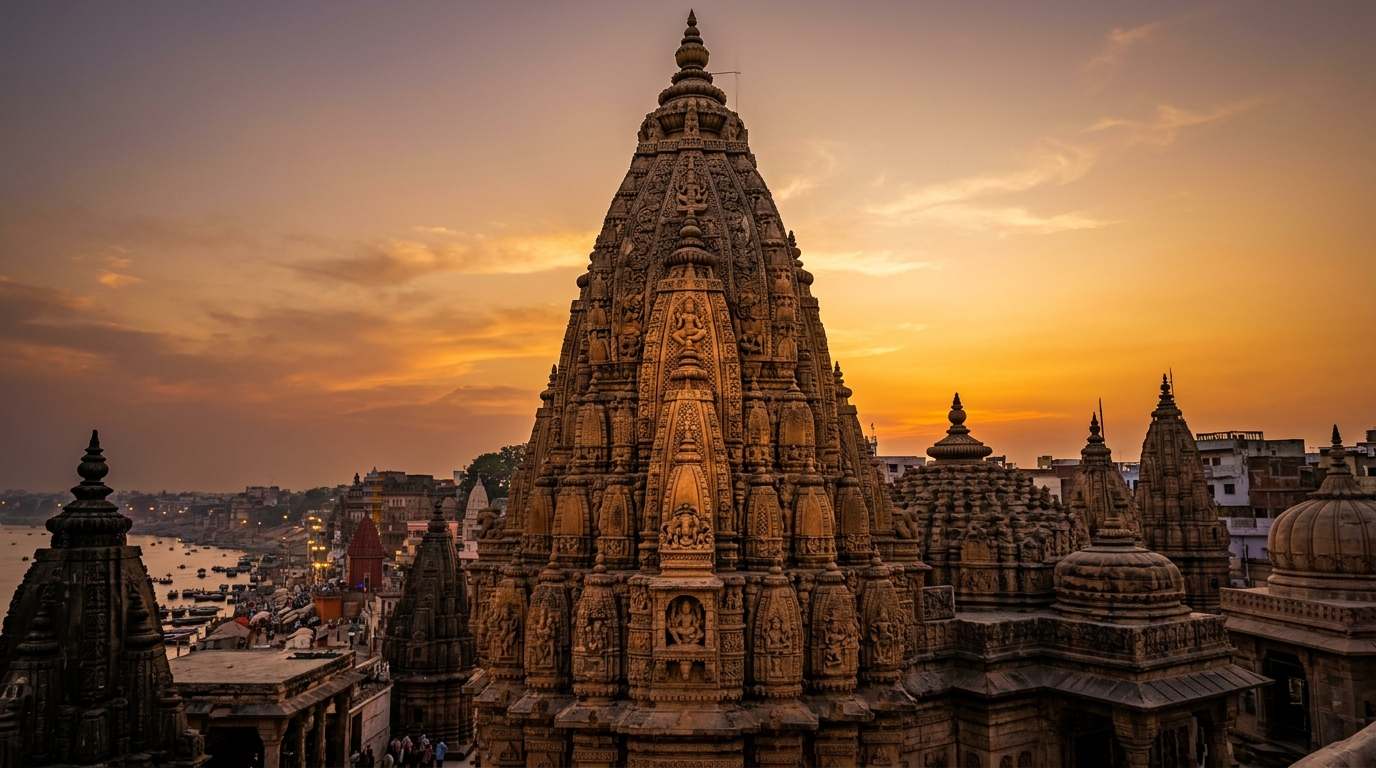
There is no single building, ghat, or temple that completely explains Varanasi. You can stand inside the Kashi Vishwanath area, watch the Ganga at dawn, walk past ancient-looking homes in old Banaras, spend an afternoon among Buddhist remains at Sarnath, and listen to classical music in the evening—and still feel that you have only understood one layer of Kashi. That is precisely what makes Varanasi extraordinary.
Also known as Banaras or Kashi, Varanasi is one of India's most important spiritual and cultural cities. The District administration describes it as one of the world's oldest continuously inhabited cities and notes its long continuity as a centre of pilgrimage, knowledge, philosophy, culture, arts, and crafts. But calling Varanasi merely "an ancient city" does not capture it: it is ancient, but vibrant and completely alive.
Varanasi, Banaras or Kashi: What Should You Call the City?
During your journey, you will hear all three names used interchangeably. For a traveller, they represent three distinct personalities of the same place:
Varanasi
The modern administrative name, derived from the two sacred river boundaries: the Varuna in the north and the Assi in the south. It is the destination printed on your flight or railway ticket.
Banaras
The cultural, soulful name celebrated in poetry, music, street humor, and cuisine. Banaras comes alive in conversations about Banarasi silk, paan, thandai, lassi, and the unhurried joy of Mauj.
Kashi
The ancient, spiritual name derived from the root Kash (to shine). Kashi is the sacred "City of Light", revered as the cosmic abode of Lord Shiva where seekers come for Moksha (spiritual liberation).
Why Is Varanasi So Famous?
Most visitors first know Varanasi because of religion. It stands among Hinduism's most sacred pilgrimage destinations, closely associated with Lord Shiva and the holy river Ganga. But religion is only one facet of its significance.
For over three thousand years, Varanasi has been a preeminent centre of intellectual scholarship, Sanskrit philosophy, Ayurveda, yoga, Hindi literature, classical music, textile manufacturing, and international trade. Few places on earth bring sacred geography, living ritual, artisanal craft, academic prestige, and everyday urban vibrancy together as intimately as Banaras.
How Old Is Varanasi?
You will often hear Varanasi described as the "oldest city in the world." In rigorous historical terms, it is widely acknowledged as one of the world's oldest continuously inhabited cities. Unlike Pompeii, Babylon, or Mohenjo-Daro—which exist only as archaeological ruins—Varanasi has never stopped living. Its ancient Vedic hymns are chanted today in the exact meter they were chanted three thousand years ago, beside modern universities and wireless fiber-optic networks.
Kashi and Lord Shiva
The spiritual identity of Varanasi is completely inseparable from Lord Shiva. In Hindu cosmology, Kashi is Shiva's personal garden (Anandavan) perched upon the tip of his divine trident (Trishula), protected from cosmic dissolution (Pralaya).
At its heart stands Shri Kashi Vishwanath Temple, housing the seventh Jyotirlinga. But the sacred landscape extends far beyond one shrine: there are hundreds of Shiva temples, guardian Bhairava shrines (such as Kaal Bhairav, the Kotwal of Kashi), sacred water kunds, and pilgrimage circuits such as the Panchkoshi Yatra.
The Ganga: The River That Defines the City
If Shiva gives the city its soul, the Ganga provides its physical, visual, and emotional heart. As the river reaches Varanasi, it curves uniquely toward the north (Uttravahini), turning back toward its Himalayan source—a phenomenon considered supremely auspicious.
The riverfront forms a breathtaking stone crescent lined with 88 continuous ghats. From the river at sunrise, the palatial facades, temples, and staircases appear as one unbroken architectural panorama. From land, that same riverfront unfolds into intimate stone doorways, neighborhood ghats, and vibrant river life.
The Ghats: The Public Stage of Banaras
Varanasi's riverfront is organized into 88 historic ghats. Each has its own distinct personality:
- Dashashwamedh Ghat: The ceremonial center, famous for the nightly Ganga Aarti.
- Assi Ghat: The southern cultural anchor, renowned for dawn sunrise rituals, yoga, and classical music during Subah-e-Banaras.
- Manikarnika Ghat: The primary cremation riverfront where sacred pyres burn continuously, reminding pilgrims of the impermanence of mortal life.
- Kedar, Scindia & Darbhanga Ghats: Striking architectural gems featuring colorful regional temples, royal Maratha palaces, and leaning stone shrines.
Morning and Evening: Two Different Cities
Varanasi shifts character dramatically with the sun:
• Morning at Dawn: Soft pastel skies, quiet rowboats, chanting priests, peaceful river mist, and fresh kulhad chai. A time of quiet contemplation.
• Evening at Dusk: Roaring brass lamp flames, clanging bells, packed stone steps, vibrant street food stalls, and the electric communal devotion of Ganga Aarti.
Sarnath: Buddhist Crossroads of World History
Just 10 km north of Varanasi lies Sarnath, one of Buddhism's supreme world pilgrimage sites. Here in the peaceful Deer Park, Gautama Buddha delivered his momentous First Sermon (Dharmachakra Pravartana), setting the Wheel of Law into motion. The monumental 5th-century Dhamek Stupa and the Sarnath Museum (housing the original 3rd-century BCE Ashokan Lion Capital—the National Emblem of India) offer a serene, contemplative contrast to the dense old city.
A Living Centre of Knowledge & Education
Throughout history, scholars journeyed to Kashi to have their philosophical treatises verified by the council of pandits. Today, this tradition thrives at Banaras Hindu University (BHU), one of Asia's largest residential universities, along with Sampurnanand Sanskrit University and Mahatma Gandhi Kashi Vidyapith. Walking through BHU's broad, leafy campus reveals the youthful, academic, and forward-looking dimension of modern Banaras.
The Music of the Banaras Gharana (UNESCO City of Music)
Recognized by UNESCO as a Creative City of Music, Varanasi is the birthplace of the legendary Banaras Gharana. The city nurtured musical titans such as Bharat Ratna Ustad Bismillah Khan (the master of the Shehnai), Pandit Ravi Shankar (Sitar), and Vidushi Girija Devi (Thumri). Classical music in Varanasi is not confined to auditorium stages—it resonates from temple courtyards, morning ghat pavilions, and neighborhood music schools.
Banarasi Silk: A Masterwork of Weaving Heritage
Varanasi's silk-weaving tradition dates back over five centuries. In historic weaver quarters like Madanpura and Peeli Kothi, master weavers operate traditional wooden handlooms, weaving fine mulberry silk with pure silver and gold zari threads. Creating an intricate, bridal Banarasi silk saree can take anywhere from three weeks to six months of painstaking manual artistry.
Banarasi Food Culture: From Kachori to Paan
Eating in Banaras is an essential cultural ritual. The city's food culture is pure, vegetarian, and bursting with local character:
- Morning: Piping-hot hing kachoris with spicy aloo-chana sabzi and crisp jalebis.
- Evening: Tangy, spicy Tamatar Chaat and dahi golgappas served in eco-friendly clay donas.
- Desserts: Thick kulhad lassi topped with malai, and winter's delicate saffron-froth Malaiyyo.
- The Grand Finale: The legendary Banarasi Meetha Paan, carefully folded with gulkand, fennel, and silver foil.
Life and Death Coexisting in the Same Landscape
Perhaps what touches travellers most deeply about Varanasi is that it does not hide death. In western and modern societies, mortality is sanitized and hidden away behind hospital curtains. In Kashi, funeral processions pass through busy market streets with chants of "Ram Naam Satya Hai", and funeral pyres burn openly on the riverfront steps just meters away from laughing bathers and wedding parties. This profound coexistence reminds every visitor that death is not something to fear, but a natural, sacred transition in the eternal cosmic cycle.
Frequently Asked Questions About Varanasi
Are Varanasi and Banaras the same place?+
Yes. Varanasi is the official administrative name, Banaras represents its culture, food, music, and silk, while Kashi is its ancient sacred name associated with Lord Shiva.
Why is Varanasi called Kashi?+
Kashi comes from the Sanskrit root 'Kash' (to shine). It translates to the 'City of Light', reflecting its role as a beacon of cosmic truth, spirituality, and divine illumination.
Is Varanasi one of the oldest cities in the world?+
Yes, Varanasi is officially recognized as one of the oldest continuously inhabited cities on earth, maintaining an unbroken living civilization for over 3,000 years.
Why is Varanasi important in Buddhism?+
Sarnath, located 10 km north of the city, is where Gautama Buddha delivered his first sermon after enlightenment, establishing the global foundation of Buddhism.
Is Varanasi worth visiting if I am not religious?+
Absolutely. Varanasi is as much a cultural, architectural, musical, and culinary capital as it is a spiritual destination. Its history, silk weaving, street food, and ghat life captivate travellers of all backgrounds.