If you walk from Godowlia Chowk toward Dashashwamedh Ghat at five in the evening, Banaras doesn’t ask if you want to shop—it simply pulls you into the bazaar. On your left, brass lamps catch the amber light of street bulbs. Ahead, men carry tall bundles of zari-threaded sarees wrapped in white muslin on their heads, squeezing past cycle rickshaws, flower sellers, and wandering bulls.
Shopping in Varanasi is not a sterile mall experience. It is a sensory negotiation with a city that has been trading textiles, metalware, perfume, and prayer items for over two thousand years. Almost every craft sold in the lanes of Kashi grew up around two historical patrons: the temples (which demanded brass vessels, rudraksha beads, wooden toys, and natural attar) and the royal courts (which funded the intricate gold-and-silver brocades of Banarasi weavers).
Yet, for a first-time visitor, the markets of Banaras can be intimidating. Between aggressive rickshaw drivers offering "government-approved silk factory tours" and shops selling powerloom polyester at handloom prices, it is easy to overpay.
Having walked these galis (narrow lanes) for over two decades, I have put together this ground-level guide to help you find authentic crafts, pay fair local prices, and know the exact lane to turn into—whether you are hunting for a heirloom Katan silk saree or a ₹100 hand-carved wooden toy.
7 Authentic Things to Buy in Varanasi (And Why They Matter)
Before we dive into the markets, you need to know what belongs to Banaras and what is mass-produced inventory shipped in from elsewhere. Stick to these seven GI-tagged (Geographical Indication) and locally rooted specialties.
1. Banarasi Handloom Silk Sarees, Dupattas & Stoles
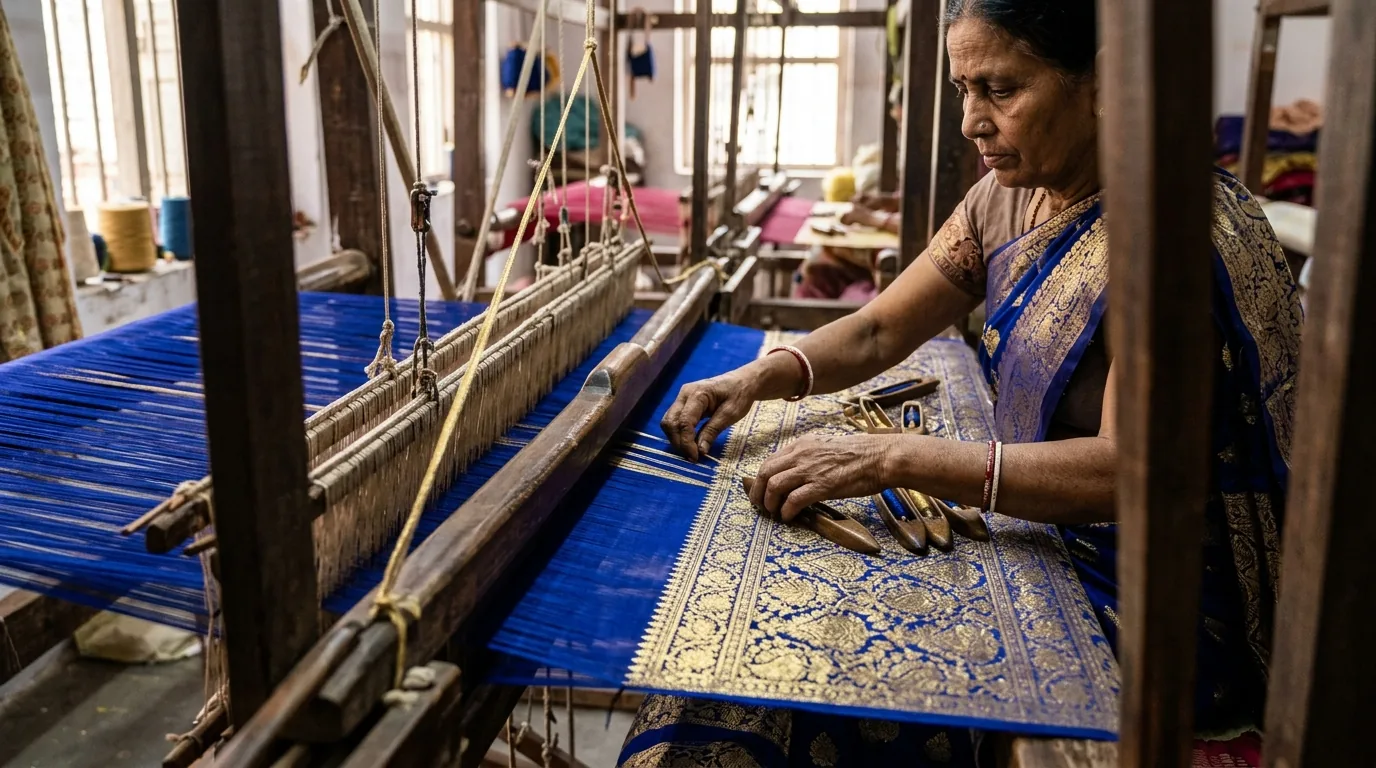
Varanasi is one of the world’s great weaving capitals. True Banarasi silk is woven on pit looms or frame looms by master karigars (weavers), often taking anywhere from ten days to six months for a single piece. Look for four main variations:
- Katan: Pure, tightly twisted mulberry silk threads that create a light, durable, and luminous drape.
- Kadhwa (or Kadhua): An heirloom weaving technique where each motif is woven individually by hand without leaving loose floating threads on the reverse side.
- Tanchoi: Intricate, satin-like weaves featuring miniature jamawar or paisley patterns using multiple colored weft threads—often without heavy metallic zari.
- Jangla & Shikargah: Dense, all-over floral vines or historical hunting scenes woven across the entire body of the saree.
Don’t want a full saree? Pick up a pure silk Banarasi dupatta, a brocade men’s waistcoat fabric, or a lightweight silk-cotton (Kora/Organza) stole, which starts around ₹1,200 to ₹2,500.
2. GI-Tagged Banaras Metal Repoussé Craft & Brassware
Walk into Thatheri Bazar and you will hear the rhythmic tap-tap-tap of hammers shaping sheet metal. Varanasi’s metalworkers are legendary for everything from heavy ceremonial aarti lamps and kamandals (water pots) to delicate embossed wall plates depicting Shiva, Ganesha, or the signs of the zodiac. Unlike the bright, machine-polished brass from Moradabad, traditional Banarasi brass and copper work often has a heavier gauge and deeper hand-chiseled detailing.
3. Wooden Lacquerware Toys (Lakdi ke Khilaune)
Originating in the narrow lanes of Khojwan and Kashmiriganj, Banaras wooden toys are carved from seasoned Kariya wood and painted with natural, non-toxic lacquer dyes. Originally carved so children and households could set up miniature jhankis (tableaux) during festivals like Janmashtami and Navratri, these sets include miniature musicians, traditional brides and grooms, vermilion boxes (sindoor-daan), and nesting dolls.
4. Gulabi Meenakari (Pink Enamel Jewelry & Miniatures)
Brought to Varanasi by Persian enamelists during the Mughal era, Gulabi Meenakari is one of India’s rarest crafts, practiced mainly inside the lanes near Gai Ghat and Lalita Ghat. Artisans shape pure silver into birds, peacocks, elephants, or jhumka earrings, engrave tiny grooves into the metal, and paint them with crushed glass mixed with natural pomegranate juice. Once fired in a small kiln, the enamel turns a signature rose-pink that exists nowhere else in Rajasthan or Gujarat.
5. Rudraksha Malas & Spiritual Paraphernalia
As the city of Shiva, Kashi is the primary hub in India for Rudraksha beads (sourced from Nepal and Indonesia), sandalwood paste, gangajal (Ganga water sealed in copper pots), and crystal (sphatik) shivalingams. While regular five-faced (panchmukhi) Rudraksha malas are inexpensive and widely available for daily chanting, rare single-faced (ek-mukhi) beads require certification from an established gem and rudraksha laboratory.
6. Natural Attars (Kannauj & Banarasi Perfumes)
Near Vishwanath Gali and Chowk, small wooden-shuttered shops lined with cut-glass decanters sell alcohol-free natural perfumes (ittar or attar). Distilled in copper degs using sandalwood oil as a base, the signature scents to try in Varanasi are Mitti Attar (the exact scent of baked earth after the first monsoon rain), Ruh Khus (wild vetiver, prized for its cooling properties in summer), Kewda, and Chameli (jasmine).
7. Banarasi Glass Beads & Hand-Knotted Carpets
Few travelers realize that the Varanasi-Mirzapur-Bhadohi belt is the largest handmade carpet and glass-bead cluster in India. In the markets around Godowlia and Cantonment, you can buy lampwork glass bead necklaces for a song, or ship a hand-knotted wool-and-silk rug directly to your home doorstep.
How to Spot Fake Banarasi Silk: 4 Street-Level Tests
Roughly 70% of what is sold to casual tourists in street-front showrooms is either Surat powerloom polyester or Chinese synthetic yarn disguised as "pure silk." Use these four checks before opening your wallet:
- Flip the Saree Over (The Float Test): Turn the saree or dupatta to its back side. Machine-made powerloom sarees have a smooth, uniform reverse or cleanly clipped threads. A handloom Banarasi saree (unless it is a pure Kadhwa weave) will show slightly irregular floats of thread between motifs, or small variations in tension that only human hands leave behind.
- Check the Selvedge & Pallu Edge: Look closely at the six inches of plain silk near the blouse piece and the borders. Handloom pure silk has tiny pin-holes along the edge where the temple hooks held the fabric taut on the loom.
- The Ring & Warmth Test: Pure mulberry silk (Katan) is a natural protein fiber. When you scrunch a section in your fist for ten seconds, it warms up against your skin and leaves soft creases. Polyester stays cool, slippery, and springs back immediately with a harsh metallic shine.
- Look for the Silk Mark India Tag: While tags can occasionally be misused, reputable weavers and showrooms carry the official Silk Mark Organization of India hologram with a scannable QR code, alongside the Handloom Mark.
Best Places for Shopping in Varanasi: Market-by-Market Breakdown
To help you plan your route without wasting hours in traffic, here is a quick comparison of Varanasi’s major shopping districts, followed by a deep dive into each neighborhood.
| Market / Area | Best Known For | Price Level | Best Time to Visit | Closed On |
|---|---|---|---|---|
| Vishwanath Gali | Pooja items, wooden toys, attar, trinkets, stoles | Budget to Mid | 10:00 AM – 8:30 PM | Open Daily |
| Thatheri Bazar | Brassware, copper vessels, antique metal craft | Mid-Range | 11:00 AM – 8:00 PM | Sunday |
| Chowk & Golghar | Silk sarees, chikankari, wholesale dry fruits, silver | Mid to Premium | 11:00 AM – 9:00 PM | Sunday (Partial) |
| Peeli Kothi & Madanpura | Direct-from-weaver Banarasi sarees & dress material | Wholesale | 10:30 AM – 7:30 PM | Sunday / Friday Afternoon |
| Dalelganj (Dal Mandi) | Footwear, cosmetics, everyday glass bangles, hardware | Bargain | 12:00 PM – 9:00 PM | Sunday |
| Lanka & Assi | Books, khadi kurtas, handicrafts, boutique cafes | Fixed Price / Mid | 10:00 AM – 9:00 PM | Open Daily |
1. Vishwanath Gali: The Heartbeat of Temple Shopping
Winding parallel to the Kashi Vishwanath Corridor approach, Vishwanath Gali is the most famous pedestrian lane in Varanasi. Even after the construction of the wide corridor plaza, the surviving stretches of the old gali remain packed with family-run shops that have occupied the same stone plinths for four generations.
- What to buy here: Hand-carved wooden toys, brass Nandi and Annapurna idols, Rudraksha malas, glass bangles, natural attar, and inexpensive everyday cotton kurtas.
- Local tip: Don’t buy at the very first shop near the main road where rents and footfall are highest. Walk ten minutes deeper into the lane, compare rates at two or three counters, and refuel with a bowl of hot choora matar or malaiyyo (in winter) along the way.
2. Thatheri Bazar: The Brass & Copper Guild
Located a short walk from Chowk police station, Thatheri Bazar takes its name from the Thatheras (traditional metal-beaters). As you enter the lane, shops overflow with gleaming mountains of brass, bronze (kansa), and copper.
- What to buy here: Heavy brass urli bowls for floating flowers, multi-tiered Ganga Aarti lamps, copper water bottles, and bronze dinner sets (thalis).
- How it’s sold: Remember that authentic everyday brass and copper vessels are sold by weight (per kilogram), not by arbitrary piece prices. Only intricately hand-engraved artwork or inlaid stone pieces are priced individually by craftsmanship. Ask the shopkeeper to put the vessel on the digital scale first.
3. Chowk, Kunj Gali & Rajan Gali: The Retail Silk Hub
Just north of Godowlia lies Chowk, the historic commercial spine of old Banaras. Branching off from Chowk are narrow alleys like Kunj Gali where bridal shoppers from across North India come to buy wedding trousseaus.
- What to buy here: Heavy Banarasi lehengas, Katan silk sarees, zardozi borders, silver anklets (payal), and gota-patti work.
- Vibe: You won’t stand at a counter here. You will take off your shoes, step onto white floor mattresses (gaddis), sip sweet masala chai or cold limca, and watch salesmen unfold dozens of sarees in rhythmic snaps until the entire floor is a sea of magenta, emerald, and gold.
4. Madanpura & Peeli Kothi: Buying Directly from Weaver Families
If you want to bypass middlemen and retail showroom markups altogether, head either to Madanpura (walking distance between Godowlia and Sonarpura) or Peeli Kothi / Alaipura (towards the northern side of the city). These are residential-cum-workshop neighborhoods of the Ansari weaving community, who have kept the Banarasi loom alive for centuries.
- What to expect: You will hear the mechanical clatter of powerlooms alongside the quieter wooden thud of handlooms behind brick walls. Many master weavers (gaddidars) operate modest wholesale rooms on the first or second floor of their homes.
- Insider rule: Go here strictly without a local guide, hotel driver, or auto-rickshaw driver trailing behind you. The moment a third party walks into a weaver's house with you, the weaver is forced by local street custom to pad your bill by 25% to 40% to pay that person’s commission later in the evening.
5. Khojwan & Gai Ghat: For Collectors going to the Source
If you are a serious design lover or craft collector who wants to watch an artisan at work:
- Take an e-rickshaw to Khojwan (near Bhelupur/Nawabganj) to meet the national-award-winning families who carve and paint Banarasi wooden toys right on their front verandas.
- Walk into the lanes above Gai Ghat to visit the home workshops of Gulabi Meenakari master artisans (such as the family workshops of Kunj Bihari Lal and his successors), where you can purchase delicate pink-enameled silver birds directly from the workbench.
6. Government Emporiums & Fixed-Price Stores (Cantonment, Chowk & Lanka)
Hate bargaining? Want 100% peace of mind with an official invoice? Head to the fixed-price cooperatives and heritage stores:
- UP Handlooms & UPICA Emporiums: Located in the Cantonment and Chowk areas, offering verified handloom weaves at standardized prices.
- Khadi Gramodyog Bhawan: Great for pure spun cotton kurtas, raw silk yardage, and natural soaps.
- Lanka & Assi Road Boutiques: Around the Banaras Hindu University (BHU) gate at Lanka and along Assi-Ravindrapuri road, you’ll find contemporary designer stores, indie bookstores (like Pilgrim’s Book House / Harmony area), and curated craft stores catering to travelers who prefer fixed tags and credit card terminals.
The Golden Rules of Bargaining & Avoiding Scams in Varanasi
Varanasi shopkeepers are sharp, witty, and hospitable—they enjoy a good conversation as much as a sale. Follow these five rules to shop like a local:
- The "No-Tail" Rule: Never let an auto driver, boatman, or casual street acquaintance walk you into a silk shop. Even if they claim "he is my uncle, you get wholesale price," their commission goes straight onto your bill. Tell your driver to drop you at a main landmark (like Godowlia Crossing, Chowk Police Station, or Assi Crossing) and walk into shops on your own two feet.
- How Much to Bargain:
- In small tourist street stalls (trinkets, stone necklaces, cheap stoles), initial quotes can be inflated by 40% to 50%.
- In established family silk stores or brass shops, margins are tighter—expect a polite negotiation of 10% to 20% off the quoted price, especially if you buy multiple pieces.
- Morning Boni Advantage: In Indian bazaar culture, the very first sale of the day is called boni and is considered auspicious. If you visit a market around 10:30 AM or 11:00 AM just after the shopkeeper has finished his morning incense prayer, he will rarely let the first customer walk away empty-handed and will give you his best bottom price quickly.
- Shipping Heavy Items: If you are buying heavy brass idols or carpets, reputable stores in Thatheri Bazar and Cantonment can pack and courier items across India via DTDC/BlueDart or internationally via DHL/FedEx. Always take a photo of the exact piece you bought—including a small discreet chalk mark on the base—before leaving it for packing.
- Payment Methods: Almost every shop in Varanasi, right down to the roadside wooden toy seller, accepts UPI (Google Pay, PhonePe, Paytm). Larger silk showrooms accept Visa/Mastercard, though some wholesale weaver houses in Madanpura may add a 2% card machine surcharge or prefer UPI/cash.
A Half-Day "Shop & Eat" Walking Trail in Old Banaras
Don't treat shopping as a chore separate from sightseeing. Here is the exact 4-hour afternoon walking route I take visiting friends on:
- 3:00 PM – Start at Chowk: Take a cycle rickshaw or walk to Chowk. Duck into Thatheri Bazar to browse brass lamps and pick up copper vessels. Stop at Ram Bhandar inside Thatheri Bazar for warm, crisp kachoris or seasonal malaiyyo.
- 4:15 PM – Silk Browsing in Kunj Gali / Madanpura: Spend an hour sitting on a white gaddi learning the difference between Katan, Organza, and Georgette weaves. Even if you only buy a single pure silk dupatta, the education in textiles is unforgettable.
- 5:30 PM – Enter Vishwanath Gali: Walk through the bustling lane to pick up natural Mitti Attar, a five-faced Rudraksha mala, and brightly lacquered wooden toys for gifts.
- 6:30 PM – Finish at Dashashwamedh Ghat & Godowlia: Emerge from the lanes just as the evening Ganga Aarti bells begin to ring, followed by a hot clay cup (kulhad) of rabri-topped malai milk or Banarasi paan near Godowlia crossing.
Frequently Asked Questions (FAQs) About Shopping in Varanasi
Which is the best market for shopping in Varanasi?
Godowlia, Chowk, and Vishwanath Gali form the best all-in-one shopping hub in Varanasi. Within a 1-kilometer walking radius, you can access Thatheri Bazar for brassware, Kunj Gali for silk sarees, and Vishwanath Gali for wooden toys, pooja items, and perfumes.
On which day are Varanasi markets closed?
Most wholesale silk markets in Chowk, Thatheri Bazar, and Dal Mandi remain closed on Sundays. Additionally, many traditional weaver workshops in Madanpura and Peeli Kothi close on Friday afternoons for prayers. However, tourist-facing shops in Vishwanath Gali, Assi Ghat, and Lanka stay open all seven days of the week.
How much does a real Banarasi silk saree cost in Varanasi?
An authentic, handloom-woven pure Banarasi silk saree (Katan, Organza, or Georgette) starts at approximately ₹6,500 to ₹8,000 for lighter designs directly from weavers, and ranges from ₹15,000 to over ₹1,00,000 for intricate bridal Kadhwa weaves. Machine-made art-silk or cotton-silk sarees that look similar are available everywhere between ₹800 and ₹3,000.
Where can I buy genuine Rudraksha beads in Varanasi?
You can buy everyday five-faced (panchmukhi) Rudraksha malas across Vishwanath Gali and Dashashwamedh Road. If you are purchasing expensive, collector-grade beads (such as 1-mukhi or 14-mukhi Nepal Rudraksha), only buy from long-standing, government-registered gem and rudraksha testing stores around Godowlia and Bansphatak that provide an X-ray lab certificate confirming internal seed compartments.