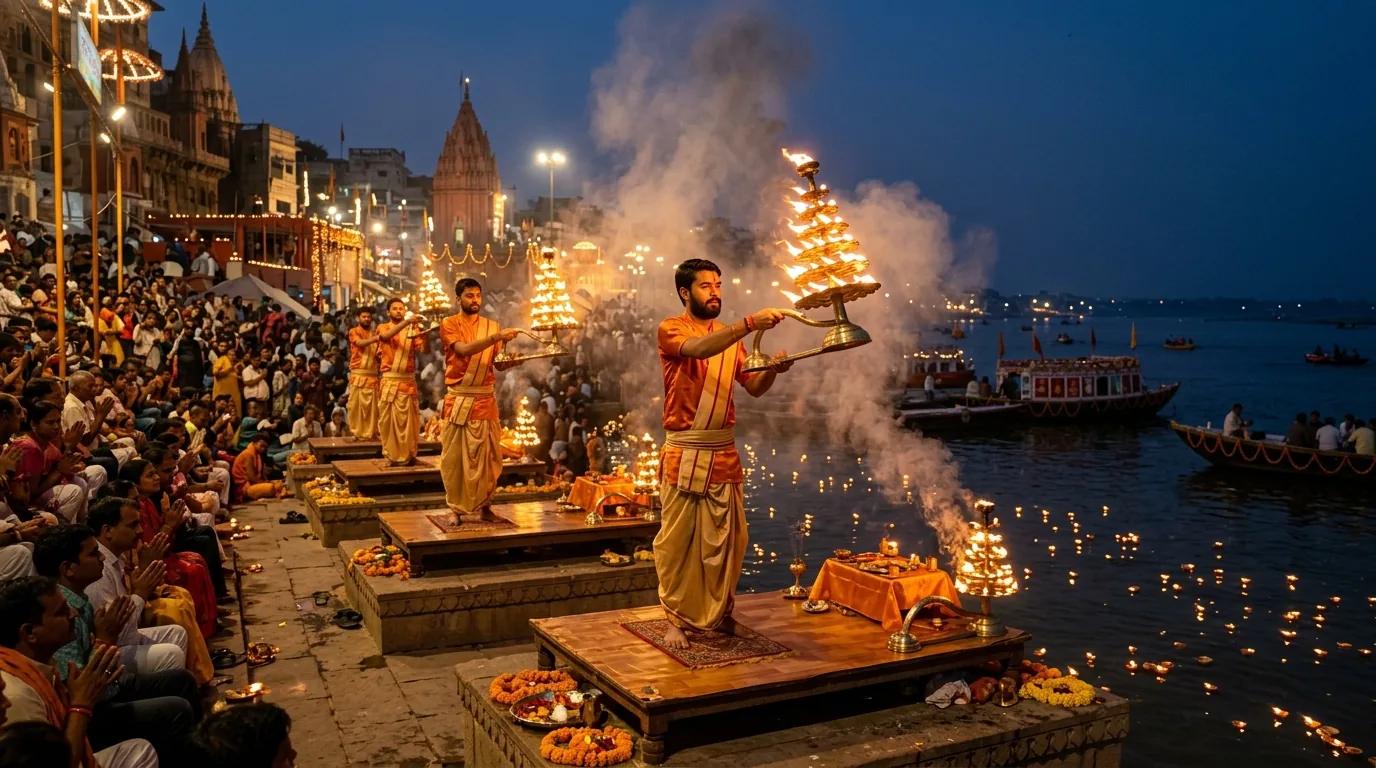
From the first sound of the conch shell to the final offering of light, discover how to experience one of Kashi's most meaningful evening traditions.
In the last hour of daylight, something changes along the riverfront of Varanasi.
The narrow lanes grow busier as pilgrims make their way towards the Ganga. Flower sellers arrange marigolds and small offerings. Families settle on the stone steps, while priests prepare for the prayers that will soon begin.
The river continues to flow quietly past the ghats, seemingly untouched by the growing excitement on its banks.
Then comes the sound of a conch shell.
Bells begin to ring, devotional chants rise above the gathering, and burning lamps illuminate the evening sky. For those watching, it can feel as though the entire riverfront has joined in a single act of prayer.
This is the evening Ganga Aarti in Varanasi, one of the city's most important living religious traditions.
But there is more to this experience than its famous photographs. The ceremony has deep spiritual meaning, takes place at several ghats, and requires a little planning—particularly if you are visiting for the first time.
This guide explains where to go, when to arrive, what to expect, and how to experience the evening Aarti with the respect it deserves.
Evening Ganga Aarti in Varanasi: Quick Information
| Detail | Visitor information |
|---|---|
| Main location | Dashashwamedh Ghat |
| Other locations | Assi Ghat and selected other ghats |
| Usual time | Around sunset; varies by season and organiser |
| Ceremony duration | Approximately 45–60 minutes at major ceremonies |
| Public entry fee | Free |
| Suggested arrival | 60–90 minutes before the main Aarti |
| Best for first-time visitors | Dashashwamedh Ghat |
| Alternative experience | Assi Ghat |
Why Is the Evening Ganga Aarti So Special?
Many cities have beautiful riverfronts, and many temples perform evening prayers. Varanasi brings these experiences together in a way that feels distinctly its own.
Here, the Ganga is woven into daily life.
For centuries, the river has been associated with pilgrimage, sacred bathing, religious ceremonies, and the spiritual identity of Kashi.
In Hindu belief, the Ganga is worshipped as Maa Ganga, a divine mother associated with purification, blessings, and liberation.
The evening Aarti is an expression of reverence towards her.
The offering of light represents devotion and the removal of darkness. Incense, flowers, bells, and chanting form part of the ritual, each contributing to an atmosphere of prayer.
What makes the experience particularly memorable is the participation of the gathering.
Some people stand with folded hands. Others quietly chant along. Children watch the lamps with curiosity, while elderly pilgrims offer prayers with deep concentration.
The ceremony is visually spectacular, but its significance lies in worship rather than entertainment.
Where Does the Evening Ganga Aarti Take Place in Varanasi?
Although Dashashwamedh Ghat hosts the city's best-known grand evening ceremony, it is not the only place where Maa Ganga is worshipped after sunset.
Different ghats offer different experiences.
1. Dashashwamedh Ghat – The Grand Evening Aarti
Located near the Kashi Vishwanath Temple area, Dashashwamedh Ghat is the most recognised location for evening Ganga Aarti.
Priests perform coordinated offerings on raised platforms while devotional music and the ringing of bells accompany the ritual.
The gathering can become very large, particularly during weekends, pilgrimage seasons, and important festivals.
For someone visiting Varanasi for the first time, this is usually the most memorable introduction to the grand public ceremony.
It is also an excellent place to understand how worship and everyday life meet along the river.
For the detailed ritual sequence and ghat-specific guidance, explore our Dashashwamedh Ghat Ganga Aarti guide.
2. Assi Ghat – A More Relaxed Evening Experience
Assi Ghat, towards the southern end of Varanasi's main riverfront, offers a different atmosphere.
Its evening Aarti is generally less overwhelming than the grand gathering at Dashashwamedh, making it appealing to families and travellers seeking a comparatively relaxed experience.
Assi is also famous for Subah-e-Banaras, a morning cultural and devotional programme associated with sunrise prayers, music, and yoga.
If you are spending several days in Varanasi, experiencing evening worship at Dashashwamedh and another programme at Assi offers a fuller picture of the city's riverfront traditions.
Read our Assi Ghat Ganga Aarti guide for additional information.
3. Other Ghats with Evening Aarti
The official Kashi tourism portal also identifies Rajendra Prasad Ghat, Raj Ghat, and Kedar Ghat among locations associated with Ganga Aarti.
These settings can offer alternatives to the main Dashashwamedh gathering.
However, arrangements may differ between locations. Do not assume that every ghat follows the same schedule or offers the same ceremonial presentation.
Check locally before making a special journey.
What Happens During the Evening Ganga Aarti?
The ceremony is performed through a sequence of offerings, prayers, and symbolic gestures.
The precise order may vary by organising committee and occasion, but several elements are commonly recognisable.
The ritual begins with invocations and the blowing of the shankh, or conch shell.
Priests then offer incense, flowers, and light while bells and devotional chants accompany their movements.
The most striking moment comes when large multi-tiered brass lamps are raised towards the Ganga.
Flames move in graceful circles, illuminating the priests and drawing the attention of everyone gathered along the river.
Other traditional objects, including ceremonial fans and fly-whisks, may form part of the worship.
The ceremony concludes with prayers and blessings.
For visitors unfamiliar with Hindu rituals, the most important thing is to understand that every offering is an act of devotion.
You are welcome to watch quietly without participating in each prayer.
Evening Ganga Aarti Timings in Varanasi
The Aarti generally takes place around sunset, but there is no universally fixed start time.
As a broad planning guide, evening ceremonies are often associated with approximately 6 PM in winter and 7 PM during the warmer months.
However, schedules differ between organising committees.
For example, Gangotri Seva Samiti publishes a 6 PM start for its ceremony at Dashashwamedh and advises visitors to arrive by 5 PM.
Other ceremonies and seasonal arrangements may use different timings.
The safest approach is to verify the schedule of the specific Aarti you plan to attend.
Arriving early is worthwhile even when the ceremony begins later.
You can observe the preparations, identify a suitable viewing area, and avoid making your way through the crowd during the opening prayers.
Is the Evening Ganga Aarti Free?
Yes. Watching the evening Ganga Aarti from the public ghat steps is free.
No compulsory ticket is required simply to attend.
Some private properties offer separately arranged viewing areas, and certain organisers provide opportunities for religious participation that may involve charges.
These are different from ordinary public viewing.
Be cautious of anyone selling unofficial VIP passes or claiming that free public access has been replaced by paid entry.
Gangotri Seva Samiti specifically states that it does not provide VIP seating for its ceremony.
Before paying for any optional service, confirm exactly what is included and who is providing it.
Can You Watch the Evening Aarti from a Boat?
When officially permitted, watching Ganga Aarti from the river can provide a striking frontal perspective of the ritual platforms and illuminated ghats.
However, boat operations are subject to restrictions related to river levels, weather, passenger safety, and administrative orders.
October 2026 boating advisory: The most recent operating order verified for this guide, effective 9 October 2026, permitted large motorboats between 6 AM and 5 PM, with smaller manually operated boats remaining restricted.
That order does not establish permission for evening Aarti boat viewing.
Visitors should therefore avoid booking an evening boat experience unless a newer authorisation is confirmed.
Read our Ganga Aarti from Boat guide for additional planning and safety considerations.
A Simple Evening Ganga Aarti Itinerary
If this is your first time in Varanasi, it helps to plan the evening around the ceremony rather than trying to fit it into a rushed sightseeing schedule.
Before the Ceremony
Spend the late afternoon exploring the old-city area or visiting nearby attractions.
If you intend to combine Kashi Vishwanath Temple darshan with Ganga Aarti, allow enough time for temple queues and security checks.
Try to reach your selected ghat at least an hour before the confirmed ceremony time.
Use this period to become familiar with the surroundings.
During the Ceremony
Find a position where you can watch without blocking other devotees.
Avoid moving repeatedly between spectators simply to capture photographs.
Listen to the chanting, observe the offerings, and appreciate the atmosphere.
A few photographs are enough to preserve the memory. You do not need to record every minute.
After the Ceremony
The crowd may begin leaving immediately after the final prayers.
If your location is safe and officials permit it, allowing the first wave to disperse can make your departure more comfortable.
You can then explore the nearby streets, enjoy a cup of chai, or sample some of Varanasi's well-known street food.
How to Reach the Evening Ganga Aarti
For Dashashwamedh Ghat, Godowlia is one of the main approach points.
Visitors usually travel towards the old-city area by taxi, auto-rickshaw, or e-rickshaw before completing the final stretch on foot.
Traffic restrictions and drop-off points may change because of religious gatherings or security arrangements.
Allow additional walking time, especially if you are travelling with children or elderly relatives.
For Assi Ghat, access is generally through the southern Varanasi road network, although the final approach and available parking can vary.
Save your accommodation details and confirm your return transport arrangements before entering a large gathering.
Best Season to Experience Evening Ganga Aarti
October to March is generally a comfortable period for exploring Varanasi's ghats, although winter evenings can be cold and occasionally misty.
In summer, the heat can make waiting outdoors tiring, so drinking water and sensible arrival planning are important.
The monsoon presents different challenges.
High river levels may submerge lower steps, alter the ceremony's location, or restrict public access and boat services.
Never enter submerged or barricaded areas for a closer view.
Major festivals, particularly Dev Deepawali, create a remarkable atmosphere along the riverfront but also bring larger crowds and additional movement restrictions.
For a first visit, a non-festival weekday may provide a more manageable experience.
Practical Tips for Families and First-Time Visitors
The evening Aarti welcomes people of different ages and backgrounds, but the central ghats can become crowded.
A little preparation helps.
- Wear comfortable clothing and footwear suitable for uneven stone steps.
- Keep valuables secure and carry only essential belongings.
- Stay close to children and agree on a meeting point.
- Check accessibility arrangements in advance if anyone has limited mobility.
- Respect priests, devotees, and restricted ceremonial areas.
- Avoid intrusive flash photography and do not use drones without the required permissions.
- Keep the Ganga and surrounding steps free of plastic and litter.
Remember that a paid terrace or boat does not automatically provide a safer or more accessible experience. Always assess the actual arrangements.
Evening Ganga Aarti vs Morning Ganga Aarti
Both experiences express devotion to Maa Ganga, but their atmosphere is different.
The evening ceremony is characterised by illuminated lamps, devotional chanting, and the gathering that forms as darkness settles over the river.
Morning programmes, particularly Subah-e-Banaras at Assi Ghat, are associated with sunrise, prayers, classical music, and a gentler start to the day.
If your schedule permits, experience both.
The evening reveals the ceremonial energy of Kashi, while morning offers an opportunity to observe the city awakening beside the Ganga.
Frequently Asked Questions
1. What time is the evening Ganga Aarti in Varanasi?
Evening Aarti generally takes place around sunset. Timings differ by season, ghat, and organising committee. Confirm the current schedule locally before visiting.
2. Which ghat is best for evening Ganga Aarti?
Dashashwamedh Ghat is the most popular choice for the grand ceremony. Assi Ghat offers an alternative that is generally more relaxed.
3. How long does evening Ganga Aarti last?
Major evening ceremonies commonly last about 45–60 minutes, although the duration may vary.
4. Is there an entry ticket for evening Ganga Aarti?
No. Public viewing from the ghat steps is free. Optional private arrangements or religious participation may involve separate charges.
5. Can foreigners attend Ganga Aarti?
Yes. International visitors are welcome to observe the ceremony respectfully.
6. Does Ganga Aarti take place during the monsoon?
The tradition generally continues, but heavy rain and high river levels may change the location, format, or public viewing arrangements. Follow current local instructions.
7. Can I attend Kashi Vishwanath Temple and Ganga Aarti on the same evening?
Yes. Many visitors combine them, but temple queues and security checks can take time. Plan the sequence carefully and avoid relying on tight timings.
8. Is the evening Ganga Aarti suitable for children and senior citizens?
Yes, provided crowd density, uneven steps, walking distances, and accessibility requirements are considered. Quieter viewing arrangements may be preferable for some visitors.
Final Thoughts: An Evening to Remember in Kashi
Varanasi reveals itself in many ways.
Through the sound of bells in narrow lanes, the devotion of pilgrims at ancient temples, and the steady movement of life beside the sacred Ganga.
The evening Ganga Aarti brings these experiences together.
Its lamps, music, and prayers create a memorable scene, but the real meaning lies in the gratitude and faith expressed through the ritual.
Whether you stand among devotees at Dashashwamedh or choose a quieter gathering at another ghat, approach the experience with curiosity and respect.
Watch the lamps rise. Listen to the prayers. Notice the river continuing its journey beyond the illuminated steps.
And when the ceremony ends, carry away more than a photograph.
Carry away an understanding of why the Ganga remains so deeply connected to the heart of Kashi.