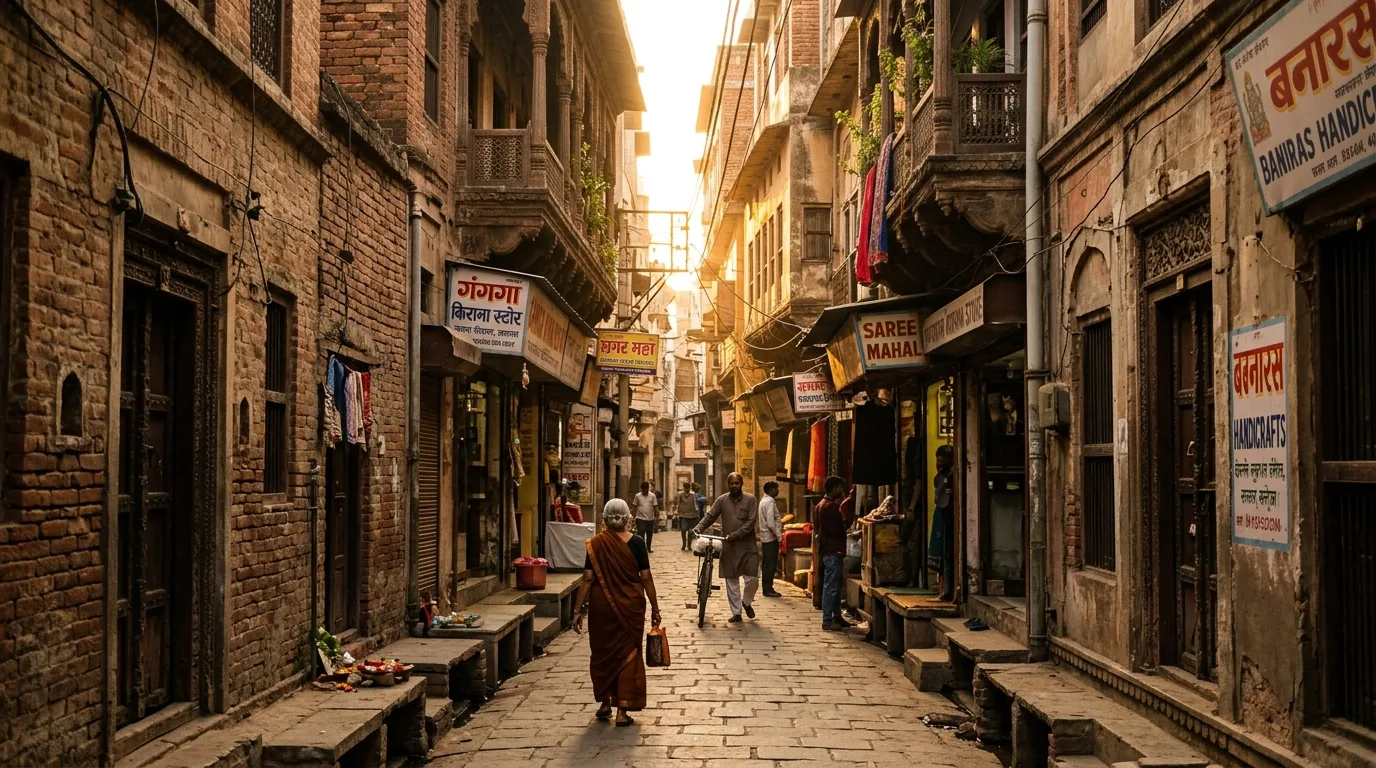
Walk south from Scindia Ghat or weave your way through the tight, labyrinthine stone lanes of Lahori Tola, and your senses will tell you that you have arrived at Manikarnika Ghat long before you actually see the river. First comes the sharp, resinous scent of burning mango wood mixed with sandalwood paste, clarified butter (ghee), and camphor. Then comes the sound: the rhythmic crackle of timber, the clanging of temple bells, and the urgent, echoing chant of "Ram Naam Satya Hai" (The name of Lord Rama is the only truth) bouncing off centuries-old sandstone walls.
In almost every city on earth, cemeteries and crematoriums are tucked away on the quiet outskirts, hidden behind high walls so the living do not have to look at death. In Varanasi (Kashi), death isn't hidden. It sits right at the geographic and spiritual center of the riverfront.
Known in Hindu scriptures as the Mahashmashana (The Great Cremation Ground), Manikarnika Ghat is where the boundary between life and the afterlife dissolves into the smoke above the Ganges. For the first-time visitor, standing on the upper balconies here can feel overwhelming. Yet, spend twenty minutes watching the river, and you will notice something unexpected: there is almost no wailing here. In Kashi, death is not mourned as a tragedy; it is celebrated as a graduation—the ultimate liberation (Moksha) from the exhausting cycle of rebirth.
Whether you are a spiritual seeker, a heritage traveler, or someone trying to understand the soul of Banaras, this comprehensive guide covers the history, living rituals, hidden architectural gems, and unspoken rules you need to know before stepping onto Manikarnika Ghat.
Quick Visitor Information: Manikarnika Ghat at a Glance
| Feature | Details |
|---|---|
| Location | Near Lalita Ghat & Kashi Vishwanath Corridor (Gate No. 4), Lahori Tola, Varanasi |
| Ghat Sequence | Ghat No. 28 (Between Scindia Ghat and Dashashwamedh Ghat) |
| Timings | Open 24 hours a day, 365 days a year |
| Entry Fee | Free (Beware of touts asking for "cremation wood donations") |
| Photography | Strictly Prohibited near the pyres (Heavy fines and local backlash apply) |
| Best Way to View | From a boat on the Ganges (early morning or dusk) or the upper stone terraces |
| Nearest Railway Station | Varanasi Junction (Cantt) – Approx. 5.5 km; Banaras Station (Manduadih) – Approx. 6 km |
The Mythology: How Manikarnika Got Its Name
In Varanasi, history and mythology are braided together so tightly that you cannot pull one thread without moving the other. The name Manikarnika literally translates from Sanskrit as "Jeweled Earring" (Mani = Jewel/Bead, Karnika = Ear ornament). If you ask the local Pandas (priests) sitting under their bamboo parasols how the ghat got its name, they will tell you two distinct Puranic legends.
1. The Sweat of Vishnu and the Earring of Shiva
According to the Kashi Khanda of the Skanda Purana, before the universe took its current shape, Lord Vishnu sat at this exact spot for thousands of years, performing intense penance (Tapasya) to please Lord Shiva. Using his Sudarshana Chakra, Vishnu dug a deep pit (now known as the Chakra-Pushkarini or Manikarnika Kund) and filled it with the sweat of his own devotion.
When Lord Shiva arrived with Goddess Parvati to witness Vishnu’s devotion, he was so deeply moved that his body trembled with cosmic joy. As he nodded to grant Vishnu a boon, a jewel-encrusted earring (Manikarnika) slipped from Shiva’s ear (some versions say Parvati's ear) and fell directly into the sacred water tank. Vishnu requested that this spot remain eternally blessed, where souls could be freed from all worldly illusions.
2. The Shakti Peetha Legend (Mata Sati’s Earring)
A second, widely revered tradition links Manikarnika to the tragedy of Daksha Yagna. When Goddess Sati self-immolated after her father insulted Lord Shiva, a grief-stricken Shiva carried her charred body across the cosmos on his trident. To stop Shiva from destroying creation in his sorrow, Lord Vishnu used his Chakra to sever Sati’s body into 51 pieces. Wherever a piece fell on earth, a Shakti Peetha was born. At this spot along the Ganges, Sati’s ear ornament fell to the ground. Because of this, Manikarnika is revered not only as a cremation ground of Shiva, but also as a potent seat of the Divine Mother (Manikarnika Devi / Vishalakshi).
Historical Evolution: From Forest Shrine to Maratha Stone
While the spiritual roots of Manikarnika stretch back over 3,000 years, the physical stone steps you walk on have a documented architectural timeline:
- The Gupta Era (4th–5th Century CE): Archaeological references and Gupta-era inscriptions confirm that Manikarnika was already established as a premier Tirtha (pilgrimage ford) long before medieval temples rose along the river.
- The 1302 CE Inscription: Historical stone records from the early 14th century explicitly refer to the site as a place of supreme liberation.
- The Maratha Reconstruction (1730–1791): Like much of old Varanasi’s riverfront, Manikarnika owes its current monumental sandstone architecture to the Marathas. In 1730, Peshwa Bajirao I patronized major structural repairs to the ghat. Six decades later, in 1791, the legendary Maratha queen Maharani Ahilyabai Holkar of Indore rebuilt the entire ghat complex in durable Chunar sandstone, adding the surrounding shrines and steps.
- 19th & 20th Century Additions: In the 1850s, the Maharaja of Awadh constructed the twin-spired Shiva-Durga temple overlooking the steps, and in 1912, Raja Sir Moti Chand raised the main cremation platform to help keep the pyres operating even when the monsoon floods swell the Ganges.
Why Dying in Kashi Matters: Kashi Labh & The Taraka Mantra
To understand why families travel hundreds—sometimes thousands—of kilometers by ambulance, train, or plane to bring their loved ones to Manikarnika Ghat, you have to understand the concept of Kashi Labh (the ultimate spiritual profit of dying in Kashi).
In Hindu philosophy, the human soul (Atman) is trapped in Samsara—an endless loop of birth, death, and rebirth governed by Karma. Breaking out of this loop (Moksha) normally requires lifetimes of strict asceticism, meditation, and detachment. However, Kashi offers a cosmic shortcut.
Scriptures state that when a person takes their final breath in Varanasi, or is cremated at Manikarnika, Lord Shiva himself steps in as the Guru. As the physical body dissolves into the five elements (Panchabhuta—Earth, Water, Fire, Air, and Ether), Shiva leans down and whispers the Taraka Mantra (the Mantra of Crossing) into the right ear of the deceased. At that moment, Goddess Parvati fans the soul with her scarf to cool the heat of worldly attachments, and the soul crosses the ocean of existence forever.
Just steps away from the pyres sits Mukti Bhawan and Kashi Labh Mukti Bhawan—unique guest houses where elderly people from across India check in when they know their final days are near, waiting peacefully for their transition.
Inside the Rituals: How a Cremation Unfolds at Manikarnika
Between 150 and 300 cremations take place at Manikarnika Ghat every 24 hours. The ghat never sleeps. As soon as one pyre cools into gray ash, the stone platform is washed with Ganga water, and fresh logs are stacked for the next arrival.
If you stand respectfully on the upper terrace or watch from a boat, you will witness a ceremony that has remained virtually unchanged since the Vedic period:
1. The Final Dip in the Ganga
The deceased is carried down the narrow alleys on a bamboo stretcher (Arthi), draped in vibrant marigolds and auspicious cloth—red or gold for married women, white for men and widows, and shiny brocade for the elderly who lived a full life. The bearers walk straight down to the water's edge and submerge the body in the Ganges one last time to purify the physical vessel. After the dip, the body is placed on the steps for a few minutes to dry while the pyre is prepared.
2. The Timber Economy of the Lanes
Walk the alleys behind Manikarnika, and you will see mountainous stacks of firewood reaching the second-floor balconies of old buildings. Every log—whether dense mango, babul, peepal, or high-grade sandalwood—is weighed on giant iron scales. An average cremation requires between 300 and 350 kilograms of wood. The price of wood varies by type and weight, creating a massive, centuries-old micro-economy that runs around the clock.
3. The Custodians of the Flame: The Dom Community
No cremation at Manikarnika can proceed without the Dom community, historically led by the family of the Dom Raja. Though historically placed at the bottom of the traditional caste hierarchy outside the ghat, at Manikarnika, the Doms hold supreme ritual authority.
Down in the smoky lower chamber of the ghat burns the Akhand Agni—the Eternal Flame that locals believe has been kept alive continuously for over three millennia. A pyre at Manikarnika is never lit with a modern matchstick or lighter. The chief mourner (usually the eldest son or closest male relative), head shaved and dressed in an unstitched white cotton dhoti, purchases a bundle of dried grass (Kusha or Khar) lit directly from the Dom's eternal hearth.
4. Mukhagni and Kapal Kriya
The chief mourner circles the wooden pyre five times (moving counter-clockwise, the direction of reversal and dissolution), carrying an earthen pot of Ganga water on his shoulder. On the final circuit, the pot is dropped behind him, shattering on the stone to signify the breaking of worldly ties. He then sets the bundle of sacred fire to the pyre (Mukhagni). Near the end of the three-hour burning process, the ritual of Kapal Kriya takes place—striking the skull with a long bamboo stave to release the remaining vital breath (Prana) from the crown chakra.
Once the fire dies down, the Doms sift through the cooled ashes, and the remaining Asthi (calcified bone fragments) are consigned to the flowing current of Mother Ganga.
Architectural & Sacred Landmarks Around Manikarnika Ghat
Most visitors get so transfixed by the cremation fires that they completely miss the extraordinary historic monuments tucked right into the ghat complex. Take time to look for these five landmarks:
1. Manikarnika Kund (Chakra-Pushkarini)
Located just above the main ghat steps, surrounded by an ornate iron railing and stone steps, is the sacred water tank dug by Lord Vishnu. Every year before the monsoon floods arrive, the silt deposited by the river is cleared out in a massive community ritual, and pilgrims take a ritual bath here during afternoon hours to cleanse karmic debts.
2. Charan Paduka (The Marble Footprints of Vishnu)
Near the Kund, look for a circular marble slab set into the stone platform. Engraved into the marble are the Charan Paduka—the sacred footprints of Lord Vishnu, marking the exact spot where he meditated for millennia. In centuries past, only VIPs and royalty were cremated directly adjacent to the Charan Paduka.
3. Ratneshwar Mahadev (The Leaning Temple of Varanasi)
Standing right at the northern edge of Manikarnika (merging into Scindia Ghat) is one of the most photographed architectural wonders in India: the Ratneshwar Mahadev Temple (also known locally as Matri-Rin Mahadev). Built in the mid-19th century, this classical Nagara-style temple leans at a staggering 9-degree angle—more than double the tilt of the Leaning Tower of Pisa! For several months during the monsoon, the river swallows the temple almost up to its carved spire (Shikhara).
4. Tarakeshwar Mahadev Temple
Perched at the edge of the cremation zone is the shrine of Tarakeshwar Mahadev. Dedicated to the form of Shiva who whispers the liberating Taraka Mantra, this temple is a vital stop for devotees completing their Kashi pilgrimage.
5. Baba Mashan Nath Temple
Located right amidst the smoke of the pyres is the shrine of Baba Mashan Nath (Lord of the Cremation Ground). This is the focal point of one of Varanasi’s wildest, most mystical celebrations: Masan Holi (or Bhasma Holi). On the day after Rangbhari Ekadashi (just before Holi), Naga Sadhus, Aghoris, and devotees gather at Manikarnika to play Holi not with colored powder, but with freshly cooled pyre ash (Bhasma), celebrating Shiva’s union with his unconventional entourage of ghosts, spirits, and ascetics.
Essential Visitor Etiquette: How to Visit Respectfully (And Avoid Scams)
Because Manikarnika Ghat is an active, deeply emotional site for grieving families, visiting requires a high degree of cultural sensitivity. Follow these ground rules to ensure a safe, respectful experience:
- Keep Your Camera and Phone Away: This cannot be stressed enough. Do not take photos or videos of the burning pyres or grieving families. Not only is it deeply disrespectful to turn someone’s final rites into social media content, but the local workers and families take a hard stance against it. Even if you are on a boat out on the river, put the zoom lens down when passing Manikarnika.
- Beware of the "Hospice / Firewood Scam": As soon as you approach the alleys leading to Manikarnika, smooth-talking unauthorized "guides" may approach you. They will give you a 5-minute tour, walk you up to a smoky balcony, tell you a heartbreaking story about how poor families cannot afford firewood, and pressure you to donate ₹3,000 to ₹10,000 for "grandmother’s wood." Politely decline and walk away. Genuine charitable trusts in Varanasi do not solicit tourists in the alleys.
- Dress Conservatively and Watch Your Step: Cover your shoulders and knees. Wear closed-toe shoes or sturdy sandals that slip off easily if you enter a temple, as the lanes around the ghat are often slick with river water, mud, cow dung, and ash.
- Give Right of Way to Funeral Processions: When you hear the loud chant of "Ram Naam Satya Hai!" coming down the narrow Galies (lanes), immediately step flat against the nearest wall to let the bamboo stretcher and the family pass without obstruction.
- Can Women Visit Manikarnika Ghat? Yes. While traditional Hindu customs often restrict women of the grieving family from attending the final cremation to spare them emotional trauma, female travelers and pilgrims are completely allowed to walk through the ghat or observe respectfully from boats and upper platforms.
Best Time to Visit & How to Reach Manikarnika Ghat
When to Go
Manikarnika operates 24/7, and the atmosphere shifts dramatically depending on the hour:
- Dawn (5:30 AM – 7:30 AM): Taking a morning boat ride from Assi Ghat or Dashashwamedh Ghat past Manikarnika as the sun rises over the eastern bank is unforgettable. The golden morning light cutting through the rising woodsmoke softens the intensity of the scene.
- After Dark (7:00 PM – 10:00 PM): At night, the ghat takes on a raw, primordial energy. Against the pitch-black water of the Ganga, the orange flames of a dozen pyres reflect off the hulls of wooden rowboats.
How to Get There
Because the old city around the ghats is a vehicle-free zone during peak hours, you will need to cover the last 500–800 meters on foot or by boat:
- By Walk via Kashi Vishwanath Corridor: Take an auto-rickshaw or e-rickshaw (Toto) to Godowlia Chowk or Maidagin. Walk toward Gate No. 4 of Shri Kashi Vishwanath Temple. From there, you can walk straight through the grand Kashi Vishwanath Dham corridor down to Lalita Ghat, and Manikarnika is right next door (a 2-minute walk north along the river).
- By Walk from Dashashwamedh Ghat: If you are already at the main Dashashwamedh Ghat, simply walk north along the riverfront steps for about 10–12 minutes (passing Manmandir, Tripura Bhairavi, and Lalita Ghat). (Note: During July–September monsoon floods, the connecting steps are submerged, so you will need to use the inner city alleys or a boat).
- By Boat: Hire a rowboat or motorboat from Dashashwamedh Ghat or Assi Ghat. Watching from the water gives you the widest, safest, and least intrusive vantage point.
Frequently Asked Questions (FAQs) About Manikarnika Ghat
Q1: Why does the fire at Manikarnika Ghat never go out?
The sacred hearth fire (Akhand Agni) maintained by the Dom community is believed to have been lit by Lord Shiva himself over 3,000 years ago. Furthermore, because 150 to 300 bodies arrive for cremation every single day, the funeral pyres themselves burn continuously around the clock without ever going cold.
Q2: Is Manikarnika Ghat the only cremation ghat in Varanasi?
No. Of the 84 ghats in Varanasi, two are dedicated exclusively to cremations: Manikarnika Ghat (the oldest and largest) and Harishchandra Ghat (located further south toward Assi Ghat, which also houses a modern electric/CNG crematorium alongside traditional wooden pyres).
Q3: Who is NOT cremated at Manikarnika Ghat?
According to Hindu scriptures (Garuda Purana), five categories of individuals are not cremated with fire because their souls are already considered pure or detached from karmic debt: Saints/Sadhus (who are given Jala Samadhi or buried in salt), pregnant women, children under the age of 5, people who die from cobra bites, and historically, those afflicted with leprosy.
Q4: How much time should I spend at Manikarnika Ghat?
Most visitors spend 20 to 40 minutes here. It is best combined with a morning or evening boat ride along the ghats, or paired with a darshan visit to the nearby Kashi Vishwanath Temple and Kaal Bhairav Temple.
Final Thoughts: Leaving Manikarnika Changed
Travelers often arrive in Varanasi chasing exotic postcard images of saffron-robed sadhus and glowing Ganga Aarti lamps. Those things are beautiful, of course. But if Dashashwamedh Ghat is the theatre of Varanasi, Manikarnika Ghat is its truth.
Standing before the pyres of the Mahashmashana strips away every trivial worry you carried into the city. Rich or poor, king or ascetic—everyone arrives here wrapped in the same simple cloth and leaves as the same handful of gray ash riding the current of the Ganga. You don't visit Manikarnika Ghat to look at death; you visit to remember how precious it is to be alive.