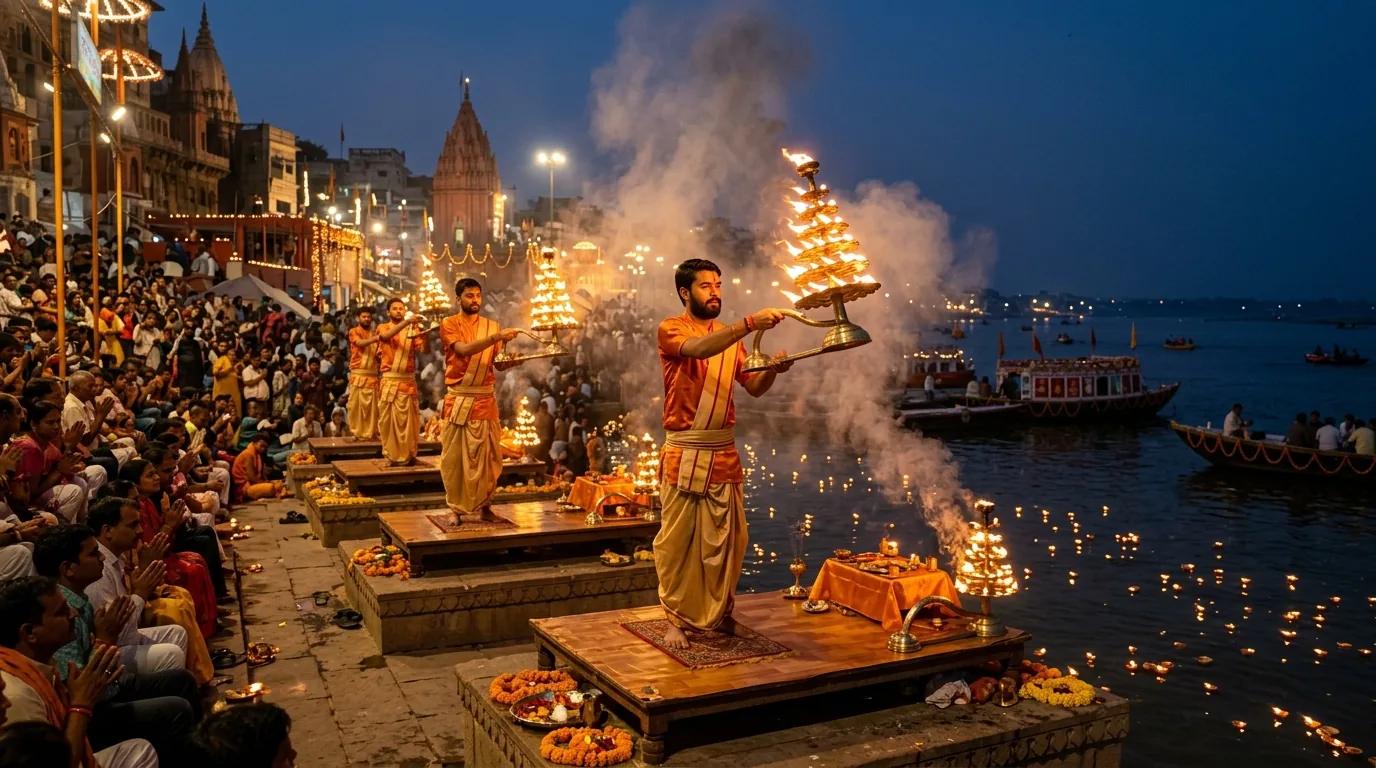
There is no single best place for everyone. The right choice depends on whether you want scale, quiet, photographs, easy access or a close connection with the people gathered on the steps.
For most first-time visitors, Dashashwamedh Ghat delivers the iconic evening scene. A boat gives the cleanest view of the river-facing ritual, while Assi Ghat is the better choice for a more spacious and unhurried experience. Read the options below, keep your plan flexible and confirm on-the-day arrangements locally.
That First Moment When the Conch Shells Blow
The first time I walked down the worn sandstone steps of Dashashwamedh Ghat in the winter of 2004, I made every rookie mistake in the book. I arrived at 6:00 PM thinking I was on time. I wasn’t. I ended up wedged behind a pillar, staring at the back of fifty heads, breathing in thick frankincense while catching only fleeting glimpses of brass flames reflected on the dark waters of the Ganga.
Yet, even from that terrible vantage point, when seven young priests raised the heavy, multi-tiered Mashal lamps in perfect unison and the low, vibrating roar of the conch shells (shankh) echoed off the centuries-old palaces, the hair on my arms stood up.
Over the last two decades of walking the galis (lanes) of Kashi, watching the river rise in the August monsoons and recede into golden sandbanks by November, I have seen the Ganga Aarti hundreds of times. I’ve watched it from Rs. 50 shared rowboats, from the velvet-cushioned balconies of heritage havelis, from the quiet steps of southern ghats where tourists rarely tread, and right from the front-row stone plinths where the heat of the camphor touches your face.
If you are planning a trip to Varanasi, you already know the Ganga Aarti is non-negotiable. What most travel guides won't tell you, however, is that where you sit changes the entire spiritual and visual experience. Choosing the wrong spot can leave you feeling claustrophobic, hustled by touts, and visually blocked. Choosing the right one turns a tourist attraction into a core memory.
Let’s break down the exact locations, the honest pros and cons of every viewing angle, seasonal timing shifts, and how to claim the best seat in the house without falling into tourist traps.
Understanding the Ritual: It’s Not Just One Aarti
Before picking a spot, you need to decide which mood you are looking for. In Kashi, the river is worshipped twice a day—at dawn and at dusk—and across multiple ghats simultaneously.
Every evening just after sunset, young pandits (selected and trained rigorously from Vedic schools) dress in identical silk dhotis and kurtas. Facing the river, they perform an intricate, 45-minute choreographed offering of the five elements of nature—Earth (Prithvi), Water (Jal), Fire (Agni), Air (Vayu), and Ether (Akash)—back to Mother Ganga.
It starts with the blowing of the conch, moves through incense sticks, peacock-feather fans (Morpankh), yak-tail whisks (Chamar), and reaches its crescendo with the heavy, tiered brass oil lamps (Naag Deep) that weigh up to 7 kilograms each.
The Top 4 Ghats to Watch the Ganga Aarti (Compared)
While small neighborhood Aartis happen at nearly a dozen ghats along the 6.5-kilometer crescent of the river, four specific locations stand above the rest.
| Ghat Name | Best Time | Crowd Level | Vibe & Experience | Best Suited For |
|---|---|---|---|---|
| Dashashwamedh Ghat | Evening (Sunset) | Extremely High | Grand, theatrical, high-energy, deafening chants | First-time visitors, photographers |
| Assi Ghat | Morning (Sunrise) & Evening | Moderate | Meditative, cultural, classical music, open space | Families, seniors, peace-seekers |
| Rajendra Prasad Ghat | Evening (Sunset) | High | Twin ceremony right next to Dashashwamedh | Travelers wanting a wider angle |
| Kashi Vishwanath Corridor (Lalita Ghat) | Evening | Moderate to High | Modern amphitheater steps, organized seating | Devotees combining Temple Darshan & Aarti |
1. Dashashwamedh Ghat: The Grand Epicenter
According to Hindu mythology, this is where Lord Brahma performed the ten-horses (Dasa-Ashwamedha) sacrifice to welcome Lord Shiva back from exile. Today, the Ganga Seva Nidhi conducts the world-famous grand evening Aarti here.
Seven priests stand on seven elevated wooden and marble octagon platforms (chowkis) draped in maroon and saffron cloth. Thousands of devotees pack the steps behind them, while hundreds of wooden boats interlock on the water in front of them, forming a floating stadium.
- The Catch: It is intense. During peak season (October to March) and especially on Mondays, Full Moon nights (Purnima), and festivals, the crowd begins building by 4:30 PM. If you suffer from claustrophobia, standing in the middle of the main steps here is not for you.
2. Rajendra Prasad Ghat: The Underrated Neighbor
Walk literally 50 meters north of Dashashwamedh Ghat and you are standing on Rajendra Prasad Ghat. Technically, the two ghats merge seamlessly into one another. Another trust—Gangotri Seva Samiti—conducts an equally grand, synchronized seven-priest Aarti right here at the exact same time.
- Why Locals Love It: The upper stone steps of Rajendra Prasad Ghat are wider and rise like a stadium. If Dashashwamedh’s main enclave feels packed to suffocation, shifting just a few yards left toward Rajendra Prasad Ghat often opens up cleaner sightlines.
3. Assi Ghat: The Soulful Alternative (Subah-e-Banaras)
If the chaos of Godowlia and Dashashwamedh feels overwhelming, head to the southernmost tip of the riverfront: Assi Ghat, where the Assi River meets the Ganga.
While Assi Ghat hosts a lovely, much calmer evening Aarti where you can actually find a place to sit twenty minutes before sunset, its real crown jewel happens before dawn. Known as Subah-e-Banaras, this morning ritual begins around 5:00 AM (winter) or 4:30 AM (summer).
- The Experience: Young batuks (female and male Vedic students) perform a sacred Yagya (fire sacrifice), followed by the morning Aarti as the sky turns from indigo to saffron over the eastern sandbanks. Immediately after the flames die down, live Hindustani classical vocalists or sitar players perform morning Ragas, followed by a community yoga session. It costs nothing, the air smells of wet earth and marigold, and there is zero pushing or shoving.
4. Panchganga & Ahilyabai Ghat: For the Purists
Want to experience what Varanasi felt like fifty years ago? Take a walk north toward Ahilyabai Ghat or Panchganga Ghat. Here, the Aarti is performed by one or three local priests without booming PA speaker systems or tourist boats jockeying for position. At Panchganga Ghat, you will also see ancient stone Deepmalas (towers of a thousand stone lamps) that are lit during the holy month of Kartik.
The 3 Best Vantage Points at Dashashwamedh Ghat (Where to Actually Sit)
Let’s assume you want to see the main event at Dashashwamedh Ghat. Once you walk past the barricades at Godowlia Crossing and descend toward the water, you have three distinct choices for where to position yourself. Each gives you a completely different perspective.
Option A: From a Boat on the River (The Unobstructed Front View)
Ask any wedding or travel photographer where the "correct" angle is, and they will point to the water. Why? Because the priests face the river, not the steps. Their entire devotion is directed toward the water.
When you sit on the ghat steps, you are looking at the priests’ backs or side profiles. When you sit on a boat anchored 20 to 30 feet off the shoreline, you are looking directly into their faces. You see the seven platforms framed against the illuminated temple spires behind them, and the shimmering reflections of the brass lamps dancing directly on the black water in front of you.
- How It Works: Around 5:00 PM, hundreds of rowboats and motorboats pull up to the shoreline and tie themselves together, creating a massive, stable floating raft.
- Shared Boat vs. Private Boat:
- Shared Boat: Costs between ₹100 and ₹250 per person. You will sit on wooden planks alongside 15 to 25 other passengers. It’s budget-friendly and social, though your view depends on how early your boatman reaches the front mooring line.
- Private Boat: Costs between ₹1,200 and ₹2,500 depending on the size of the boat, season, and whether you include a 1-hour cruise from Assi Ghat or Manikarnika Ghat prior to the Aarti.
- The Insider Trick: Tell your boatman you must reach the Dashashwamedh mooring spot by 5:15 PM. The first row of boats ties up directly to the wooden poles in front of the priests' platforms. If your boat arrives at 5:50 PM, you will be parked in the 4th or 5th row of boats—which means you’ll be watching the ceremony through a forest of other people's raised mobile phones.
Option B: The Elevated Gaddi & Balconies (The Bird’s-Eye View)
Look up behind the priests' platforms at Dashashwamedh Ghat and you will notice two-story stone buildings, temple balconies, and elevated bamboo platforms covered in white mattresses (gaddis).
- How to Get Up There: The front balconies directly overlooking the main platforms belong to the organizing trust (Ganga Seva Nidhi) and adjacent heritage structures (like the BrijRama Palace side or the trust office). While VIP seating is reserved for dignitaries or high-tier donors, arriving 90 minutes early and politely speaking with the trust volunteers at the desk on the ghat (or making a direct, official donation to the trust with a receipt) can sometimes secure a spot on the upper viewing terraces.
- Rooftop Cafes: Several small guesthouses and rooftop cafes flanking Rajendra Prasad and Dashashwamedh Ghat offer a top-down view for the price of a snack or a ₹200–₹300 cover charge.
- Pros: You are completely above the crowd, there is a cool river breeze, and wide-angle photography of the entire crowd + priests + river is unmatched.
- Cons: You are further away from the priests, so you lose the intimate heat of the fire and the close-up expressions unless you carry a 70-200mm zoom lens.
Option C: The Ghat Steps & Stone Plinths (The Immersive Ground View)
There is something raw and grounding about sitting directly on the ancient stone steps, surrounded by grandmothers from Maharashtra chanting Har Har Gange, sadhus smeared in vibhuti ash, and wide-eyed travelers from across the globe. Plus, it is 100% free.
- The Sweet Spot: Do not sit in the dead center of the main stairs five rows back—the angle is too flat, and the moment the Aarti peaks, everyone in front of you will stand up, blocking your view entirely. Instead, aim for the octagonal stone umbrellas (Chhatris) or the raised stone ledges immediately to the left or right flanks of the seven priest platforms. These side ledges put you at eye-level with the priests, less than 15 feet away.
- The Monsoon Shift (July to September): This is crucial information most blogs miss. During the monsoon months, the Ganga rises by 20 to 30 feet, submerging the lower steps and the seven permanent platforms completely. During these months, the Aarti shifts upward to the rooftops and upper terraces of Dashashwamedh Ghat. Space becomes very tight on land, making a boat ride (when boating isn't suspended due to high currents) or arriving 75 minutes early mandatory.
Updated Ganga Aarti Timings (Season-by-Season)
The priests in Varanasi do not follow standard corporate clocks; they follow the sun (Surya). Because sunset and sunrise times shift by nearly an hour between June and December, the Aarti schedule shifts accordingly.
| Season | Months | Evening Aarti Start Time | Morning Aarti (Assi Ghat) | Ideal Arrival Time (Evening) |
|---|---|---|---|---|
| Winter | November – February | 6:00 PM – 6:15 PM | 5:30 AM – 5:45 AM | 4:45 PM |
| Spring / Autumn | March & October | 6:30 PM | 5:00 AM | 5:15 PM |
| Summer / Monsoon | April – September | 6:45 PM – 7:00 PM | 4:30 AM – 5:00 AM | 5:30 PM |
Note: The entire evening ceremony lasts approximately 45 minutes from the opening Ganga Puja (flower and milk offering at the water's edge) to the final Karpur Gauram chant and distribution of Prasad.
7 Hard-Earned Local Tips to Guarantee a Flawless Evening
After twenty years of guiding friends, family, and fellow writers through the ghats, these are the non-negotiable rules I live by:
- Account for the "Godowlia Walk": No cars, autos, or e-rickshaws are allowed past Godowlia Chowk in the evening. From the barricade at Godowlia, it is a 600-meter walk down a bustling road to Dashashwamedh Ghat. In normal conditions, it takes 8 minutes; at 5:30 PM when thousands are funneling down, it takes 20 minutes. Factor this into your arrival time, especially if traveling with elderly parents.
- Beware the "VIP Pass" Scammers on the Street: As you walk from Godowlia toward the ghat, young men will approach you claiming, "Ghat is full, come with me for a secret VIP balcony ticket for ₹500." Ignore them and keep walking. The ghat is public property and free. Many touts will lead you to a third-floor shop window where you can barely see two priests through electrical wires. If you want a balcony or boat, walk all the way down to the water first, inspect the actual view with your own eyes, and only then pay.
- Choose Rowboats Over Motorboats for the Aarti: When booking a boat, try to hire a classic wooden rowboat (Chappu boat) or ensure the motorboat operator turns off the diesel engine once moored. Nothing ruins the meditative sound of Sanskrit hymns faster than a rattling diesel motor vibrating under your floorboards and belching exhaust smoke.
- Buy a ₹10 Leaf Diya (Dona), Not the ₹100 One: Young kids on the ghats and floating vendors jumping from boat to boat will try to sell you small leaf bowls filled with marigolds and a candle (Diya) to float on the river. It is a beautiful tradition, and you should definitely do it—just know the fair local price is ₹10 to ₹20, not ₹100 or ₹200.
- What to Do When the Flames Go Out (Wait 10 Minutes): The moment the priests set down the final lamp, 10,000 people stand up simultaneously and rush up the narrow stairs toward Godowlia, creating a massive bottleneck. Instead of joining the crush, stay seated for 10 to 15 minutes. Walk down to the edge of the priests' platforms, where volunteers pass around the big brass lamp so devotees can cup their hands over the warm flame and touch their foreheads (Aarti lena). By the time you finish, half the crowd has cleared out.
- Combine It With the Kashi Vishwanath Corridor Walk: Since the opening of the grand Kashi Vishwanath Dham Corridor at Lalita Ghat, you can now walk along the riverfront from Lalita Ghat directly toward Manikarnika or south toward Dashashwamedh (as LONG as the water levels are normal between November and June). Doing your temple Darshan around 3:30 PM and walking south along the ghats to reach Dashashwamedh by 4:45 PM is the smartest itinerary in town.
- Keep Your Phone on a Lanyard (If on a Boat): Every single week, at least a dozen tourists drop their iPhones into the murky depths of the Ganga while leaning over the side of a boat to film a 9:16 vertical reel. Once it hits the river at Dashashwamedh, it is gone forever. Keep a firm two-handed grip when leaning over the gunwale.
Frequently Asked Questions (FAQs)
Is there a ticket fee to watch the Ganga Aarti in Varanasi?
No. Watching the Ganga Aarti from the steps of Dashashwamedh Ghat, Assi Ghat, or any other ghat in Varanasi is completely free of charge. You only pay if you choose to hire a boat (₹100–₹2,500) or sit in a private rooftop cafe.
Which is better: watching Ganga Aarti from a boat or from the ghat steps?
If it is your first time and you want the cleanest photographs and a panoramic, front-facing view of all seven priests, a boat is undeniably better. However, if you want to feel the raw vibration of the crowd, smell the camphor up close, and sing along with local devotees, sitting in the front two rows of the ghat steps is more emotionally powerful. Better yet? Stay two nights in Varanasi and do both.
Does the Ganga Aarti happen if it rains?
Yes. The Ganga Aarti at Dashashwamedh Ghat has not stopped for a single day in decades—through torrential monsoon downpours, thick January fog, or power cuts, the ritual goes on without fail.
How can I watch Ganga Aarti with senior citizens or wheelchair users?
For senior citizens who struggle with steep stairs or dense crowds, avoid the main Dashashwamedh steps at peak hours. Your two best options are:
- Boarding a private boat at Assi Ghat or Namo Ghat (both have much easier access, and Namo Ghat has modern ramps) and cruising to Dashashwamedh by water, then returning to the same accessible ghat.
- Attending the morning or evening Aarti at Assi Ghat, where vehicles can drop passengers much closer to the steps (less than 100 meters walk) and the seating area is flat and spacious.
Final Thoughts: Putting the Camera Down
Here is my final piece of advice as someone who has spent half a lifetime documenting this city: take your photos and record your videos during the first fifteen minutes of the ceremony—when the incense and peacock feathers are waving.
When the priests finally lift the heavy, blazing multi-tiered fire lamps and the entire riverfront erupts into the rhythmic clapping of "Har Har Gange", put your phone in your pocket. Look at the fire, feel the cool river breeze coming off the eastern bank, and just be present in a city that has been performing this exact act of gratitude to a river for thousands of years. That feeling is the real reason you came to Kashi.