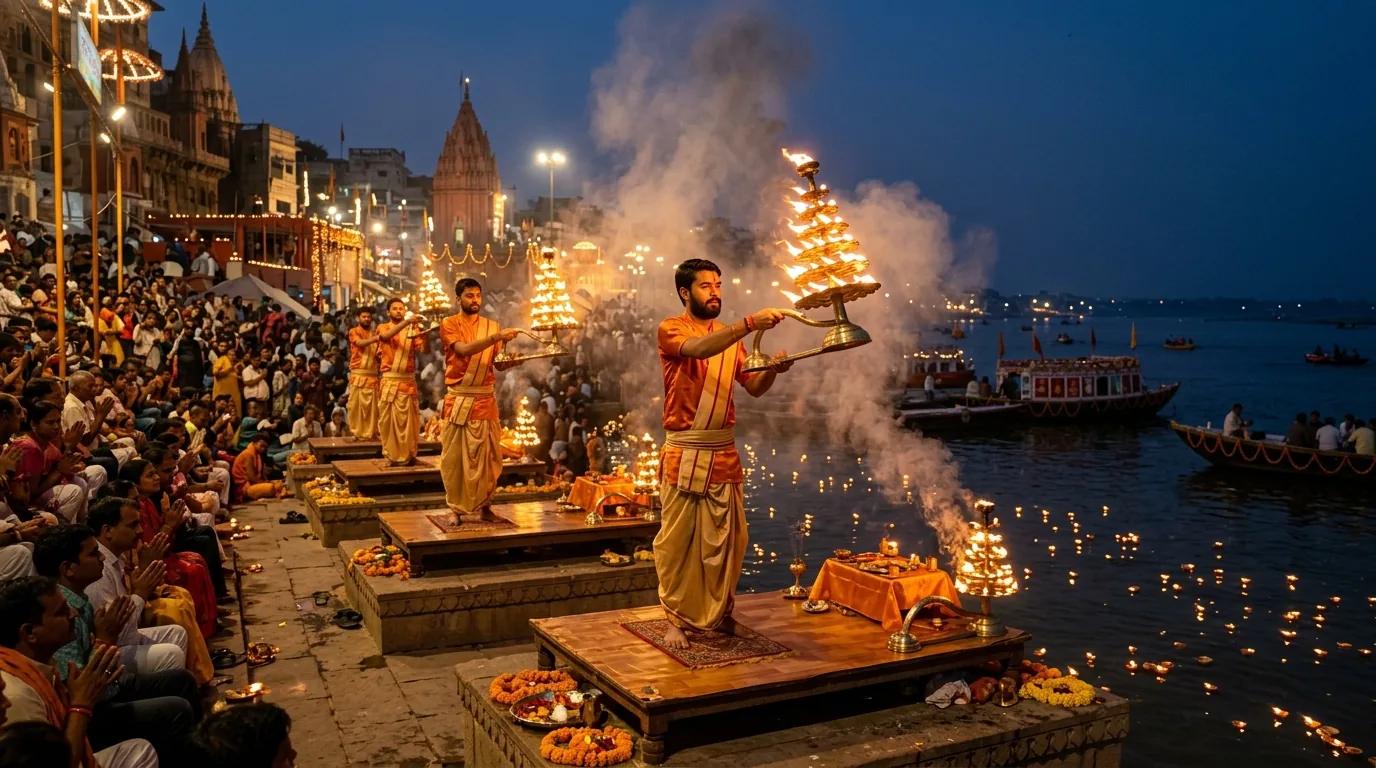
Most travellers come to Varanasi knowing only about the high-decibel evening ceremony at Dashashwamedh Ghat. They brave the elbow-to-elbow crowds in the old city lanes, watch the evening lamps, and leave thinking they have seen the Ganga Aarti.
Ask anyone who lives in Banaras where they actually go when they want peace of mind, and almost everyone points south to Assi Ghat.
Unlike the central ghats—where getting to the riverfront means walking 700 meters through packed pedestrian alleys—Assi Ghat opens onto a broad, breezy courtyard at the southern tip of the river crescent. More importantly, Assi Ghat hosts two distinct Ganga Aarti ceremonies every single day:
- The Dawn Awakening (Subah-e-Banaras): A deeply moving pre-sunrise ritual involving a Vedic fire sacrifice (Yagya), morning Ganga Aarti performed by female Vedic scholars, live Hindustani classical music, and community yoga.
- The Evening Ganga Aarti: A spacious, family-friendly dusk ceremony on the lower riverfront steps that offers all the grandeur of brass lamps and conches without the suffocating crush of Dashashwamedh.
Here is everything you need to know to plan your visit to the Assi Ghat Ganga Aarti—including exact summer and winter timings, where to sit, how to book a sunrise boat right after the ritual, and why this ghat is the smartest choice if you are travelling with elderly parents or children.
Complete Assi Ghat Ganga Aarti Timings (Winter vs. Summer Schedule)
Because the morning ceremony is timed strictly to the first light of dawn (Brahma Muhurta) and the evening ceremony follows sunset, the schedule shifts by 30 to 45 minutes between summer and winter.
1. Morning Schedule at Assi Ghat (Subah-e-Banaras)
| Ritual Stage | Summer Timings (Apr – Sept) | Winter Timings (Oct – Mar) | Duration | Venue at Assi Ghat |
|---|---|---|---|---|
| 1. Vedic Yagya (Havan) | 4:45 AM – 5:15 AM | 5:15 AM – 5:45 AM | 30 Mins | Yagyashala Pavilion (Upper Steps) |
| 2. Prabhat Ganga Aarti | 5:15 AM – 5:45 AM | 5:45 AM – 6:15 AM | 30 Mins | Main Subah-e-Banaras Platform |
| 3. Morning Raga (Classical Music) | 5:45 AM – 6:30 AM | 6:15 AM – 7:00 AM | 45 Mins | Open-Air Amphitheater Stage |
| 4. Sunrise Yoga & Pranayama | 6:30 AM – 7:15 AM | 7:00 AM – 7:45 AM | 45 Mins | Main Ghat Plaza |
2. Evening Ganga Aarti Schedule at Assi Ghat
| Season | Official Start Time | Best Arrival Time | Duration | Entry / Seating Fee |
|---|---|---|---|---|
| Winter (October to March) | 6:00 PM – 6:15 PM | 5:20 PM | 40 Mins | 100% Free |
| Summer (April to September) | 7:00 PM | 6:15 PM | 40 Mins | 100% Free |
Part 1: The Morning Ganga Aarti at Assi Ghat (Subah-e-Banaras)
Launched in November 2014 to revive the traditional morning culture of Kashi, Subah-e-Banaras has transformed Assi Ghat into the cultural anchor of southern Varanasi. It has run uninterrupted every morning for over a decade—through winter fog, summer heatwaves, and monsoon floods.
If you arrive 15 minutes before start time, the sky is still ink-black. Streetlights reflect off the dark water, boatmen are untying their wooden oars, and clay-cup (kulhad) tea sellers are fanning coal stoves along the upper plaza. Over the next two hours, the ghat moves through four seamless stages as the sun comes up over the eastern bank of the Ganga.
Stage 1: The Pre-Dawn Vedic Yagya (Fire Ritual)
Before a single brass lamp is lit at the water’s edge, five Vedic scholars sit around a sacred fire pit (Havan Kund) inside the covered pavilion on the upper steps. For thirty minutes, the dark ghat echoes with crisp, rhythmic chanting of Rigvedic and Yajurvedic hymns as offerings of ghee and herbal samagri are poured into the fire. You can sit right on the stone tiers around the pavilion; the warmth of the fire pit is especially welcome on chilly December and January mornings.
Stage 2: The Morning Ganga Aarti (Led by Female Vedic Scholars)
One of the most remarkable features of the morning Ganga Aarti at Assi Ghat—and something that sets it apart from almost every other orthodox shrine in India—is that the ceremony is frequently performed by young female Vedic scholars (Kanyas and Acharyas) trained in Sanskrit scriptures, including scholars associated with Varanasi’s historic Panini Kanya Mahavidyalaya.
As the eastern sky turns from navy blue to soft amber, five to seven priests step onto the wooden platforms facing the river.
- The ritual opens with synchronized conch blowing (Shankhnaad).
- Unlike the fast, pounding drums of the evening ceremonies, the morning Aarti is accompanied by gentle bells and slow, meditative Sanskrit stotras dedicated to Mother Ganga and the rising Sun (Surya).
- As the priests lift the heavy, multi-tiered brass lamps (deepmalas), the orange flames frame the exact moment the sun breaks over the sandy bank across the river.
Stage 3: Morning Raga (Live Hindustani Classical Concert)
Right as the Aarti concludes and the priests offer flower petals to the river, the focus shifts fifty feet back to the open-air stone stage. Every morning, a classical musician—sometimes a seasoned maestro from the Banaras Gharana or Banaras Hindu University, and sometimes a rising vocalist, flautist, sitar player, or tabla artist—performs a 40-minute live recital.
In Indian classical music, specific melodic frameworks (Ragas) are meant to be sung only at dawn—such as Raga Bhairav, Raga Lalit, Raga Bairagi, or Raga Ahir Bhairav. Listening to a live bansuri flute or classical vocal recital on the stone steps while sipping hot lemon-ginger tea and watching rowboats glide across the golden river is an experience you simply cannot buy in a concert hall.
Stage 4: Community Sunrise Yoga
Around 6:30 AM (7:00 AM in winter), yoga instructors take the main stage and lead a free 45-minute session of Surya Namaskar, light stretching, and Pranayama (breathing exercises). You don’t need to register or bring a yoga mat—locals in tracksuits, saffron-clad sadhus, college students from BHU, and international travellers all join in right on the swept stone terrace.
Part 2: The Evening Ganga Aarti at Assi Ghat (The Crowd-Free Alternative)
While mornings at Assi are famous, many visitors don't realize that Assi Ghat also hosts a full-scale Evening Ganga Aarti every night at dusk.
If you visited Dashashwamedh Ghat on your first evening and felt overwhelmed by the jostling crowds, police whistles, and long walk back to Godowlia, spend your second evening at Assi Ghat.
- What It Looks Like: Five to seven priests dressed in traditional silk dhoti-kurtas stand on elevated wooden chowkis right at the water’s edge (slightly south of the Subah-e-Banaras stage). They perform the complete 40-minute Vedic ceremony—complete with smoking incense censers, heavy tiered brass lamps, yak-tail whisks (chawar), peacock feather fans, and collective chanting.
- Why Families Love It: Because Assi Ghat has a wide, open brick-and-stone amphitheater, you never feel trapped. Even if you walk in just 20 minutes before the Aarti starts, you can find a comfortable step to sit on with a clear line of sight to the priests.
Assi Ghat vs. Dashashwamedh Ghat Aarti: Honest Comparison
Not sure which ghat fits your travel style? Here is how the two compare on the ground:
| Feature | Assi Ghat Ganga Aarti | Dashashwamedh Ghat Ganga Aarti |
|---|---|---|
| Ceremony Timings | Both Morning & Evening (Famous for Dawn Subah-e-Banaras) | Morning & Evening (World-famous for the Grand Evening Aarti) |
| Crowd Density | Moderate & Relaxed — plenty of breathing room on the steps | Extremely High — 4,000 to 7,000+ people packed onto steps and boats |
| Vehicle Drop-Off | 50 Meters Away — Autos, e-rickshaws, and cabs drop you right at the ghat entrance | 600–700 Meters Away — Vehicles stop at Godowlia; mandatory walk in pedestrian zone |
| Senior Citizen & Kid Friendly | Excellent — Wide steps, flat upper plaza, easy exit | Challenging — Steep stone stairs and heavy post-Aarti crowd bottlenecks |
| Atmosphere | Meditative, cultural, musical (Morning Raga + Yoga) | Electric, loud, theatrical, and deeply devotional |
| Post-Aarti Food & Cafes | Immediate access to Pizzeria Vaatika Cafe, chai stalls, and Lanka street food | Must walk back up Dashashwamedh lane toward Godowlia/Luxa |
Our Recommendation: Do not treat this as an either/or choice. Watch the Evening Ganga Aarti at Dashashwamedh Ghat on Day 1 for its sheer scale and spectacle, and wake up early on Day 2 for the Morning Subah-e-Banaras Aarti at Assi Ghat.
Where to Sit at Assi Ghat for the Best View
Assi Ghat is wide, and first-time visitors sometimes sit at the wrong end of the steps waiting for the ceremony to start. Keep this layout in mind:
- For Morning Aarti (Subah-e-Banaras): Walk past the giant Peepal tree shrine at the main entrance and turn left (north) toward the permanent stone amphitheater (Subah-e-Banaras Manch). Sit on the middle stone tiers between the Yagyashala pavilion and the riverfront platforms. From this spot, you can watch the fire ritual, the Aarti lamps against the sunrise, and the classical music stage without changing seats.
- For Evening Ganga Aarti: The evening platforms are set up closer to the central water’s edge in front of the main Assi steps. You can either sit three rows up on the stone steps or hire a stationary wooden boat parked ten feet out on the water for a front-facing view of the priests.
Combining Morning Aarti with a Sunrise Boat Ride (Rates & Timing)
The single best morning routine in Varanasi is to attend the Subah-e-Banaras Aarti at Assi Ghat first, and board a sunrise boat immediately after the brass lamps are set down (around 6:15 AM in winter / 5:45 AM in summer).
Why does this work better than boarding a boat at 5:00 AM? Because at 5:00 AM it is pitch dark on the river—you cannot see the architecture of the palaces or take clear photos. By boarding at 6:00 AM right after the Aarti, you catch the soft golden light hitting all 84+ ghats as your boat rows north from Assi toward Dashashwamedh and Manikarnika Ghat.
Honest Boat Rates from Assi Ghat (2026):
- Shared Boat (Morning Sunrise Cruise): ₹150 to ₹200 per person for a 1-hour ride from Assi Ghat to Dashashwamedh Ghat and back.
- Private Hand-Rowed Boat (1 to 6 People): ₹1,000 to ₹1,400 total (Assi to Dashashwamedh and back) or ₹1,500 to ₹1,800 if going all the way to Manikarnika Ghat.
- Private Motorboat (Group of 6 to 12): ₹1,800 to ₹2,500 total for a 60-to-90-minute trip along the riverfront.
*Local Tip:* Walk down to the water’s edge at Assi Ghat and speak directly to the boatmen standing beside their boats rather than middlemen standing near the auto stand on the road—you will instantly save ₹300 to ₹500.
How to Reach Assi Ghat at 4:45 AM (Transport & Parking Guide)
Unlike the old city around Kashi Vishwanath, Assi Ghat is connected by wide, motorable roads via Lanka, Bhadaini, and Ravindrapuri.
- By Auto-Rickshaw or Cab (Uber/Ola): Even at 4:30 AM, autos and app cabs operate smoothly across Varanasi. Tell your driver to drop you at Assi Ghat Chauraha (right outside Subah-e-Banaras gate). From the drop-off point, the ghat steps are less than a 1-minute flat walk.
- Typical Early-Morning Auto Fares:
- From Godowlia / Luxa / Chowk: ₹100 – ₹150 (10–12 mins)
- From Sigra / Mahmoorganj: ₹150 – ₹200 (15 mins)
- From Cantonment (Varanasi Junction Railway Station): ₹200 – ₹250 (20–25 mins)
- Self-Drive / Private Car Parking: There is paid municipal parking available right beside the Assi Ghat road approach (near the Jagannath Temple lane). In the early morning before 6:00 AM, finding a parking slot is effortless.
What to Do Right After the Morning Aarti (Your 7:00 AM Mini-Itinerary)
Once the morning music recital wraps up around 6:45 AM, don’t rush straight back to your hotel. The hour between 6:45 AM and 8:00 AM around Assi is pure Banarasi magic:
- Drink Lemon-Ginger Chai or Malai Toast on the Steps: Right behind the Subah-e-Banaras stage, local vendors serve steaming clay cups (kulhads) of black lemon tea spiked with crushed ginger and special masala (₹10–₹15), alongside coal-toasted butter bread.
- Pay Respects at Assi Sangameshwar & Under the Peepal Tree: At the top of the steps sits an ancient cluster of Shiva lingams beneath a sprawling Peepal tree, along with the Asisangameshwar Lingam—marking the spot where Goddess Durga threw down her sword (Asi) after slaying the demons Shumbha and Nishumbha.
- Walk 5 Minutes North to Tulsi Ghat & Lolark Kund: Stroll along the stone riverfront just 300 meters north to Tulsi Ghat, where the 16th-century poet-saint Goswami Tulsidas lived while composing the Ramcharitmanas. Just above the steps lies the ancient stepwell of Lolark Kund and an old traditional wrestling pit (akhada) where local pehlwans train with heavy wooden clubs (mugdals) every morning.
- Eat Piping-Hot Kachori Sabzi & Jalebi at Assi Crossing: As you exit Assi Ghat toward the main road at 7:30 AM, stop at any of the bustling sweet shops right at the Assi crossing for crisp kachori-sabzi and hot saffron jalebis.
Seasonal & Monsoon Advisory (Winter Fog vs. August Floods)
- Winter Mornings (December & January): Morning temperatures on the open riverfront drop to 7°C–10°C, and thick white fog often hangs over the Ganga until 8:00 AM. Carry a warm jacket, woollen cap, and socks (the stone steps get freezing cold if you sit directly on them—carry a small shawl or folded newspaper to sit on).
- Monsoon Flood Season (Late July to September): Assi Ghat is relatively flat compared to the steep central ghats. When the Ganga floods in August, the river water climbs all the way up the steps and submerges the lower Subah-e-Banaras stage. However, the morning and evening Aartis never stop. The priests simply move the wooden platforms and Havan Kund up to the highest road-level pavilion near the entrance plaza.
Frequently Asked Questions About Assi Ghat Ganga Aarti
What is the exact time of morning Ganga Aarti at Assi Ghat?
In summer (April to September), the Subah-e-Banaras morning sequence begins with the Vedic Yagya at 4:45 AM, and the main brass-lamp Ganga Aarti takes place from 5:15 AM to 5:45 AM. In winter (October to March), the Yagya starts at 5:15 AM, and the main Ganga Aarti runs from 5:45 AM to 6:15 AM, followed immediately by classical music and yoga.
Does Assi Ghat have an evening Ganga Aarti as well?
Yes, Assi Ghat conducts a full Vedic Ganga Aarti every evening in addition to the morning ceremony. It starts at 6:00 PM – 6:15 PM in winter and 7:00 PM in summer. It is far less crowded than Dashashwamedh Ghat and ideal for families and senior citizens.
Is there any ticket or entry fee for Subah-e-Banaras at Assi Ghat?
No. Every part of the Assi Ghat experience—including the Vedic Yagya, the morning and evening Ganga Aarti, the 45-minute live classical music concert, and the morning yoga session—is 100% free and open to everyone. No advance booking or pass is required.
How early should I reach Assi Ghat for a good seat?
Because Assi Ghat has a wide, open amphitheater, you do not need to arrive hours in advance. For the morning Subah-e-Banaras Aarti, arriving 15 to 20 minutes before start time (by 5:00 AM in summer or 5:30 AM in winter) guarantees a front-row seat on the stone steps. For the evening Aarti, arrive 30 to 40 minutes early (around 5:20 PM in winter or 6:15 PM in summer).
Is it safe for solo travellers and women to visit Assi Ghat at 4:30 AM?
Yes, Assi Ghat is one of the safest, best-lit, and most active areas in Varanasi before dawn. Located right beside Banaras Hindu University (BHU) and residential neighbourhoods like Dumraon Colony and Ravindrapuri, the ghat is well-patrolled by tourist police and filled with morning walkers, yoga practitioners, and local families from 4:30 AM onward.
Explore Related Guides on MyVaranasi
- Ganga Aarti in Varanasi: Complete Guide to All Ghats & Timings
- Dashashwamedh Ghat Ganga Aarti: Evening Seating, Boats & Route
- Assi Ghat Neighbourhood Guide: History, Cafes, Stays & Walks
- Assi to Dashashwamedh Ghat Walk: Complete Riverfront Route
- 1, 2 & 3-Day Varanasi Itineraries (Includes Subah-e-Banaras Loop)
- Plan My Trip: Book a Private Sunrise Boat from Assi Ghat