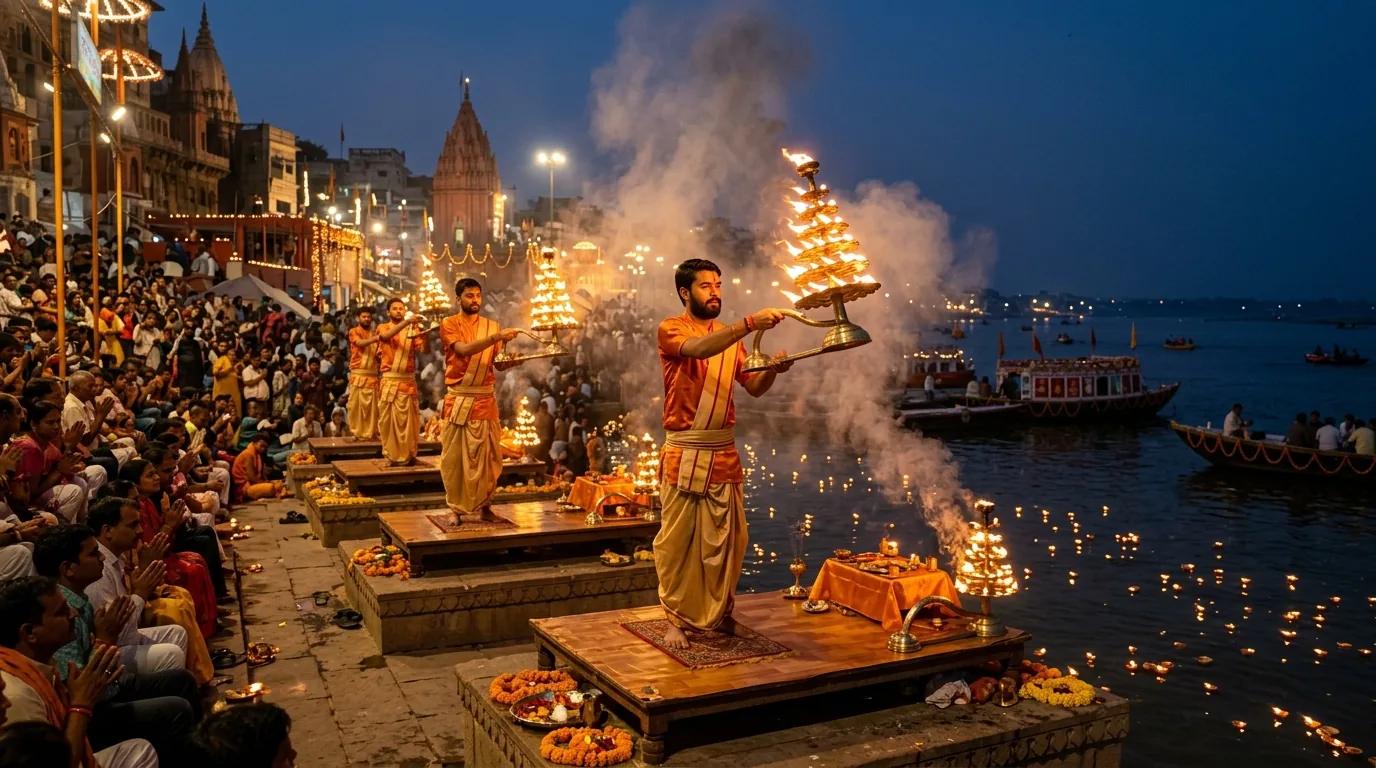
As daylight fades over Varanasi, Dashashwamedh Ghat changes from a busy riverfront into a gathering of lamps, bells, incense and prayer.
The evening Ganga Aarti is visually extraordinary, but it is first an offering of gratitude and reverence to Maa Ganga. This complete guide explains its spiritual context, typical sequence, timing, approach, practical planning and respectful ways to attend.
Discover the spiritual heart of Varanasi, where ancient devotion, flickering flames, and the sacred Ganga come together every evening.
As daylight begins to fade over Varanasi, the ancient steps of Dashashwamedh Ghat undergo a remarkable transformation.
The busy riverfront gradually fills with pilgrims, families, and curious travellers. Flower sellers arrange their offerings, priests prepare brass lamps, and the evening air carries the fragrance of incense. Across the Ganga, the eastern bank slips into shadow while the buildings of old Kashi glow in the remaining light.
Then a conch shell sounds.
For a brief moment, the distractions of the city seem to disappear. Temple bells begin ringing, devotional chants grow louder, and priests lift flaming lamps towards the sacred river.
This is the Dashashwamedh Ghat Ganga Aarti, one of the most significant religious experiences in Varanasi.
To visitors, it is an extraordinary sight. To countless Hindu devotees, it is something much deeper: an offering of gratitude, reverence, and prayer to Maa Ganga.
Whether you are visiting Kashi for spiritual reasons or exploring its living traditions, understanding the ceremony beforehand can make the experience more meaningful.
This guide explains the Aarti's significance, history, timing, rituals, and everything worth knowing before you visit.
Dashashwamedh Ghat Ganga Aarti: Essential Information
| Detail | Visitor information |
|---|---|
| Location | Dashashwamedh Ghat, Varanasi, Uttar Pradesh |
| Ceremony | Evening Ganga Aarti |
| Usual timing | Around sunset; commonly between 6 PM and 7 PM depending on season and organiser |
| Duration | Approximately 45–60 minutes |
| Entry fee | Free public viewing |
| Recommended arrival | 60–90 minutes before the ceremony |
| Common approach | Godowlia towards Dashashwamedh Ghat |
| Best suited for | Pilgrims, families, cultural travellers and photographers |
Important: Exact timings and arrangements may change. Different organising committees in the Dashashwamedh area publish their own information, so confirm the ceremony you intend to attend before setting out.
Why Is Dashashwamedh Ghat So Important?
Among the many sacred ghats of Varanasi, Dashashwamedh holds a particularly prominent position.
Its name is deeply connected with Hindu mythology. Dash means ten, Ashwa means horse, and Medh refers to sacrifice.
According to a traditional belief, Lord Brahma performed the sacrifice of ten horses at this location to welcome Lord Shiva to Kashi.
The legend gives the ghat its name and forms an important part of its religious identity.
Situated near the revered Kashi Vishwanath Temple, Dashashwamedh has long been associated with pilgrimage, prayer, and worship beside the Ganga.
During the day, devotees descend the steps for sacred bathing and religious offerings. Priests conduct rituals, boatmen attend to their vessels when operations are permitted, and visitors explore the surrounding lanes.
By evening, the riverfront becomes the setting for its celebrated Ganga Aarti.
The grand ceremony seen today is a publicly organised expression of a much older tradition of offering light in worship. While its coordinated presentation has developed over time, its devotional meaning remains central.
The Spiritual Meaning of Ganga Aarti
In Hindu tradition, the Ganga is not regarded merely as a river.
She is worshipped as Maa Ganga, the divine mother whose waters are associated with purification, compassion, blessings, and liberation.
The word Aarti refers to a ritual offering of light before a deity.
During Ganga Aarti, lamps, incense, flowers, and prayers are offered in reverence to the sacred river.
The flames represent light overcoming darkness, while the ringing bells and devotional chants help create an atmosphere of concentrated worship.
For many pilgrims, the ceremony is an opportunity to express gratitude, seek blessings, and reflect on their spiritual journey.
Visitors sometimes describe Ganga Aarti as a spectacular performance. Its visual beauty certainly attracts attention, but it is important to remember that the ceremony is first and foremost an act of worship.
You do not need to understand every Sanskrit verse to appreciate it. Watching respectfully, listening carefully, and observing the devotion of those around you can be meaningful in itself.
What Happens During the Dashashwamedh Ghat Ganga Aarti?
Although the precise order and objects used can vary according to the organising committee and occasion, the ceremony follows a recognisable sequence of devotional offerings.
1. Preparation and Invocation
Before the main Aarti begins, priests prepare the ceremonial platforms and arrange lamps, incense, flowers, and other ritual materials.
Devotees gather on the surrounding steps, and the riverfront gradually becomes quieter as attention turns towards the priests.
Prayers and invocations establish the sacred purpose of the ceremony.
2. Shankhnaad: The Sound of the Conch
The blowing of the shankh, or conch shell, is one of the most recognisable moments.
Its deep, resonant sound carries across the gathering and marks an important transition into collective prayer.
In Hindu worship, the conch is an auspicious instrument associated with divine invocation.
The sound is followed by bells and chanting, creating the distinctive atmosphere of the evening Aarti.
3. Dhoop Aarti: The Offering of Incense
Priests raise ornate incense burners and move them in measured, circular gestures.
Fragrant smoke rises above the platforms, spreading through the evening air.
The incense offering is an expression of reverence and hospitality towards the divine.
For spectators, this stage is especially atmospheric as smoke and light mingle against the darkening riverfront.
4. Deep Aarti: The Offering of Flames
This is the most visually striking part of the ceremony.
Priests lift large, multi-tiered brass lamps and offer the flames towards Maa Ganga through carefully coordinated movements.
The lamps are raised, lowered, and moved in graceful circles while bells and devotional music continue.
From the steps, visitors can observe the gestures of the priests and the reactions of worshippers.
When the ceremony is viewed from the river under authorised boating arrangements, the illuminated platforms and the surrounding architecture form a different perspective.
Yet the significance remains the same: the offering of sacred light.
5. Chamar, Mor Pankh and Other Offerings
Other traditional ritual objects may be used, including chamar (ceremonial fly-whisks) and mor pankh (peacock-feather fans).
These gestures express honour and devotion within Hindu worship.
The movements are accompanied by prayers and music, with worshippers often joining in the chanting.
6. Closing Prayers and Blessings
As the ceremony approaches its conclusion, the intensity of the music gradually gives way to the final prayers.
Many devotees fold their hands, bow their heads, or receive the blessing of the Aarti flame when this is offered.
The ritual ends, but the atmosphere remains with the gathering as people begin making their way back through the lanes of Kashi.
Dashashwamedh Ghat Ganga Aarti Timings
The evening Aarti is associated with sunset, so its timing changes through the year.
Travel guides commonly refer to approximately 6 PM during winter and around 7 PM during summer. However, organisers may operate different schedules.
For example, Gangotri Seva Samiti's published guidance lists a 6 PM ceremony and requests devotees to arrive by 5 PM.
For planning purposes, treat published seasonal timings as indicative rather than a guaranteed daily schedule.
Recommended approach: Confirm the current timing with the relevant organising committee or locally on the day of your visit.
The main ceremony generally takes about 45 minutes to an hour.
If you want a comfortable place on the public steps, arrive at least 60–90 minutes beforehand, especially during weekends and major pilgrimage periods.
Is There an Entry Fee for Ganga Aarti?
No. Watching Ganga Aarti from the public steps of Dashashwamedh Ghat is free.
You do not need to purchase an admission ticket simply to attend.
Some visitors choose private terraces or separately arranged religious participation, which may involve charges.
These should not be confused with an official public viewing ticket.
Gangotri Seva Samiti states that it does not offer VIP seating for its ceremony.
Be cautious if someone approaches you claiming that the public Aarti is fully booked or that you must pay for a compulsory VIP pass.
If you are considering any paid arrangement, confirm the provider, the actual service, and the cost before making a payment.
Where Can You Watch the Ganga Aarti?
Most visitors watch from the stone steps surrounding the ceremony.
These public areas provide an opportunity to hear the devotional chants and experience the atmosphere alongside pilgrims.
A slightly elevated position may offer a broader view, while certain side positions allow a closer look at individual priests.
Private elevated terraces may also provide views, but visibility varies considerably between properties.
Traditionally, boats have offered a frontal view from the Ganga. However, this is possible only when evening boating is officially authorised.
Boating advisory (October 2026): The latest verified permission report dated 9 October allowed large motorboats to operate from 6 AM to 5 PM, while restrictions on rowing boats continued. Visitors should not assume boat-based evening Aarti viewing is available without confirming a newer order.
For a more detailed comparison, read our Best Place to Watch Ganga Aarti in Varanasi guide.
How to Reach Dashashwamedh Ghat
Dashashwamedh Ghat is located in Varanasi's old-city riverfront area, close to the Kashi Vishwanath Temple precinct.
Godowlia is one of the most commonly used access points.
Visitors arriving by taxi, auto-rickshaw, or e-rickshaw may need to complete the final stretch on foot because of traffic restrictions and security arrangements.
The approach passes through a lively market area where pilgrims, residents, shopkeepers, and travellers share the narrow streets.
Allow extra time for walking, particularly around the evening Aarti.
If you are coming from Varanasi Junction, Banaras railway station, or the airport, ask your driver about the currently permitted drop-off point near Godowlia rather than assuming vehicles can reach the ghat directly.
Wear comfortable footwear and keep your phone's map or hotel details available for the return journey.
A Practical Evening Plan for First-Time Visitors
One of the most enjoyable ways to experience Dashashwamedh Ghat is to arrive well before the lamps are lit.
Begin by exploring the surrounding old-city streets during the late afternoon.
If you plan to visit Kashi Vishwanath Temple, allow adequate time for darshan and security checks. Avoid combining a tight temple schedule with a last-minute arrival for the Aarti.
Reach the ghat while the priests and volunteers are still preparing the ceremonial area.
Take a few minutes to observe the river, locate the viewing platforms, and decide where to sit.
Once the ceremony begins, remain in your chosen position rather than moving repeatedly through the gathering.
Afterwards, follow the crowd-control instructions and allow the busiest exits to clear when it is safe to do so.
You can then explore nearby lanes or enjoy the local food scene at a comfortable pace.
This simple itinerary avoids unnecessary rushing and allows the evening to feel like an experience rather than a checklist.
Best Time of Year to Experience the Aarti
The cooler months from October to March are generally pleasant for exploring Varanasi's riverfront.
Winter evenings can become cold, however, particularly when you are sitting outdoors for an extended period.
Summer visitors should carry drinking water and avoid remaining in direct heat for longer than necessary before the ceremony.
During the monsoon, rising river levels may cover the lower steps and require changes to viewing and ritual arrangements.
Do not approach submerged areas or attempt to board boats during restrictions.
Major celebrations such as Dev Deepawali bring an exceptional festive atmosphere to the ghats, but they also attract substantially larger crowds and additional security arrangements.
For visitors seeking a more manageable introduction, an ordinary weekday can be a better choice than a festival evening.
Important Tips for Families, Senior Citizens and Photographers
Dashashwamedh is an active religious space, and its popularity means that practical preparation matters.
Families travelling with children should agree on a meeting point and keep children close in crowded areas.
Senior citizens and visitors with mobility difficulties should assess the steps and exit routes before selecting a seat. A paid elevated viewpoint is not necessarily accessible; some terraces require climbing steep stairs.
Carry a small bag, keep your belongings secure, and avoid blocking pathways.
Photography is generally part of the visitor experience, but use your camera respectfully.
Avoid intrusive flash, do not enter priest-only platforms, and never push through worshippers for a better photograph.
Drone use requires compliance with applicable aviation and local security restrictions. Do not fly a drone without verifying the necessary permissions.
Most importantly, keep the riverfront clean. Do not leave plastic, food packaging, or other waste on the steps or in the Ganga.
Dashashwamedh Ghat vs Assi Ghat Ganga Aarti
Both ghats offer meaningful experiences, but they have different characteristics.
Dashashwamedh is renowned for its grand evening ceremony and large gathering of devotees.
Assi Ghat, towards the southern part of the riverfront, offers its own evening worship and the distinctive Subah-e-Banaras morning programme.
If you have only one evening, Dashashwamedh is an excellent choice for a first-time visitor.
If your itinerary allows, visit Assi Ghat Ganga Aarti on another occasion to experience a different atmosphere.
Frequently Asked Questions About Dashashwamedh Ghat Ganga Aarti
1. What time does Ganga Aarti start at Dashashwamedh Ghat?
The timing varies by season and organising committee. Evening ceremonies commonly begin around 6–7 PM. Confirm the current schedule before visiting rather than relying on a fixed year-round time.
2. How long does the evening Ganga Aarti last?
The ceremony usually takes approximately 45–60 minutes, although special occasions and individual organising arrangements can affect the duration.
3. Is Dashashwamedh Ghat Ganga Aarti free?
Yes. Public viewing from the ghat steps is free, and no general entry ticket is required.
4. Can tourists attend the Ganga Aarti?
Yes. Visitors from India and abroad may observe the ceremony respectfully, regardless of whether they are attending for religious or cultural reasons.
5. How early should I arrive for Ganga Aarti?
Arriving 60–90 minutes before the scheduled ceremony is a sensible choice for first-time visitors. Allow additional time during festivals and busy pilgrimage periods.
6. Does Ganga Aarti take place during the monsoon?
The ritual traditionally continues through the seasons, but heavy rain, high river levels, and safety arrangements may change the location or public access. Always check current local conditions.
7. Can I attend Ganga Aarti after Kashi Vishwanath darshan?
Yes, both experiences can be included in an evening itinerary. Allow sufficient time for temple queues, security procedures, walking, and the Aarti gathering.
Final Thoughts: An Evening That Reveals the Spirit of Kashi
Varanasi is a city where spirituality is not confined to temples.
It lives in the prayers heard along narrow lanes, the daily rituals performed beside the river, and the relationship between its people and Maa Ganga.
The evening Aarti at Dashashwamedh Ghat brings many of these traditions together in one remarkable setting.
The lamps are beautiful. The chants are powerful. The gathering is unforgettable.
But beyond the spectacle lies a quieter message of reverence and gratitude.
When the final prayers are offered and the crowd begins to move away, take a moment to look towards the Ganga.
The flames may have been extinguished, but the river continues its journey past the ancient ghats of Kashi.
And perhaps that is the most enduring part of the experience: the ceremony ends, but the devotion to Maa Ganga continues.