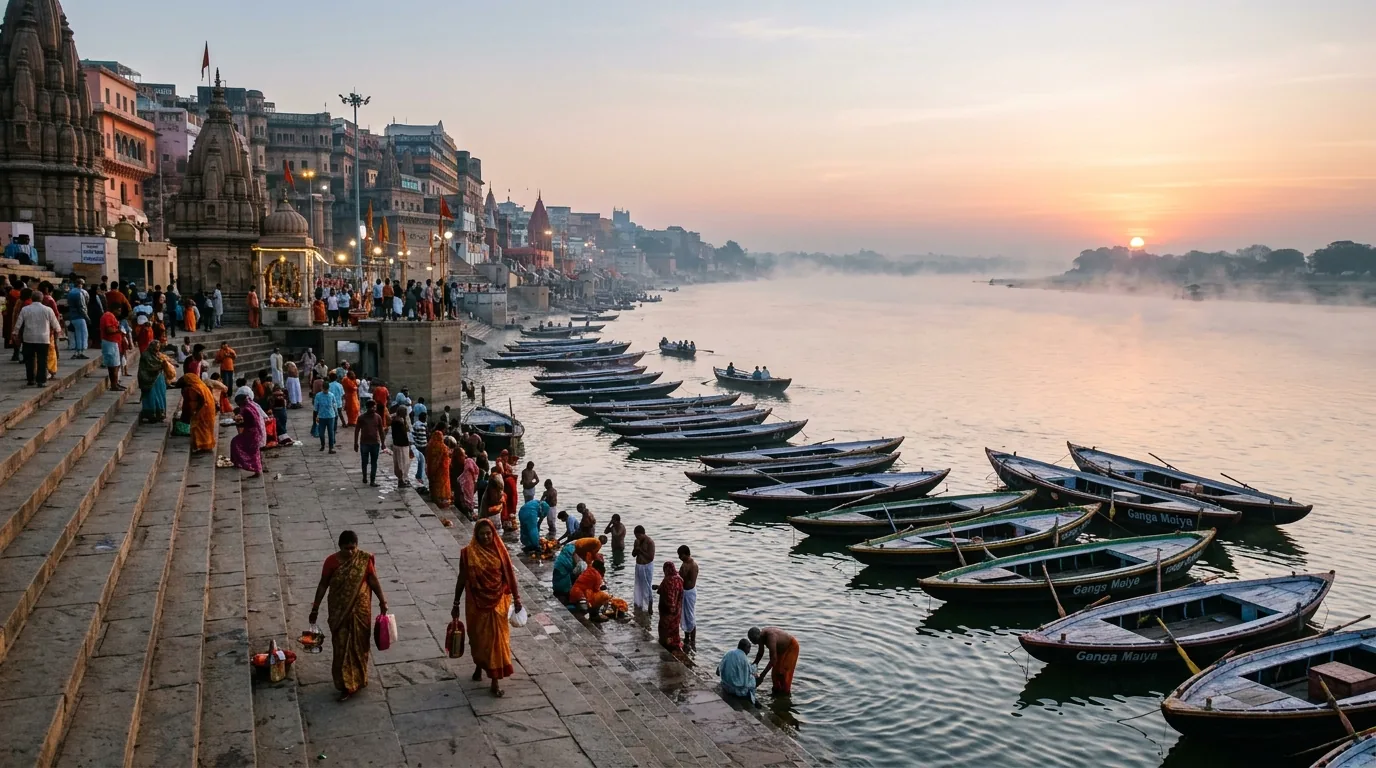
Waking up for a morning on the Varanasi riverfront offers a completely different way to experience the city. Instead of navigating the heavy evening crowds, you arrive before sunrise and let the river, Vedic chants, and changing light set the pace for your day.
For travellers looking for the Morning Ganga Aarti in Varanasi, Assi Ghat and its famous Subah-e-Banaras programme are the clearest starting point. Because the rituals begin in the dark before dawn, planning your early ride, verifying the seasonal timings, and giving yourself enough time to sit through the music—rather than rushing off after a few quick photos—makes all the difference.
Where to Go for Morning Ganga Aarti
Assi Ghat—located at the southern end of the main ghat stretch—is the home of Subah-e-Banaras, a daily dawn cultural and devotional gathering. The programme takes place on the main raised platform at Assi Ghat (right below the Pizzeria Vaatika Cafe area) and includes:
- Vedic Chanting by young scholars and priests
- Morning Ganga Aarti facing the rising sun
- Havan (Yajna) at the pavilion
- Live Indian Classical Music (Morning Ragas)
- Community Yoga sessions on the platform
Do not confuse this dawn gathering with the high-energy evening Ganga Aarti at Dashashwamedh Ghat or the inner-sanctum Mangala Aarti inside Kashi Vishwanath Temple.
Local Tips for Reaching the Right Spot:
- Be specific with your driver: Always ask for "Assi Ghat for Subah-e-Banaras." If you simply ask your hotel or auto driver for a "sunrise visit," you might be routed to a random boat dock or a different ghat entirely.
- Know the drop-off point: Autos and cabs usually drop passengers near the Assi Chauraha police barrier. From there, it is a flat 100 to 150-metre walk straight onto the wide ghat courtyard.
- Entry is 100% Free: Subah-e-Banaras is a free public event. You do not need to buy a VIP ticket, pay an agent, or book a boat just to watch the ceremony. Always ask what a payment actually covers before accepting any "special seating package" offered near the parking area.
(Read our complete Assi Ghat Guide to explore the neighbourhood's cafes, heritage lanes, and evening atmosphere).
Subah-e-Banaras Timings & How to Plan Your Arrival
Because the programme is tied to the sunrise, timings shift between summer and winter. The official seasonal schedule runs for roughly two hours:
| Season | Approximate Programme Window | Best Time to Reach Assi Ghat |
|---|---|---|
| Summer (March – October) | 4:50 AM – 7:00 AM | By 4:30 AM |
| Winter (November – February) | 5:40 AM – 7:45 AM | By 5:15 AM |
Note: Sunrise shifts gradually across the months, and there is no single overnight changeover date between summer and winter timings. Always confirm the exact start time at your hotel desk or at the ghat the evening before.
Why You Should Arrive 15–20 Minutes Early:
A published start time doesn't account for walking from the Assi Chauraha barrier, taking off your shoes where required, or finding a comfortable step with a clear view of the stage. Reaching 15 to 20 minutes early lets you settle down quietly without hurrying down the stone steps or stepping in front of people while the chanting is already underway. Also, double-check local arrangements during major festivals, heavy monsoon rains, or periods when the Ganga water level is high.
(Check our detailed Ganga Aarti Timings Guide to compare schedules across all major ghats).
What to Expect Beyond the Lamps
Subah-e-Banaras is much more than a 15-minute lamp ceremony. While the visual highlight is the synchronized aarti against the pre-dawn sky, the real soul of the morning lies in the Havan, classical ragas, and quiet rhythm of the riverfront. If you only stay for the lamps and leave immediately after taking photos, you miss the best part of the morning.
- No prior ritual knowledge needed: You don't need to understand Sanskrit or ritual rules to attend. Simply observe where locals and visitors are seated, follow the announcements, and keep the walking pathways clear.
- Observation vs. Participation: Taking a holy dip in the Ganga, joining the yoga session, or simply sitting quietly on the steps to listen to the music are all separate choices. You are completely welcome to just sit and observe.
- Keep expectations grounded: Assi Ghat is a living, working public riverfront. Locals will be arriving for their morning bath, priests will be setting up their umbrellas, and boats will be moving along the bank. Embrace the natural bustle rather than expecting a silent, studio-like performance.
Morning vs. Evening Ganga Aarti: How to Choose
Many visitors wonder whether they should attend the morning aarti at Assi Ghat or the evening ceremony at Dashashwamedh Ghat. Both offer completely different experiences:
- Morning at Assi Ghat (Subah-e-Banaras): Peaceful, open, and meditative. The courtyard is wide and accessible, and the focus is on sunrise light, Vedic recitation, and classical music.
- Evening at Dashashwamedh Ghat: Grand, crowded, and intensely theatrical, featuring giant brass lamps, conch shells, and thousands of spectators on steps and boats. (See our Evening Ganga Aarti Guide for full comparison details).
Planning Tip for Families: If your trip allows both, do not pack them into a late-night and early-morning back-to-back schedule, especially when travelling with children or elderly parents. Attending the evening aarti until 8:00 PM and waking up at 4:00 AM the next day leads to quick burnout.
Also, remember that the Kashi Vishwanath Mangala Aarti (held inside the temple between 3:00 AM and 4:00 AM) is a completely separate ticketed temple service. Do not assume you can easily rush from Mangala Aarti to Assi Ghat in the same morning window without missing key parts of the programme.
Arrange Your Pre-Dawn Transport the Night Before
Finding an auto or cab on the street at 4:15 AM can be tricky if you stay far from the southern ghats.
- Pre-book your ride: Confirm your auto or cab driver, pickup point, and fare the night before. Ask whether the driver will wait at the Assi parking area for your return or if you'll take a fresh ride back after breakfast.
- Walking from nearby stays: Unlike the narrow, maze-like alleys of the old city near Dashashwamedh, Assi Ghat has direct road access. Still, if you are staying in a nearby guesthouse in Assi, Nagwa, or Bhadaini, ask your host for the best lit main-road route rather than relying on dark side lanes or slippery ghat steps before sunrise.
- Overnight train/flight arrivals: If your train reaches Varanasi Junction or Banaras Station at 3:30 AM, avoid dragging heavy luggage straight to the ghat. Check in, rest, and save the dawn visit for the next morning. (Use our Varanasi Local Transport Guide to plan your routes and fares).
Clothing, Seating, and Photography Etiquette
- Dress comfortably and modestly: Wear clothes that allow you to sit comfortably on stone steps. Between November and February, the river breeze before sunrise is surprisingly chilly—carry a shawl, fleece, or light jacket.
- Seating for Senior Citizens: Unlike standard steep ghats, Assi Ghat has a wide flat courtyard and some plastic chairs set up during the musical programme, making it one of the most senior-friendly ghats in Varanasi. However, reach early if someone in your group cannot sit on steps or stand for long.
- Mindful Photography: Avoid using camera flash during the chanting and aarti. Never step in front of seated devotees or climb onto ritual platforms for a "better reel angle." Always be careful when stepping backward near the water's edge.
Boats, Breakfast, and Shaping the Rest of Your Morning
Use this quick checklist to organize what happens right after the ceremony:
| Your Priority | How to Shape Your Morning Plan |
|---|---|
| Attend the full programme | Keep 6:00 AM – 7:30 AM open to sit through the classical music and yoga. |
| Add a sunrise boat ride | Book the boat after the aarti lamps conclude (~6:00 AM) so the two don't clash. |
| Travel with senior citizens | Secure flat courtyard seating early and plan a relaxed auto return via Assi Chauraha. |
| Head to Kashi Vishwanath Temple | Return to your hotel first for breakfast and to drop off phones/bags before darshan. |
Avoiding the Boat Ride Overlap
Boatmen at Assi Ghat will often approach you as soon as you arrive before dawn. If you take a boat immediately, you will be out on the water while the aarti and chanting are happening onshore. The smartest approach is to watch the aarti from the ghat steps first, and then hire a hand-rowed or motor boat around sunrise (6:00 AM – 6:15 AM) to glide along the ghats in the golden morning light.
Classic Banarasi Breakfast After Aarti
Once you return to Assi Ghat, don't rush straight into another monument tour. Walk two minutes out to Assi Chauraha or Lanka Road for a classic morning breakfast—piping hot Kachori-Sabzi, crispy Jalebi, and Kulhad Chai at the local street stalls, or seasonal Malaiyyo if you are visiting in winter.
If you plan to visit Kashi Vishwanath Temple later in the morning, remember that mobile phones, smartwatches, and bags are strictly prohibited inside the temple premises. Head back to your hotel to drop off your electronics first. (Check our Kashi Vishwanath Mobile & Locker Rules Guide and Varanasi Itineraries to plan the rest of your day smoothly).
BEFORE YOU GO
Frequently Asked Questions (Before You Go)
Where is the morning Ganga Aarti held in Varanasi?
Assi Ghat is the main venue for the famous morning Ganga Aarti, held as part of the daily Subah-e-Banaras programme on the main ghat platform.
What time should I reach Assi Ghat for Morning Aarti?
Reach by 4:30 AM in summer (programme starts around 4:50 AM) and by 5:15 AM in winter (programme starts around 5:40 AM). Arriving 15–20 minutes early ensures you get a good spot on the steps.
Is Subah-e-Banaras only a 15-minute aarti?
No. It is a nearly two-hour morning programme that includes Vedic chanting, Ganga Aarti, a Yajna (Havan), live morning classical music, and community yoga.
Is the Assi Ghat morning aarti the same as Mangala Aarti at Kashi Vishwanath?
No. Mangala Aarti is an early pre-dawn indoor temple ritual at Kashi Vishwanath requiring advance online booking. Subah-e-Banaras is an open, free public programme on the riverfront at Assi Ghat.
Do I need to book a boat or buy a ticket to attend?
No, attending Subah-e-Banaras on the ghat steps is completely free. You do not need to rent a boat or pay for a reserved seat to watch the ceremony.
Can I combine Subah-e-Banaras with a sunrise boat ride?
Yes! The best way is to watch the chanting and aarti onshore first, and then step onto a boat from Assi Ghat right after the lamp ceremony finishes to enjoy the sunrise along the river.
REFERENCE NOTES
Sources and practical updates
These primary sources support the factual background of this guide. For your travel dates, confirm the current arrangements with the responsible venue, property or service provider.
- Subah-e-Banaras organisers: programme activities and published seasonal timings
- Subah-e-Banaras organisers: daily programme and free public event
- Subah-e-Banaras organisers: contact and venue
- Incredible India, Ministry of Tourism: Assi Ghat and morning programme