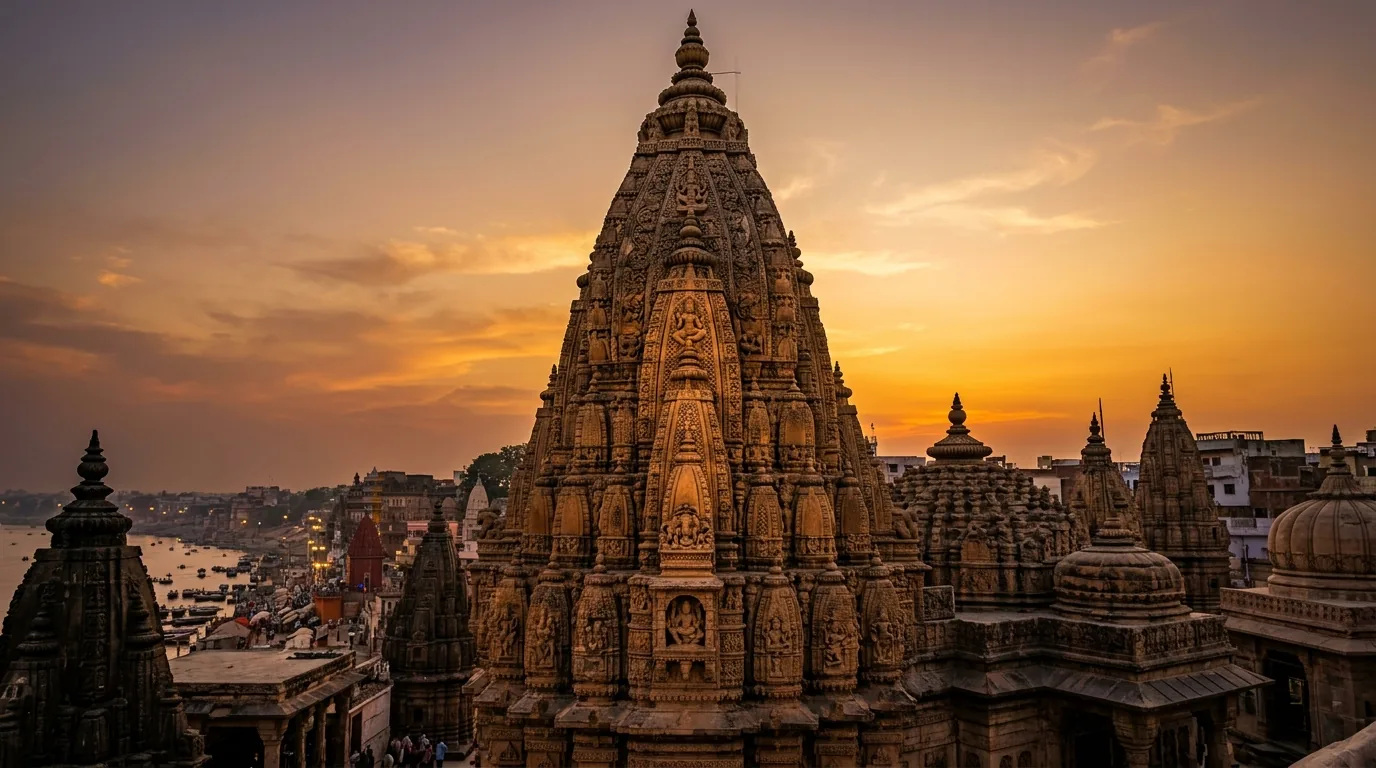
Kashi Vishwanath is an ancient sacred presence housed within a temple shaped by later rebuilding. That distinction is the starting point for understanding its history. A pilgrim may speak of Shiva's eternal city; a historian asks when a building was constructed, who supported it and which records survive. Both perspectives matter, provided their claims are identified clearly.
The temple stands in Varanasi's Old City and is revered as one of the twelve Jyotirlingas. The present shrine is associated with Maharani Ahilyabai Holkar's reconstruction in 1780, while the spacious approach to the Ganga belongs to the modern Dham project. Between those layers lies a history of royal patronage, destruction, renewed worship and changing administration.
Sacred tradition and historical evidence
In Hindu tradition, Kashi is Shiva's city, a place associated with spiritual knowledge and liberation. Vishwanath, also written Vishvanatha, means Lord of the Universe; Vishveshvara is another name used for the deity. The Jyotirlinga tradition describes Shiva through a manifestation of divine light. These ideas explain why people make the pilgrimage.
They do not supply an archaeological construction date. Statements that Shiva founded Kashi, that the city rests on his trident, or that worship here grants liberation belong to religious belief. They should be read respectfully as theology and sacred narrative, rather than as events that can be placed on a modern calendar.
Historical evidence has a different purpose. Building inscriptions, contemporary chronicles, administrative records and documented patronage can establish particular developments. Later accounts may preserve valuable memories, but their distance from the event matters. Even an official tourism page can combine belief, historical summary and visitor information within one paragraph.
This guide therefore dates the better-supported building and administrative milestones, while identifying devotional traditions in their own terms. It does not assign an unsupported age to the current sanctum or present a legendary founder as a documented architect.
A timeline with the main evidence limits
The following chronology distinguishes the religious identity of the shrine from changes to its physical setting. Dates refer to the stated event, not to the age of every structure now within the precinct.
| Period or date | Milestone | How to understand it |
|---|---|---|
| Sacred tradition | Vishwanath is revered as a Jyotirlinga in Shiva's city | Religious significance, without a historical founding date |
| Before 1669 | An earlier Vishwanath temple existed in the area | Earlier buildings must be distinguished from the present shrine |
| 1669 | Destruction of the earlier Bishnath/Vishwanath temple under Aurangzeb is recorded in the Maasir-i-Alamgiri | A chronicle-based historical milestone |
| 1780 | Ahilyabai Holkar's reconstruction of the present temple | The central documented rebuilding date used by the Trust |
| 1785 | Addition of a naubatkhana, according to the Trust's historical account | A later contribution to the temple setting |
| Nineteenth century | Maharaja Ranjit Singh's gold donation | Royal patronage behind the Golden Temple association |
| 28 January 1983 | Change to state-supervised temple administration | A management milestone, distinct from temple construction |
| 13 December 2021 | Inauguration of Kashi Vishwanath Dham, phase one | Modern redevelopment of the surrounding precinct and river connection |
A timeline is useful because it prevents several centuries from collapsing into one story. It also leaves room for uncertainty: not every earlier rebuilding episode has equally clear support in the sources used here.
Earlier temples and the destruction recorded in 1669
The earlier history is often presented online as a perfectly continuous list of demolitions and rebuilding dates. Some accounts name early medieval rulers and patrons without identifying the underlying record. Repeating each version would make the page longer without making the history more reliable.
One particularly significant source is Saqi Mustaid Khan's Maasir-i-Alamgiri, a Persian chronicle compiled after Aurangzeb's reign. It records that officials reported the destruction of the Bishnath temple at Benares in 1669. Translations and historical discussions of that passage form part of the evidence for the destruction of the earlier Vishwanath temple.
The important distinction is between that earlier temple and the present Ahilyabai shrine. The surrounding Gyanvapi area is part of the historical setting, but buildings, remembered sacred locations and later legal questions should not be treated as interchangeable evidence. A devotional account of a protected lingam, for example, needs to be identified as tradition unless separately supported by a historical record.
This travel history does not determine current litigation, ownership or access entitlements. Visitors should follow the boundaries and security directions in force at the site. Historical interest is a reason to read carefully, never a reason to enter a restricted area or challenge worshippers elsewhere in the neighbourhood.
Ahilyabai Holkar and the present temple
The Temple Trust credits Maharani Ahilyabai Holkar of Indore with building the temple in its present form in 1780. For visitors asking who built today's Kashi Vishwanath Temple, this is the clearest answer. It should be phrased as reconstruction of the present shrine, rather than the beginning of Vishwanath worship in Kashi.
Ahilyabai's importance becomes easier to appreciate when a temple is understood as more than a structure. Rebuilding established a renewed physical centre for daily worship and pilgrimage. It gave later patrons a place to support, while preserving a devotional identity older than the visible masonry.
The current experience can make that scale difficult to imagine. Approaching through the broad modern Dham, a visitor first encounters a much larger setting. The historic temple remains the central destination within it. New circulation space around a shrine does not make the shrine itself a twenty-first-century building.
For a thoughtful visit, keep three questions separate: who is worshipped here, when was the present temple rebuilt, and when was its surrounding approach redeveloped? The answers belong to religious tradition, eighteenth-century patronage and contemporary planning respectively. Our complete temple guide connects those distinctions with practical visiting arrangements.
Gold, patrons and the changing temple setting
The name Golden Temple refers to the gold associated with the temple's upper structure. Maharaja Ranjit Singh of Punjab is the celebrated nineteenth-century patron behind this contribution. The Trust's historical account dates the covering of two domes to 1839; many popular summaries instead repeat 1835 for the donation or gilding.
Those dates should not be silently combined into a single supposedly undisputed year. Donation, delivery and completed work can be separate events, but the sources consulted here do not establish that explanation for this discrepancy. The secure wording is that Ranjit Singh's nineteenth-century patronage supported the gilding, with 1839 being the date used in the Trust's account.
The Trust also records a naubatkhana added in 1785, associated with the collector Mohammad Ibrahim Khan and Warren Hastings. Such details remind us that the temple setting grew through contributions made at different times. One founder's name does not describe every building, gateway or decorative layer.
Avoid treating older descriptions as a current inventory. A historical page's statement about an uncovered dome, for example, does not establish today's finish. For visitors, appreciating the sequence of patronage is more useful than repeating an unverified gold weight or claiming that every visible feature dates to one ruler.
Administration and the modern Kashi Vishwanath Dham
The Trust's account identifies 28 January 1983 as the point when management came under the Uttar Pradesh government's framework. That is an administrative event. It explains a layer of modern institutional responsibility, rather than marking a new foundation or replacement of the deity.
The next major change visible to travellers is the Dham redevelopment. Phase one was inaugurated on 13 December 2021. The Prime Minister's Office described a project linking the temple with the river, enlarging the visitor precinct and providing facilities. Its account also reported the recovery and restoration of more than forty older temples during the work.
Those restored shrines are part of the project's documented account, but a total is not a construction date for each temple. Nor does redevelopment mean that all older neighbourhood features survived in the same form. The physical relationship between lanes, buildings and open space changed substantially.
For present-day planning, the relevant outcome is a broader temple precinct with a river-facing connection. The historic shrine, the Dham's open areas and an individual admission route still serve different purposes. Read the corridor guide for the layout and the entry-gates guide for arrival preparation.
How to read the history during your visit
Start by noticing the layers rather than hunting for a single “oldest” object. The temple's sacred identity, Ahilyabai's rebuilding, later gold patronage and the modern approach each tell a different part of the story. A short visit becomes richer when those layers remain distinct.
Use a guide who can explain the source of a claim. “According to local tradition” is a useful and honest phrase; “proved to be thousands of years old” needs evidence. If a story changes between guides, ask whether they are describing a religious narrative, a recorded event or an interpretation of a building.
Leave time for ordinary worship. Bells, offerings and the movement of pilgrims are part of the temple's continuing life, although they cannot by themselves establish how every ritual was performed in an earlier century. Keep photography and security rules in mind, and avoid blocking a queue to examine architecture.
After darshan, a walk to nearby temples can show how Vishwanath belongs within a larger sacred neighbourhood. Annapurna and Vishalakshi help explain Kashi's devotional landscape without requiring every shrine to share the same foundation date. That is a more accurate way to understand a living pilgrimage city than reducing it to one uninterrupted building biography.
BEFORE YOU GO
Frequently asked questions
Who built the present Kashi Vishwanath Temple?
The Temple Trust credits Maharani Ahilyabai Holkar with the present temple's reconstruction in 1780. This dates the current historic shrine, not the beginning of Shiva worship in Kashi. Earlier temples and the religious traditions associated with Vishwanath belong to a longer history.
Is the current temple thousands of years old?
Its sacred tradition is ancient, but that does not make every visible structure thousands of years old. The present temple is associated with the 1780 rebuilding, later additions and modern redevelopment. A reliable account identifies which building or tradition an age claim concerns.
What happened to the earlier temple in 1669?
The Maasir-i-Alamgiri records the reported destruction of the Bishnath temple at Benares during Aurangzeb's reign. This is evidence for the destruction of an earlier Vishwanath temple. It should be distinguished from the later Ahilyabai shrine and from present-day legal or access questions.
Who donated gold to Kashi Vishwanath Temple?
Maharaja Ranjit Singh is the principal nineteenth-century patron associated with the gilding. The Trust's historical account uses 1839 for covering two domes. Other summaries use 1835, so this guide identifies the source difference instead of presenting either date as universally agreed.
Was Kashi Vishwanath Temple built in 2021?
No. Phase one of the modern Dham was inaugurated on 13 December 2021. That project redeveloped the surrounding precinct and river connection. The present historic temple is associated with Ahilyabai Holkar's 1780 reconstruction, while its religious identity extends beyond that building date.
REFERENCE NOTES
Sources and practical updates
These primary sources support the factual background of this guide. For your travel dates, confirm the current arrangements with the responsible venue, property or service provider.
- Varanasi district administration: Vishwanath and the Jyotirlinga tradition
- IGNCA historical-library digitisation: discussion reproducing the Maasir-i-Alamgiri record of the 1669 destruction
- Temple Trust: historical account, 1780 reconstruction, later patronage and 1983 administration
- Prime Minister’s Office: phase-one Dham inauguration, 13 December 2021