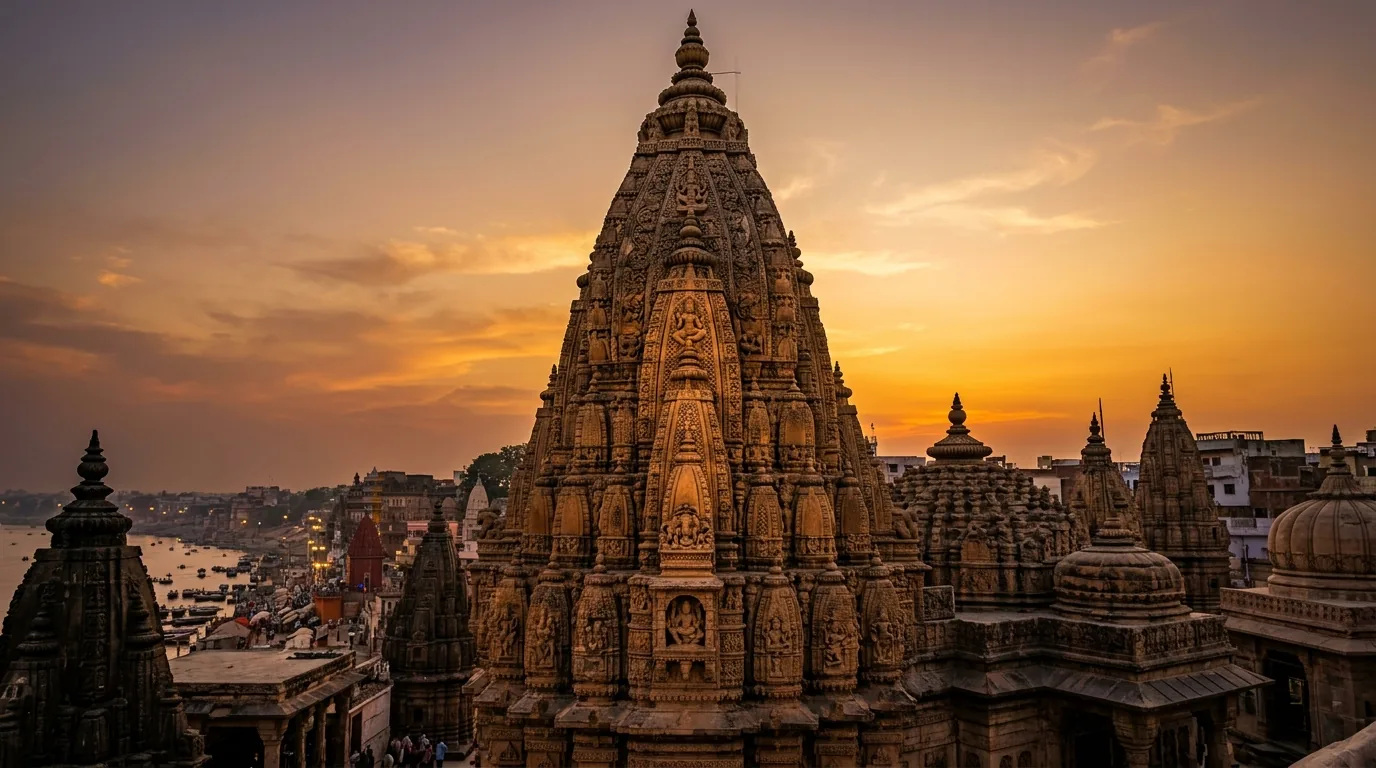
Stepping out of Kashi Vishwanath does not mean leaving Kashi's sacred centre. In the surrounding lanes, a goddess shrine may sit behind a modest doorway, a Ganesha image may attract a steady stream of local worshippers, and a turn towards the river can lead to another temple altogether. The neighbourhood rewards an unhurried walk.
The challenge is deciding what “nearby” means. Annapurna belongs naturally with a Vishwanath visit. Vishalakshi needs a separate lane walk. Kaal Bhairav is an important extension, but it should not be squeezed into the same tiny distance bracket. This guide groups the shrines by practical effort and offers a circuit that leaves room for queues, footwear, rest and getting your bearings.
Choose a compact circuit before adding extensions
Begin with Vishwanath and Annapurna as the core pair. If everyone remains comfortable, continue towards Vishalakshi in the Meer Ghat lanes. A riverfront finish around Lalita Ghat can add Nepali Mandir when access and opening arrangements suit your visit.
The movement times below are broad editorial allowances between areas, excluding worship and queues. They are not measured gate-to-gate distances: the exit permitted from the Dham, crowd barriers and your choice of lane can change the walk.
| Shrine | Area and character | Practical place in the plan |
|---|---|---|
| Maa Annapurna | Close to the Vishwanath precinct | Core addition; keep roughly 10–15 minutes for locating the approach from your exit |
| Dhundhiraj Ganesh | Vishwanath-side sacred lanes | Short optional stop if the current pedestrian route passes it |
| Maa Vishalakshi | Meer Ghat lanes | Allow roughly 15–25 minutes for the lane connection from the Vishwanath area |
| Nepali Mandir | Above Lalita Ghat | Optional riverfront extension with steps; allow about 15–25 minutes from the Meer Ghat area |
| Kaal Bhairav | Visheshwarganj side of the Old City | Separate northern extension with its own travel and queue allowance |
Do not read these allowances as a compulsory order of worship. Families follow different traditions. The circuit is a travel arrangement that can be shortened or reversed according to your priorities and the day's access.
Maa Annapurna: the natural neighbouring visit
Annapurna is revered as the goddess of nourishment. Her close association with Vishwanath gives the visit a devotional connection as well as a geographical one. The district administration identifies her temple as being near Kashi Vishwanath, making it the clearest starting point for a nearby-shrine walk.
Ask specifically for Annapurna Mandir and confirm the approach from your actual temple exit. Being close on a map does not necessarily mean an open passage connects the two entrances. Follow pedestrian directions instead of trying to cross a queue or security-controlled section.
Keep the visit simple. Locate footwear arrangements, carry permitted offerings only if you wish to make them, and ask before joining a special ritual. If a particular festival display, annadanam or prasad arrangement is your reason for coming, verify its date and availability directly. A regular temple visit does not guarantee every special observance.
For families with limited walking stamina, Vishwanath followed by Annapurna is already a worthwhile morning. Have breakfast or a rest afterwards. The quality of a pilgrimage is not measured by how many shrine names fit into a phone itinerary.
Dhundhiraj Ganesh and the smaller sacred lanes
Dhundhiraj Ganesh belongs to the sacred geography around Vishwanath. It is a useful reminder that Kashi's religious life is not confined to large compounds. A small shrine can carry substantial meaning for regular devotees even when it occupies little space in a visitor's photographs.
Treat this as a route-dependent addition. Ask a local priest or an identified guide for the currently accessible approach, and confirm the shrine name rather than assuming that every Ganesha image is Dhundhiraj. Do not accept instructions to enter a restricted section simply because an older map shows a passage.
This is also where visitors can become distracted by repeated offers of puja, flowers and guidance. Decide what you want before agreeing to a service. Ask the amount and what it covers, and keep voluntary donations separate from any charge you have explicitly accepted.
Pause only where there is room. The same lane may carry worshippers, residents, deliveries and people moving towards the main temple. A short prayer should not turn into a group gathering that blocks everyone else's route. If your group wants a longer explanation, step into a suitable open space first.
Maa Vishalakshi: allow time for the Meer Ghat lanes
Vishalakshi is an important goddess shrine near Meer Ghat. The Kashi government portal identifies the temple with Shakti Peetha tradition. Accounts connecting the site with Sati are religious narratives; they explain its sacred status, rather than provide a dated construction record.
From the Vishwanath area, plan a deliberate lane walk. Save the full temple name and locality before setting off. At an uncertain turn, ask for “Vishalakshi Mandir, Meer Ghat” instead of simply asking for a Devi temple. Small lanes and similarly named shrines can make generic directions unhelpful.
Allow time to find the entrance, remove footwear where required and join worship without rushing. Navratri and other goddess observances may change the atmosphere considerably. A quiet-looking approach on an ordinary morning is not evidence that a festival visit will be equally quick.
Afterwards, decide whether to return inland or continue towards the river. If the ghat steps are wet, crowded or difficult for a companion, choose a lane-based return. There is no need to descend to the water to make the Vishalakshi visit complete.
Nepali Mandir and the Lalita Ghat extension
Nepali Mandir, also known as Kathwala, stands by Lalita Ghat and is associated with Pashupateshwar worship. Its distinctive Nepalese form and wooden craftsmanship offer a different architectural experience from the dense inland shrines.
This addition works best when your group wants both a temple visit and time beside the river. It introduces changes in level, so assess the steps before committing. Ask whether the currently open entrance requires a particular stair approach, and confirm any visitor charge and photography rules at the entrance.
From the Meer Ghat side, a riverfront connection may be convenient when the lower ghats are dry and open. If the river is high or a section is restricted, use the upper lanes with local directions. The Dham's nearby river-facing access should not be treated as an unrestricted shortcut through temple security.
For a shorter day, save Nepali Mandir for the Dashashwamedh to Manikarnika walk. Repeating the same riverfront stretch just to complete a checklist can add fatigue without improving the visit. The shrine will make more sense when you have time to appreciate its setting.
Kaal Bhairav and Sankatha are longer additions
Kaal Bhairav is traditionally revered as Kashi's guardian, or kotwal. The temple is in the Visheshwarganj area. Many pilgrims place it early in their devotional sequence, but a travel guide should not present one family's practice as a compulsory rule for everyone.
It is beyond the compact Vishwanath–Annapurna–Vishalakshi circuit. Allow separate time for the approach, queue and return. Depending on your starting point and current traffic controls, a combination of walking and a vehicle may suit your group better than extending the entire outing on foot.
Sankatha Devi, identified by the district administration near the Scindia Ghat area, is another meaningful northern extension. It is a separate shrine from Sankat Mochan Hanuman Temple in south Varanasi. The similar names can cause avoidable transport mistakes, so use the complete name and locality when asking directions.
If you add either northern temple, reduce something else. On a warm day, a break is more valuable than a hurried dash between distant shrines. Our Varanasi temples overview helps separate the Old City cluster from the Assi and BHU circuit, which belongs on another part of the trip.
A workable half-day route and preparation checklist
For a compact morning, complete the main Vishwanath visit first, collect any deposited belongings and take stock of your group. Continue to Annapurna. After a break, choose Vishalakshi if everyone is comfortable. Treat Lalita Ghat and Nepali Mandir as an optional finish rather than a deadline.
As a personal planning budget, keep approximately three to four hours for the combined outing, while recognising that the Vishwanath queue alone can extend the day. With an uncertain main-temple exit time, avoid a prepaid appointment immediately after the circuit. If a booked aarti is the central purpose, structure the other visits around its reporting requirement.
Wear clothes suitable for worship and shoes that can be removed easily. Carry water for the walking portions and check where it may be taken inside. The belongings policy at one shrine does not establish the rule at another; consult the Vishwanath mobile-rules guide for the main temple specifically.
Choose a reunion point that remains outside narrow doorways and queues. Keep small purchases and donations optional, retain any storage token, and ask before photographing worship. A map helps with orientation, but on-site signs and staff determine usable access. If the circuit stops feeling manageable, finish at the next comfortable point. These temples are places to visit attentively, not checkpoints in a race.
BEFORE YOU GO
Frequently asked questions
Which temple is easiest to combine with Kashi Vishwanath?
Maa Annapurna is the most natural nearby addition because it is close to the Vishwanath precinct and closely connected with its devotional setting. Confirm the approach from your actual exit. Nearby buildings do not always have directly connected public entrances, particularly around security controls.
Can I walk from Kashi Vishwanath to Vishalakshi Temple?
Yes, it is a practical Old City lane connection for visitors comfortable walking there. Allow roughly 15–25 minutes as an orientation and movement budget, excluding worship or queues. The actual time depends on your exit, directions, crowd controls and walking pace.
Is Kaal Bhairav part of the short nearby-temple circuit?
It is better treated as a separate northern extension in the Visheshwarganj area. Its religious importance does not make it immediately adjacent to Vishwanath. Add travel and queue time, or visit on another outing if your group wants a compact walk.
Are Sankatha and Sankat Mochan the same temple?
No. Sankatha Devi is associated with the northern Old City near Scindia Ghat. Sankat Mochan is a Hanuman temple in south Varanasi, suited to the Assi-side circuit. Use the full temple name and locality when arranging transport or asking directions.
Can elderly visitors complete this route?
Choose according to the person's comfort with standing, uneven lanes and steps. Vishwanath plus Annapurna may be enough. Vishalakshi and the Lalita Ghat extension add walking and changes in level. Confirm current assistance and access arrangements instead of assuming the full circuit is step-free.
REFERENCE NOTES
Sources and practical updates
These primary sources support the factual background of this guide. For your travel dates, confirm the current arrangements with the responsible venue, property or service provider.
- Varanasi district administration: temple identities and neighbourhood context
- Rana P. B. Singh: Banaras-Kashi divinities list and Dhundhiraj-lane references
- Kashi government portal: Vishalakshi, Meer Ghat location and Shakti Peetha tradition
- Kashi government portal: Nepali Mandir at Lalita Ghat