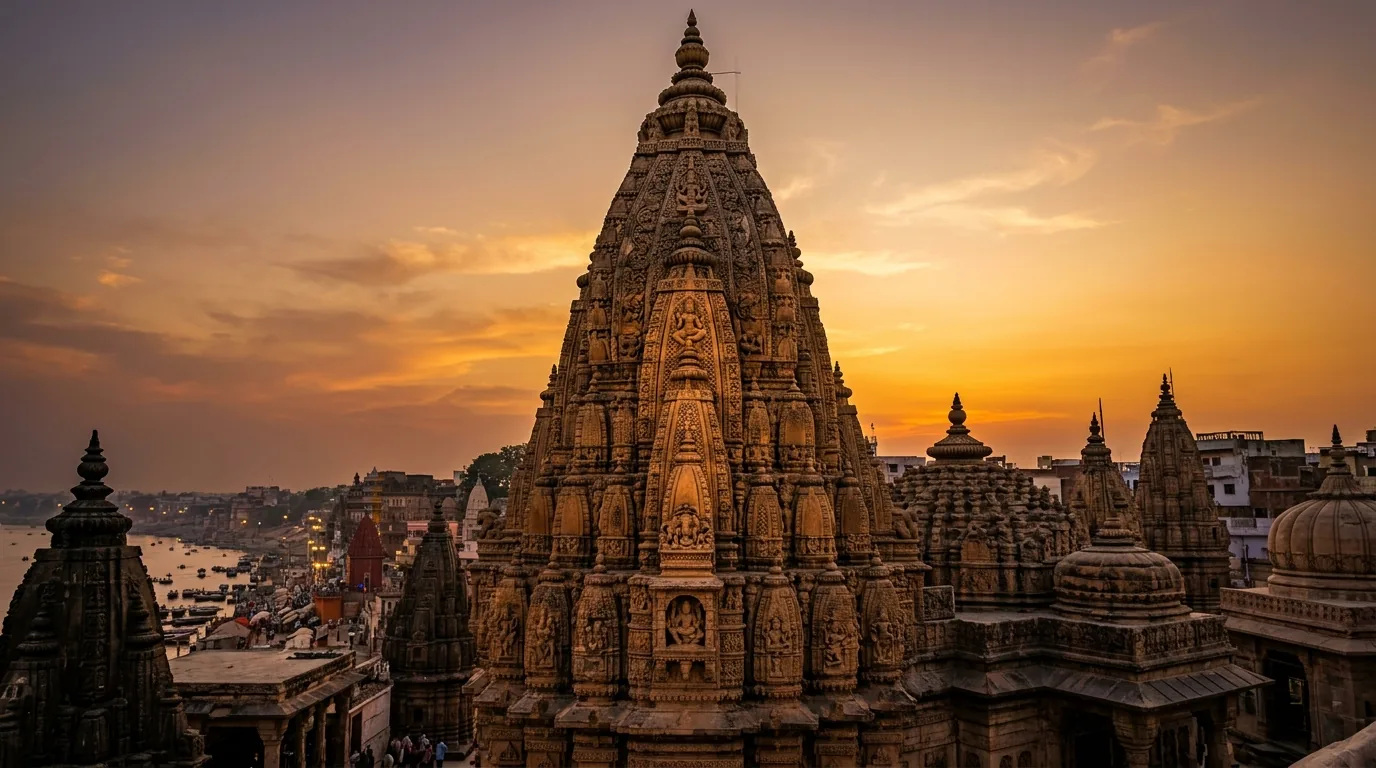
Dashashwamedh is a useful starting point for exploring the temples of central Kashi. The river lies below the steps, the Godowlia approach leads inland, and the lanes towards Vishwanath and Meer Ghat contain shrines that can turn an afternoon into a meaningful pilgrimage walk.
The evening aarti changes how you should plan that walk. A temple that looks only a short distance away can still involve a queue, security, a wrong turn or time spent collecting belongings. This guide helps you choose a small circuit and return to the river with enough time to find a comfortable viewing place.
Understand the three directions from the ghat
From Dashashwamedh, think in three directions. Inland towards Godowlia and the Vishwanath area brings you towards the main Jyotirlinga temple and Annapurna. North along the riverfront and into the Meer Ghat lanes brings Vishalakshi into reach. Continuing towards Lalita Ghat adds Nepali Mandir and the Dham's river-facing setting.
These are walking connections, not a single signed temple trail. Road restrictions, security routes and the usable level of the ghats affect the details. The broad movement allowances below exclude darshan, queues and time spent finding your entrance.
| Temple | Direction and setting | Suggested place in an aarti-day plan |
|---|---|---|
| Kashi Vishwanath | Inland through the Old City | A separate major visit; allow about 20–35 minutes for the approach from the ghat, plus security and queues |
| Maa Annapurna | Near the Vishwanath precinct | Combine with Vishwanath when time permits |
| Maa Vishalakshi | Meer Ghat lanes north of Dashashwamedh | A compact afternoon choice; allow roughly 15–25 minutes for orientation and walking |
| Nepali Mandir | Above Lalita Ghat | A longer riverfront extension involving steps |
| Kaal Bhairav | Further inland and north, around Visheshwarganj | Keep for a separate outing if evening aarti is the fixed priority |
These are editorial planning estimates, not surveyed distances or promised journey times. They deliberately leave room for locating a doorway rather than assuming uninterrupted walking.
Kashi Vishwanath is close, but it is a major commitment
Kashi Vishwanath is the principal Shiva shrine for many visitors to Varanasi. Its proximity to Dashashwamedh makes the combination attractive, but the main temple should be planned as a visit in its own right. Reaching the precinct is only one part of the process.
Choose your service first: general darshan, a confirmed aarti booking or another named offering. Check reporting requirements and the entry route applicable that day. Our darshan guide explains the stages, while the aarti timings page distinguishes temple ceremonies from riverside Ganga Aarti.
Security preparation also affects your return. If you deposit phones or bags, you must collect them before heading to the ghat. A route that looks short between temple and river can become longer when the storage point lies in another direction.
For an evening centred on Dashashwamedh aarti, visit Vishwanath well beforehand or on another day. Avoid a fixed promise such as “darshan at six, front-row aarti at seven.” Queue length and ceremony reporting rules are not controlled by your itinerary, and the temple's Sapta Rishi Aarti occupies an overlapping evening window.
Annapurna: a meaningful companion to Vishwanath
Annapurna is revered as the goddess of nourishment and has a close devotional association with Vishwanath. Her temple is near the main precinct, making it a sensible addition when you have already allowed a substantial block of time for the inland temple area.
Ask for the actual entrance from your current position. Gates, pedestrian controls and nearby shops can make a simple map line misleading. Do not try to reverse through a security route or cross an organised queue to reach a neighbouring shrine.
Special prasad, meal and festival arrangements should be checked directly. They are not automatically included in every temple visit, and a guide should not promise a particular distribution time without current confirmation. If you accept a paid puja service, agree on its scope and amount before it begins.
Annapurna is best considered part of a Vishwanath-area outing rather than a last-minute diversion from your aarti seat. After worship, leave enough time to collect belongings, take a break and walk back. If that margin disappears, choose which experience to keep instead of trying to compress both.
Vishalakshi: a compact shrine visit in the Meer Ghat lanes
Vishalakshi is an important goddess shrine in the Meer Ghat neighbourhood. The government Kashi portal identifies it with Shakti Peetha tradition. Stories linking the place with Sati explain its devotional importance; they should not be mistaken for a documented building chronology.
For visitors already at Dashashwamedh, this can be a more manageable addition than beginning the full Vishwanath process shortly before evening aarti. Walk north along an open riverfront section if conditions permit, then use local directions for the temple entrance in the lanes above.
The route is not necessarily obvious from the lowest steps. Save “Vishalakshi Mandir, Meer Ghat” as your destination and ask again before taking an uncertain lane. If you prefer an inland approach, ask for that specifically rather than descending and climbing simply to follow a map pin.
After darshan, return towards Dashashwamedh while there is still comfortable movement space. During Navratri or other busy observances, allow more time or visit earlier in the day. A short geographical connection does not guarantee a short queue at the shrine itself.
Nepali Mandir and where to stop the northern extension
Nepali Mandir stands near Lalita Ghat and is associated with Pashupateshwar worship. Its Nepalese architectural character and wooden craftsmanship make it a distinctive stop. The approach involves changes in level, so assess the current stairs and entrance before taking older relatives or a pushchair.
This is a good addition when architecture and riverfront exploration are the main purpose of the afternoon. Confirm opening, any visitor charge and photography rules on arrival. Do not assume the shrine shares the access policy or belongings rules of Kashi Vishwanath.
Beyond Lalita, the riverfront leads towards Manikarnika. That is a separate, sensitive walk through an area associated with active cremation. It should not become an impulsive “quick look” before aarti, especially with children or anyone uncomfortable around funerary activity. Read the Dashashwamedh to Manikarnika walk guide before deciding.
Kaal Bhairav is also an extension rather than an immediate riverfront neighbour. It is in the Visheshwarganj area and needs separate travel and queue time. Saving it for another outing keeps this walk coherent and gives the temple the attention it deserves.
Two itineraries that leave room for evening aarti
For a temple-focused day, begin with Vishwanath early enough to absorb delays, continue to Annapurna, then have lunch and rest. Return to the Dashashwamedh area later without another fixed temple booking. This separates the major queue from the period when riverside viewing space becomes harder to find.
For a lighter afternoon, start at Dashashwamedh, visit Vishalakshi, and add Nepali Mandir only if time and energy allow. Return to the main ghat before your chosen arrival buffer begins. If you plan an ordinary evening shore view, roughly 60–90 minutes before the locally confirmed start is a useful personal target; it is not an official admission rule.
Calculate backwards from that return target. For example, if the confirmed ceremony starts at 7:00 PM and you want to settle by 5:45 PM, finish your optional temple visits early enough to walk back and take a toilet break before 5:45. The example does not establish a daily 7:00 PM schedule.
Boat viewing needs its own meeting and boarding time. Agree the boarding ghat before you set off on a temple circuit. A boat booked elsewhere cannot be reached instantly from Dashashwamedh, and the operator's reporting time may require you to finish walking sooner.
Use our how early to reach guide for ordinary-evening and festival planning. On Dev Deepawali or other major crowd dates, build the whole day around the current traffic and access plan.
Steps, belongings, toilets and the return route
Wear secure footwear for the lanes and ghats, with a plan for removing and collecting it at each temple. Keep bags light. Phone rules vary by venue, and a device permitted on public ghat steps may still need to be deposited for a temple visit.
Use a known toilet before settling for aarti. Ask your accommodation, a restaurant you are using or identified staff about currently open facilities. Do not rely on a claim that toilets are available beside every shrine; operating hours, cleanliness and access can differ.
For anyone with limited mobility, choose one temple and assess the approach in advance. Riverfront steps, uneven lanes and crowd barriers can make a physically close destination demanding. A chair at a viewing venue does not prove that its access is step-free, so ask about the whole route.
Agree a reunion point outside the busiest stair and lane junctions. After aarti, follow the released pedestrian flow and meet your driver at the road point that is actually reachable. Godowlia and the ghat are different destinations for vehicle access; your transport plan should account for the final walk in both directions.
When the afternoon runs late, shorten the circuit at the next sensible point. One attentive temple visit followed by a settled evening beside the river is a fuller experience than several rushed doorways and a stressful search for a view after the lamps have begun.
BEFORE YOU GO
Frequently asked questions
Which temples can I visit near Dashashwamedh Ghat?
Vishwanath, Annapurna, Vishalakshi and Nepali Mandir are useful central-area choices, with different approaches and visiting requirements. Vishwanath needs a substantial separate time allowance. Vishalakshi suits a smaller lane walk, while Nepali Mandir adds a northern riverfront extension and steps.
How long is the walk to Kashi Vishwanath?
Allow roughly 20–35 minutes as a broad approach and orientation budget from the ghat area. That excludes storage, security, reporting and darshan queues. Your actual exit point from the steps, permitted temple entrance and current pedestrian controls determine the journey.
Can I do Vishwanath darshan just before Ganga Aarti?
It is possible to combine them in a day, but a late temple start makes the evening uncertain. Visit the temple well beforehand and leave a generous gap for belongings collection, walking and finding a viewing position. Keep one experience flexible if the queue extends.
Is Nepali Mandir on the way to Manikarnika?
It is near Lalita Ghat on the northern riverfront connection from Dashashwamedh. You can visit it without continuing into the cremation area. Check the usable ghat path, steps and opening arrangements, particularly when high water changes the lower-level route.
Do I need tickets for every nearby temple?
Do not assume a common ticket or access policy covers different shrines. Special worship, visitor admission and donations are separate questions. Confirm the rule at each venue and ask what any payment covers before agreeing to it. Public Ganga Aarti viewing is a different arrangement again.
REFERENCE NOTES
Sources and practical updates
These primary sources support the factual background of this guide. For your travel dates, confirm the current arrangements with the responsible venue, property or service provider.
- Kashi government portal: Dashashwamedh setting
- Varanasi district administration: temple identities and neighbourhood context
- Kashi government portal: Vishalakshi, Meer Ghat location and Shakti Peetha tradition
- Kashi government portal: Nepali Mandir at Lalita Ghat
- Ganga Seva Nidhi: evening worship after sunset and the meaning of Ganga Aarti