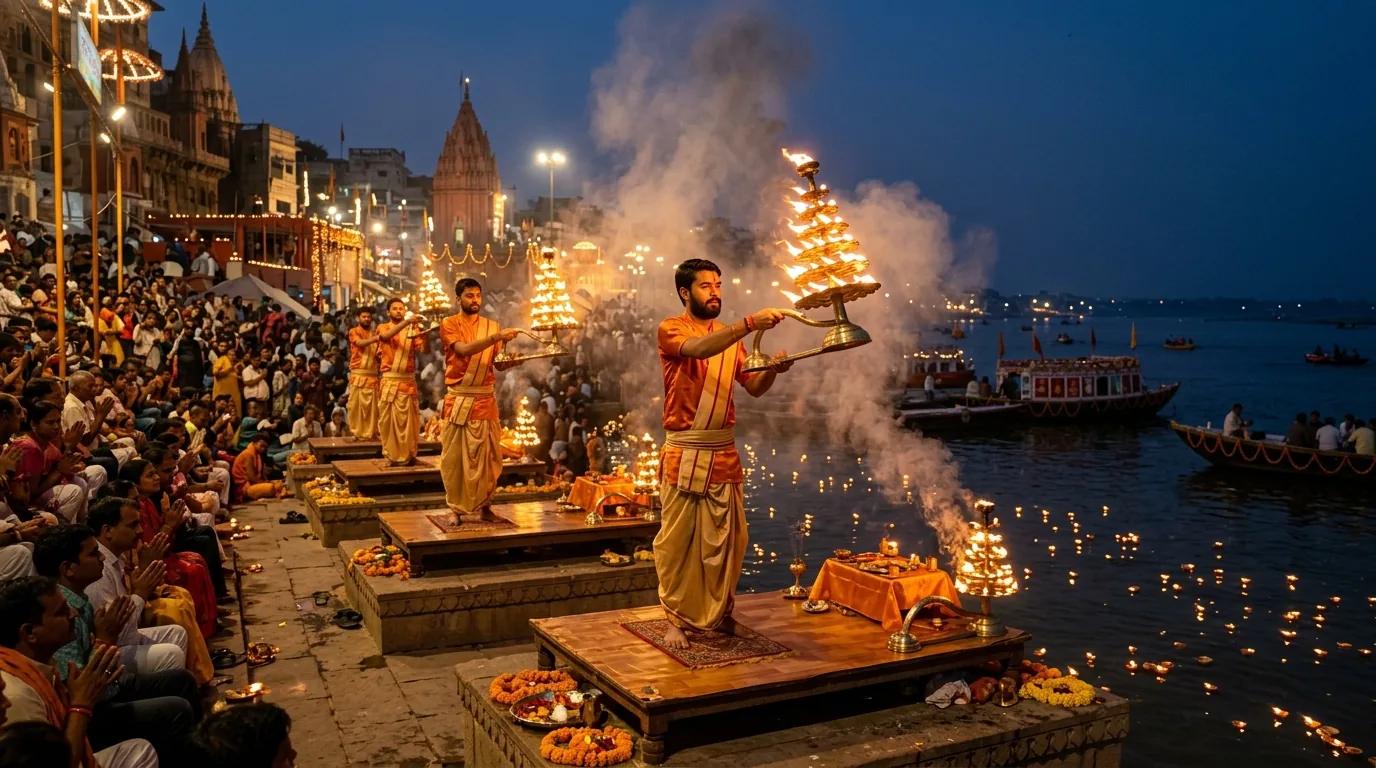
For an ordinary evening at Dashashwamedh, reaching your chosen viewing area about 60–90 minutes before the locally confirmed start is a useful planning target. If a particular position matters, or you need time to settle children or older relatives, allow more. The important word is “viewing area”: arriving at a road junction is not the same as being ready beside the river.
These buffers are editorial recommendations, not official entry deadlines or promises of a seat. Ceremony time, traffic restrictions, river conditions and festival plans can change. This guide shows how to work backwards from the actual start and give each part of the approach its own time.
Confirm which ceremony and which ghat
Varanasi has several aarti settings. Dashashwamedh is a major evening destination. Assi has evening worship as well as the separate dawn Subah-e-Banaras programme. Kashi Vishwanath's temple aartis are different ceremonies with their own booking and reporting requirements.
Before arranging a pickup, confirm the ghat, the part of the day and the same-day start. Evening ceremonies are associated with sunset, so a time remembered from another season is not a reliable fixed appointment. Use the Ganga Aarti timings guide as context, then check locally.
If you have paid for a boat, terrace or chair, ask whether the stated time is the meeting time, boarding time, venue admission time or ceremony start. A message saying “aarti at seven” does not answer when you need to meet the operator.
Write down one clear anchor: “We want to be settled at this viewing place by this time.” All travel, walking, toilets and booking formalities must happen before that. Without an anchor, everyone tends to interpret “reach early” differently.
Suggested arrival buffers for different plans
The following table offers starting points for planning. It does not predict crowd size or reserve space. If the organiser, police or your confirmed operator gives an earlier reporting requirement, use that instead.
| Your plan | Suggested target before the confirmed start | What the buffer is for |
|---|---|---|
| Ordinary evening shore view | About 60–90 minutes at the chosen viewing area | Finding a suitable place and settling without rushing |
| A particular popular position or a slower-moving group | About 90–120 minutes | More choice, breaks and a less hurried approach; still no seat guarantee |
| Boat viewing | Often 60–90 minutes at the agreed meeting point, subject to the operator's instructions | Identification of the boat, boarding and movement to a permitted position |
| Busy weekend or holiday | Consider 90–120 minutes or more | Greater pressure on the final approach and viewing space |
| Major festival, including Dev Deepawali | A provisional 2–3 hours or more, only after checking the event plan | Earlier restrictions and exceptional crowds; ordinary access may change completely |
| Assi dawn programme | About 15–25 minutes before the confirmed opening | Finding the active stage and settling before recitation begins |
Do not transfer the festival row into an ordinary-day rule. Equally, a two-hour festival arrival cannot override a road closure, restricted entry or a boat suspension.
Shore arrival: count the last walk separately
For Dashashwamedh, a cab or auto may stop at a permitted road point rather than beside the river. The remaining approach can involve busy streets, pedestrian barriers and ghat steps. Ask your driver where the ride ends and how long the final walk is likely to take under that day's arrangements.
Add time for finding the correct viewing side. The first crowd you see may be passing through rather than waiting for the ceremony. Look for a position where your group can sit or stand without occupying a stairway, blocking a route or edging too close to the water.
If you have a booked venue, confirm its entrance before joining a public queue. A rooftop or terrace address may lead through a lane rather than from the ghat steps. Ask about stairs, actual seating and how the venue handles late arrivals; “reserved view” does not explain access.
Use the toilet and arrange water before settling. Once the viewing area fills, leaving and rejoining can be difficult. Keep a clear reunion point in case one adult needs to step out. Our Dashashwamedh Ghat guide explains the setting and approach in more detail.
Boat arrival: meeting, boarding and viewing are different stages
A boat plan begins at a named boarding ghat, which may not be Dashashwamedh. Confirm the operator's contact, vessel identification, meeting point and whether the quoted time means “meet here” or “boat departs.” Ask for a clear description rather than relying on a crowded waterside phone call.
Boarding takes time. You may need to negotiate steps, wait for the boat to be positioned and make sure each passenger has a suitable life jacket. Do not shorten these checks because the ceremony is approaching. A rushed boarding is a poor trade for a few extra minutes of viewing.
As a personal objective, you might hope to be aboard and ready roughly 30–45 minutes before the start, but the operator and authorities determine permitted departure and positioning. Treat that as a planning discussion, not an instruction to move against river controls.
Ask where you will return after aarti. Disembarking at a different ghat can affect your hotel transfer and the final walk. Check whether the service is shared or private, the total duration, passenger capacity and cancellation arrangements if boats cannot operate. The boat-viewing guide covers those questions in detail.
Festival crowds require a different day's plan
Dev Deepawali and other major occasions can change the entire approach. Traffic diversions may start well before evening, pedestrian routes may become one-way, and ordinary pickup points may be unavailable. An earlier alarm alone does not solve those changes.
Check current district or police instructions and reconfirm the arrangement with your accommodation and any operator. Ask whether the boarding or venue entrance remains usable, what identification is needed and how the return is being managed. Old event photographs cannot establish this year's access plan.
The provisional two-to-three-hour buffer is only a starting discussion. You may need substantially longer, a different route or a different viewing location. If you cannot verify the arrangement, avoid making an advance payment based only on a promise of “guaranteed VIP entry.”
Families should decide their limit before leaving. Waiting for hours in a dense crowd can be harder than watching the ceremony itself. A less central authorised viewing option, a shorter visit or another evening may be the better choice. Read the Dev Deepawali guide for the event's broader context.
Work backwards: an example evening timetable
Suppose the start is locally confirmed for 7:00 PM and your ordinary-evening shore target is 5:30–5:45 PM. This is an example, not a claim that aarti always begins at seven. Finish any temple visits, shopping and food stops before that target rather than treating them as activities within the waiting buffer.
If your expected road journey takes 30 minutes, the final walk takes 20 minutes and you want 15 minutes for a toilet stop and orientation, those stages already require 65 minutes. Leaving the hotel around 4:15–4:30 PM would fit that particular example, before adding any extra allowance for uncertain traffic.
For a boat, replace the shore target with the confirmed meeting deadline. Then add the walk to the actual boarding ghat, not the walk to Dashashwamedh. For an Assi dawn visit, work backwards from the applicable programme opening and arrange predawn transport the previous evening.
Keep one earlier activity flexible. If Vishwanath darshan is delayed, either shorten the afternoon plan or move the aarti visit. Do not recover lost time by rushing down steps or accepting an overcrowded boat. Planning works best when there is a choice you are willing to drop.
If you arrive late, change the viewing plan
A late arrival does not justify pushing towards the front. Look for an open permitted position further back, follow staff directions and accept a partial view if that is what remains. Never stand on a mooring edge or squeeze into a narrow stairway to improve the angle.
If the area is full or movement is being restricted, choose another authorised location or another evening. Families should keep children beside an adult rather than splitting up to search for space. Agreeing that rule beforehand prevents a small delay from becoming a stressful separation.
After the ceremony, let the first rush ease where you are permitted to wait without blocking circulation. Keep extra return time for busy lanes and a meeting point beyond the restrictions. A nearby train or airport departure should not depend on the crowd dispersing at an exact minute.
The best arrival plan covers the whole evening: a verified start, a realistic approach, a suitable place to wait and a clear way back. Reaching early is valuable because it gives you choices. It should leave you calmer by the river, not merely waiting longer in a place that does not suit your group.
BEFORE YOU GO
Frequently asked questions
How early should I reach Dashashwamedh Ghat for aarti?
For an ordinary evening, aim to be settled at the chosen viewing area roughly 60–90 minutes before the locally confirmed start. Add travel, the final walk and essential stops before that. Earlier arrival improves choice but does not guarantee a seat or unrestricted access.
Is arriving 30 minutes before aarti enough?
It may leave you with limited choice on a busy evening, particularly if you still need to walk from the road or find a venue. If late, accept an open permitted position rather than pushing forward. Families and slower-moving groups benefit from a larger margin.
When should I reach for a boat booking?
Use the operator's confirmed reporting instruction at the exact boarding ghat. A provisional meeting allowance is often 60–90 minutes before the ceremony, but departure and positioning depend on current permissions. Leave time to identify the vessel, board carefully and check suitable life jackets.
How early should I arrive on Dev Deepawali?
Discuss a provisional two-to-three-hour buffer or more only after checking current event instructions. Traffic, pedestrian access and boating can change significantly. A standard arrival estimate cannot guarantee entry or replace the district, police, organiser or confirmed operator's requirements for that date.
Should I use the same buffer for Assi morning aarti?
No. For the dawn Subah-e-Banaras programme, about 15–25 minutes before the confirmed opening is a useful settling allowance. Add predawn travel separately. Check the seasonal programme and actual stage location; the timing of Dashashwamedh's evening ceremony does not apply.
REFERENCE NOTES
Sources and practical updates
These primary sources support the factual background of this guide. For your travel dates, confirm the current arrangements with the responsible venue, property or service provider.
- Ganga Seva Nidhi: evening worship after sunset and the meaning of Ganga Aarti
- Gangotri Seva Samiti: public viewing, separately registered pujan and ceremony duration
- Subah-e-Banaras organisers: programme elements and seasonal reference windows
- Kashi government portal: Dashashwamedh setting