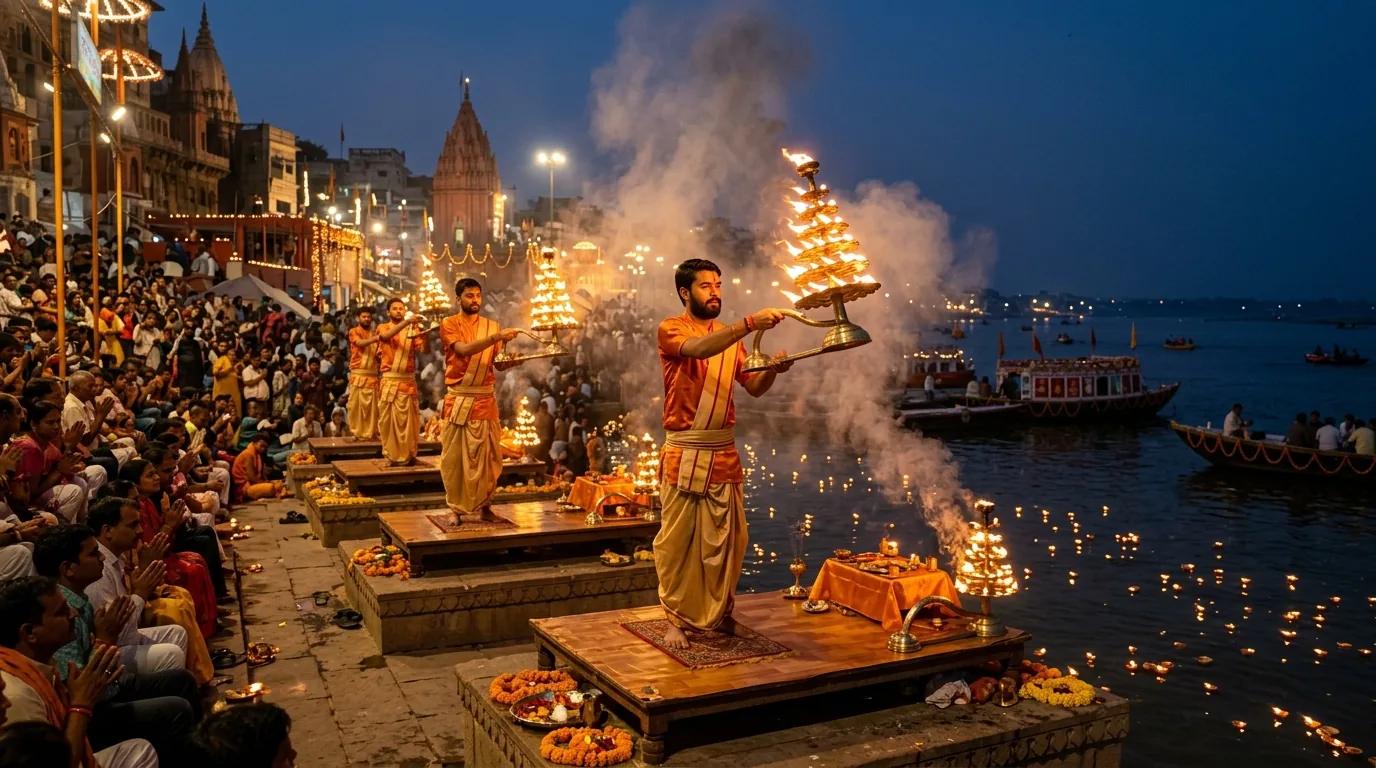
Children often remember the lamps, conch shells and boats long after a Varanasi trip. They may also remember the waiting, the noise and being unable to see past a row of adults. A good family aarti visit starts by planning for both sides of that experience.
Choose a view your children can manage, arrange the toilet and return journey before sitting down, and keep permission to leave early. Watching part of the ceremony comfortably can be more meaningful than insisting on the entire evening when a child is tired or distressed. This guide focuses on practical choices for families, rather than promising a crowd-free ghat or a universally suitable age.
Choose the ceremony around your child's routine
Dashashwamedh is a major evening aarti setting, with a strong visual impact and a busy approach. It can work well for families who prepare for the crowd and waiting time. It is less forgiving when the plan depends on a late arrival, an improvised view and a tired child staying awake beyond their normal bedtime.
Assi offers a different option, particularly the dawn Subah-e-Banaras programme. Its sequence includes worship, music and yoga, so you can choose the part that interests the family. An early start is useful only if your children can sleep enough beforehand; a late evening followed by a predawn alarm can undo that advantage.
Ask what matters most: seeing large lamps, being near the river, hearing the music or introducing children to a religious practice. A family interested mainly in the atmosphere may not need the most central position or the longest possible visit.
Explain the plan in simple language before leaving. “We will walk, find a place, wait, watch and then return” is easier to understand than a list of temple and ghat names. Tell children that the lamps are part of worship and that the ritual platform is not somewhere to play.
Compare shore, reserved seating and boat viewing
Each option has a different practical limitation. A paid arrangement may improve one part of the evening while leaving stairs, toilets or the return walk unresolved.
| Viewing choice | Family advantage | Check before choosing |
|---|---|---|
| Public ghat steps | Flexibility to choose an open position without booking a private service | Crowd density, uneven seating, water-edge distance and a clear way out |
| A less central shore position | More freedom to stand back or leave early where space permits | Whether the ceremony is still visible and the area remains open |
| A confirmed chair or terrace | A defined sitting place if the service is accurately described | Entrance stairs, actual sightline, toilet availability, child policy and total price |
| A boat | A river-facing view without standing in the shore crowd | Suitable life jackets, boarding steps, capacity, toilet limitations and return ghat |
| Assi dawn programme | A different time and a programme that can suit a shorter visit | Sleep, predawn transport, seasonal start and the active stage location |
For toddlers, the ability to step away may be more useful than a close view. For older children who enjoy boats, discuss the entire boarding and return process before deciding, rather than choosing only from attractive photographs.
Choose a position with a manageable exit
At the ghat, look for a place away from the immediate water edge and outside the main walking line. Check how you would leave if a child needed the toilet or became uncomfortable. A view that requires pushing through several dense rows to exit may not suit your family.
Keep young children beside an adult. Do not let them explore the steps, boats or gaps between seated groups alone. Avoid standing a child on an unstable chair, wall or narrow ledge to see over the crowd. If the view is poor, change the plan rather than making the position precarious.
For larger families, allocate responsibility clearly. One adult should know which child they are supervising; everyone assuming someone else is watching creates confusion. If one adult takes a child out, tell the others before moving and use a specific reunion point.
A pushchair can be awkward on stairs and in packed lanes. Check the exact approach and where it can remain without blocking movement. A carrier is a personal choice, but it also needs to suit the child's size and the adult's comfort. Neither option makes the whole riverfront step-free.
Boats: check the child's equipment before boarding
Ask the operator in advance for life jackets suitable for each child's size, and inspect them before boarding. An adult jacket that hangs loosely is not a practical substitute. NDRF boating-safety guidance emphasises having sound life jackets and knowing how to secure them, including for children.
Agree the passenger number, boat type, departure point and return point. Do not board an overcrowded vessel or accept the claim that equipment will be provided later once you are on the water. If a suitable jacket is unavailable, choose a shore plan.
Board only when the boat is properly positioned and assistance is available as needed. Keep children seated as directed, away from the edge, and supervised throughout. Do not assume being on a boat removes the need for crowd awareness: boarding and disembarking can be busy moments too.
Ask whether there is a toilet. Many small viewing boats have none, so a child's urgent need may not be easily resolved during the service. Confirm what happens if the child becomes distressed and whether the boat can return early; a shared service may not be able to change its itinerary for one family.
River permissions and weather can change the plan. Do not treat a boat as an automatic fallback when the shore is crowded. Read our boat aarti guide before paying.
Toilets, food, water and the waiting period
Make a toilet stop before entering the busiest viewing section. Ask your accommodation or a known establishment about an open facility on the approach, and use it while there is still time. This guide does not promise a clean, open or accessible toilet immediately beside every viewing place.
If booking a terrace, ask whether toilets are actually available to your group, how many stairs are involved and whether you can reach them during the ceremony. “Facilities nearby” is too vague when a small child may need help quickly. Ask about changing space separately if travelling with a baby.
Offer a meal or substantial snack at a time that suits the child before the long wait. Carry manageable drinking water and any usual essentials in a small bag. Keep wrappers and other waste with you until you find an appropriate bin; the river and steps are not disposal points.
Waiting may be longer than the part of the ceremony children most enjoy. Bring a quiet activity that does not disturb worship or occupy extra space. For sound-sensitive children, consider their usual hearing protection and choose a position away from loudspeakers. If smoke or noise makes them uncomfortable, move away rather than expecting them to tolerate it for the itinerary.
Arrival buffers and festival decisions
For an ordinary Dashashwamedh evening, a target of about 60–90 minutes before the confirmed start gives time to settle, but it also creates a long period of waiting for a young child. A slower-moving family may want more approach time while keeping the seated waiting period manageable. Think through both rather than assuming earlier is always easier.
Add the journey from the hotel, final walking time and toilet stop before the viewing target. If a venue or boat operator has a reporting requirement, follow that specific instruction. Our arrival guide explains the calculation.
During Dev Deepawali and other major crowd dates, check current police and event arrangements before committing. A normal-day family plan may be unsuitable when access restrictions and waiting increase. Ask whether a booked service remains reachable and how the return will work.
There is no need to make a child's first aarti visit the busiest evening of the year. Another date, a less central permitted position or the Assi dawn programme can preserve the experience while reducing the demands on the family. Keep a fallback that does not depend on buying a last-minute “VIP” promise in the crowd.
Agree the return plan before the lamps begin
Save your accommodation address and your driver's number before leaving. Choose a named meeting point at a road that will remain reachable under the current restrictions. “Outside the ghat” is not specific enough when thousands of people are leaving at once.
Explain a separation plan to older children: stop in a clear place, approach identified police or event staff and use the contact information you have given them. For younger children, carry an adult's contact details discreetly on their person. Take a current family photograph for your own reference before entering a busy area, without publishing personal details.
After aarti, follow the pedestrian flow and avoid rushing down or across steps. Where permitted and comfortable, let the first surge pass before moving. Keep children beside an adult until you reach the actual vehicle, not merely until you leave the main viewing area.
If a child becomes overwhelmed, finish early. One adult can leave with them while the rest follow the agreed plan, provided everyone knows what is happening. Avoid adding shopping, another temple queue or a long ghat walk just because the adults still have energy.
Back at the accommodation, leave room for food, washing and sleep. The successful family visit is the one children can enjoy and remember with curiosity. A partial view, a few questions about the ritual and a calm return can achieve that without completing every item on an adult itinerary.
BEFORE YOU GO
Frequently asked questions
Is Ganga Aarti suitable for young children?
It can be, depending on the child's response to crowds, noise, smoke and waiting. Choose a position with an easy permitted exit and keep the visit flexible. There is no single age at which every child will enjoy the same ceremony or viewing arrangement.
Is a boat safer or easier than the ghat with kids?
A boat avoids standing in the shore crowd but adds boarding, water-edge and return constraints. Check suitable life jackets, passenger capacity and toilets before choosing it. If those arrangements do not suit your child, a manageable shore position is a better practical option.
Are toilets available beside the aarti viewing area?
Do not rely on immediate access. Confirm an open facility on your approach and use it before settling. For a terrace or private venue, ask specifically about toilet access, stairs and changing space. Many small boats do not have a toilet, so check before paying.
Can we bring a pushchair to Dashashwamedh?
Check the exact approach first. Ghat stairs, uneven surfaces and crowded lanes can make a pushchair difficult to use or store. It must not block circulation. A booked seat or nearby road does not establish a continuous step-free route to the viewing position.
What if my child wants to leave before aarti ends?
Use the exit and reunion plan agreed beforehand. Tell the other adults, keep the child with a responsible adult and follow the permitted pedestrian route. Leaving early is reasonable; do not stay solely to finish the ceremony when the child is distressed or exhausted.
REFERENCE NOTES
Sources and practical updates
These primary sources support the factual background of this guide. For your travel dates, confirm the current arrangements with the responsible venue, property or service provider.
- Ministry of Tourism, Incredible India: Dashashwamedh and Assi visitor context
- Subah-e-Banaras organisers: programme elements and seasonal reference windows
- Gangotri Seva Samiti: public viewing, separately registered pujan and ceremony duration
- NDRF Aquatic Disaster Response training guidance: life-jacket checks and secure fitting, including children