Discover what makes Ganga Aarti on Dev Deepawali extraordinary, why Kashi celebrates this sacred night, and how to experience the festival in 2026.
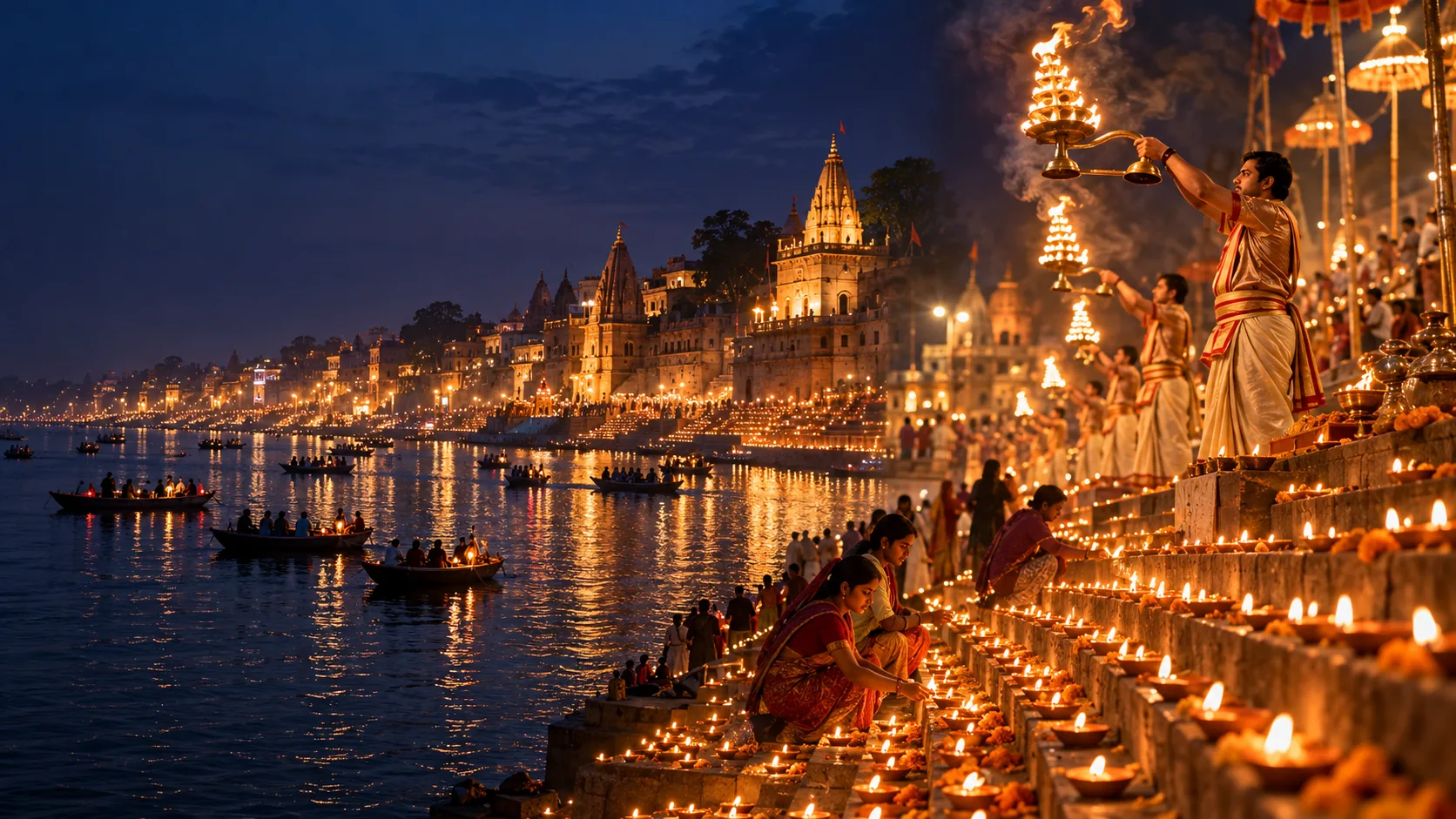
Imagine standing beside the Ganga as the last traces of daylight disappear behind the ancient buildings of Varanasi.
Hundreds of small earthen lamps are being placed along the stone steps. Some form long golden lines; others surround shrines and platforms. Families carefully shield their flames from the breeze while volunteers prepare the ghats for an extraordinary evening.
Across the river, the darkening sky makes the illuminated waterfront appear even more beautiful.
Then the conch shells sound.
Priests raise blazing brass lamps towards Maa Ganga, devotional chants fill the air, and the flickering lights of countless diyas seem to stretch endlessly along the river.
This is Ganga Aarti during Dev Deepawali in Varanasi, a celebration that brings together the city's spiritual heritage, sacred rituals, and remarkable tradition of offering light.
While the evening Ganga Aarti takes place throughout the year, Dev Deepawali transforms the entire riverfront into a celebration of faith.
For pilgrims, it is an auspicious occasion for prayer and deepdaan. For travellers, it offers an unforgettable opportunity to witness the living traditions of Kashi.
Ganga Aarti During Dev Deepawali 2026: Essential Information
| Detail | Information |
|---|---|
| Festival | Dev Deepawali (Dev Diwali) |
| Date in 2026 | Tuesday, 24 November |
| Hindu occasion | Kartik Purnima |
| Main ceremonial area | Dashashwamedh and adjoining ghats |
| Festival setting | Illuminated ghats along the Ganga |
| Deepdaan Muhurat | 5:08 PM–7:47 PM IST |
| Ganga Aarti timing | To be confirmed by organisers |
| Public ghat viewing | Free, subject to access restrictions |
| Recommended arrival | Well before sunset |
What Is Dev Deepawali and Why Is It Celebrated in Varanasi?
Dev Deepawali literally means the Diwali of the Gods.
Celebrated on Kartik Purnima, approximately fifteen days after the main Diwali festival, it holds special importance in the spiritual traditions of Varanasi.
According to Hindu belief, the gods descend to Earth on this auspicious occasion to bathe in the sacred waters of the Ganga.
Another tradition associates the festival with Lord Shiva's victory over the demon Tripurasura. This connection gives Kartik Purnima the name Tripurari Purnima, honouring Shiva as the destroyer of Tripurasura.
The lighting of lamps symbolises the triumph of divine light over darkness and the joy of this sacred occasion.
In Varanasi, the celebration extends beyond homes and temples.
The ghats themselves become places of collective worship, where residents, pilgrims, and volunteers light vast numbers of earthen lamps.
It is this relationship between the river, the city, and its people that makes Dev Deepawali so distinctive.
How Is Ganga Aarti Different on Dev Deepawali?
On an ordinary evening, the Ganga Aarti at Dashashwamedh Ghat attracts devotees and visitors who gather to witness the offering of light to Maa Ganga.
During Dev Deepawali, the ceremony becomes part of a much larger riverside celebration.
The difference is noticeable long before the Aarti begins.
The Entire Riverfront Becomes Illuminated
On regular evenings, attention centres on the ritual platforms and their brass lamps.
On Dev Deepawali, rows of clay diyas decorate the steps of numerous ghats, creating an illuminated panorama across Varanasi's historic waterfront.
The lamps are placed in patterns and lines, sometimes surrounding temples, shrines, and other prominent features.
As darkness settles, their reflections shimmer on the Ganga.
The Atmosphere Becomes More Festive
Dev Deepawali brings a particularly large gathering of devotees, pilgrims, residents, photographers, and travellers.
Religious observances may be accompanied by cultural programmes, music, and other officially organised activities.
The result is a celebration that extends beyond the duration of the main Aarti.
The Spiritual Significance Is Especially Strong
For many pilgrims, Kartik Purnima is an important day for sacred bathing, prayer, charity, and the offering of lamps.
The evening Ganga Aarti takes place within this wider atmosphere of devotion.
What makes the night remarkable is not simply a larger ceremony, but the way thousands of individual acts of worship come together along the river.
The Sacred Ganga Aarti Ceremony on Dev Deepawali
At Dashashwamedh Ghat, the evening ceremony is known for its coordinated offerings by priests standing on raised platforms.
The exact programme may be adapted for the festival by the organising committee.
The ritual generally includes the blowing of conch shells, devotional chanting, offerings of incense, and the raising of multi-tiered brass lamps.
Each movement has symbolic meaning.
The offering of incense represents reverence, while the flames are offered as an expression of devotion towards Maa Ganga.
Ceremonial fans and other traditional ritual objects may also form part of the worship.
The most memorable sight comes when the priests lift the illuminated lamps against the dark sky.
On Dev Deepawali, the surrounding rows of diyas create a luminous backdrop.
Yet it is important to remember that the Ganga Aarti is not merely a visual performance.
For devotees, it is an act of prayer and gratitude to a river worshipped as a divine mother.
If you would like to understand the regular ceremony in greater detail, read our Dashashwamedh Ghat Ganga Aarti guide.
Deepdaan: The Heart of Dev Deepawali Celebrations
One of the most meaningful traditions associated with Dev Deepawali is Deepdaan, the offering of lamps.
A small earthen diya may seem insignificant when seen alone.
But when countless people light them together along the Ganga, the riverfront becomes an extraordinary expression of collective devotion.
Some lamps are placed around shrines or along the steps, while floating offerings may also form part of local religious practices where permitted.
For many worshippers, lighting a diya is a way of offering prayers, expressing gratitude, or remembering loved ones.
Visitors should respect the religious significance of the practice.
If you wish to participate, ask locally about designated areas and environmentally responsible materials.
Avoid releasing plastic, foil, or other non-biodegradable objects into the river.
A beautiful tradition should not come at the expense of the Ganga's health.
Best Ghats to Experience Ganga Aarti During Dev Deepawali
The best location depends on whether you want to concentrate on the main ritual or appreciate the larger illuminated riverfront.
Dashashwamedh Ghat: For the Main Ganga Aarti Experience
Dashashwamedh is the first choice for visitors who want to witness the grand ceremonial atmosphere.
Its central location and religious importance make it one of the busiest areas during Dev Deepawali.
Arrive well before sunset and follow the local arrangements for viewing and movement.
Do not expect to move freely between different viewing positions once the crowd becomes dense.
Rajendra Prasad Ghat: For the Adjoining Ceremonial Area
Located next to Dashashwamedh, Rajendra Prasad Ghat forms part of the same busy central riverfront.
It is worth considering when evaluating available viewing positions, but it should not be assumed to be less crowded.
Check the current layout of platforms, barricades, and public access routes before settling down.
Assi Ghat: For a Wider Festival Atmosphere
Assi Ghat offers another opportunity to experience the lighting of lamps and the riverside celebration.
It has a different character from the central Dashashwamedh area, although it too can become crowded on Dev Deepawali.
Visitors staying in southern Varanasi may find it a practical option.
Other Illuminated Ghats
The riverfront's greatest attraction on Dev Deepawali is its collective illumination.
Areas such as Kedar Ghat, Chet Singh Ghat, Panchganga Ghat, and Raj Ghat contribute to the wider festival setting.
Specific cultural performances, lighting installations, and public access arrangements change from year to year.
For a detailed comparison of viewing locations, see our Best Place to Watch Ganga Aarti in Varanasi guide.
Can You Watch Dev Deepawali Ganga Aarti from a Boat?
A view from the river can reveal the full sweep of illuminated ghats in a way that is difficult to appreciate from a single point on land.
Historically, boat journeys have been a popular way to experience Dev Deepawali.
However, a boat booking must never be treated as proof that evening navigation is officially permitted.
On 9 October 2026, local authorities allowed large motorboats to operate between 6 AM and 5 PM, while restrictions on manually operated boats continued.
Special festival boat experiences are being advertised for November 2026, and a newly reported Uttar Pradesh tourism itinerary also includes a proposed river-viewing experience.
Nevertheless, passengers should confirm whether the administration has issued specific authorisation for evening festival operations.
Before making any payment, verify the operator, boarding location, permitted operating hours, life jackets, passenger capacity, and cancellation terms.
For families with small children or visitors with limited mobility, land-based viewing may be more practical than boarding a crowded vessel.
How to Plan Your Dev Deepawali Evening in Varanasi
A successful festival visit depends as much on planning as it does on choosing the right viewpoint.
Before Sunset: Reach Your Chosen Area
Try to reach the part of the riverfront you intend to visit well before dusk.
During major festivals, vehicles may be stopped some distance from the ghats, while pedestrian access can be managed through designated routes.
Confirm your drop-off point and walking route in advance.
Around Dusk: Experience the Lighting of Diyas
The transition from daylight to darkness is one of the most rewarding parts of Dev Deepawali.
Instead of arriving only for the main Aarti, allow time to observe the preparation and lighting of lamps.
Watch how a series of individual flames gradually transforms the steps into a continuous golden pattern.
Evening: Attend the Ganga Aarti
Remain at your selected, permitted viewing position once the main gathering begins.
Do not push towards the ritual platforms or cross barricades in search of photographs.
Follow instructions from volunteers and security personnel.
After the Aarti: Leave Without Rushing
Festival crowds can make the return journey slower than expected.
Use designated exits, avoid narrow bottlenecks, and make sure your group remains together.
If authorities permit you to stay in a safe viewing area while the immediate crowd disperses, doing so may make your departure easier.
Practical Tips for a Safe and Memorable Visit
Dev Deepawali attracts much larger crowds than an ordinary evening Aarti, so preparation is essential.
- Book your accommodation early, especially if you want to stay near the ghats.
- Carry minimal luggage, a charged phone, and essential identification.
- Agree on a meeting point before entering crowded areas.
- Consider the needs of senior citizens, children, and visitors with limited mobility.
- Keep drinking water available and wear comfortable walking shoes.
- Avoid unofficial VIP passes and unverified boat bookings.
- Follow police instructions and stay away from restricted or overcrowded sections.
- Do not use drones, fireworks, or open flames outside permitted arrangements.
Public ghat viewing is generally free, subject to crowd-control restrictions. Private terraces or separately arranged experiences may involve charges.
A paid reservation does not guarantee unrestricted access to the riverfront.
Photography During Dev Deepawali: Capturing Kashi Respectfully
For photographers, Dev Deepawali offers remarkable opportunities.
The most interesting photographs are not always close-ups of the Aarti lamps.
A wide composition showing the illuminated steps, historic buildings, and reflections on the Ganga can tell a much richer story.
The period around dusk is particularly useful because some colour remains in the sky while the diyas begin to glow.
Photographing people lighting lamps can also reveal the human side of the festival.
Avoid obstructing devotees or using intrusive flash during prayers.
Most importantly, remember to experience the celebration without looking through a camera every moment.
Frequently Asked Questions
1. When is Dev Deepawali in Varanasi in 2026?
Dev Deepawali falls on Tuesday, 24 November 2026, on Kartik Purnima.
2. What time does Ganga Aarti start on Dev Deepawali?
The exact special Aarti schedule is determined by the organisers. The 2026 Pradosh Deepdaan Muhurat is 5:08–7:47 PM, but this should not be mistaken for the confirmed Aarti timing.
3. Which ghat is best for Dev Deepawali Ganga Aarti?
Dashashwamedh Ghat is the main choice for visitors focused on the grand ceremony. Other ghats can offer views of the wider illumination and festival activities.
4. Is there an entry fee for Dev Deepawali?
Public viewing from accessible ghat areas is generally free. Optional private experiences and authorised boat services may have separate charges.
5. Is Dev Deepawali different from regular Diwali?
Yes. Diwali is celebrated on Amavasya in the month of Kartik, while Dev Deepawali is observed on Kartik Purnima, roughly fifteen days later.
6. Can visitors participate in Deepdaan?
Visitors may participate respectfully where permitted. Use designated areas and environmentally responsible offerings, and follow local instructions.
7. Should I visit Varanasi only for Dev Deepawali?
The festival is a wonderful reason to travel, but spending an additional day or two allows you to explore temples, ghats, local traditions, and the regular Evening Ganga Aarti in Varanasi.
Final Thoughts: When the Ghats of Kashi Become an Offering of Light
Dev Deepawali is often remembered for its extraordinary photographs: endless rows of lamps, illuminated temples, and golden reflections on the Ganga.
But its deeper meaning lies in the people who bring those lights to life.
A family placing a diya on the steps. A pilgrim standing in prayer. A priest raising the Aarti lamp towards Maa Ganga.
Each is part of a tradition that makes the celebration more than a festival of decoration.
If you visit Varanasi during Dev Deepawali, take time to understand the meaning behind the lights.
Watch the sacred ceremony with respect, appreciate the collective effort that transforms the riverfront, and leave the ghats as clean as you found them.
For one extraordinary evening, the ghats of Kashi become a vast offering of light—and the Ganga flows through its heart.