Sarnath is a place where a large part of the story survives close to ground level. The Dhamek Stupa commands attention, but the brick foundations around it, the remains of a pillar and the sculptures in the museum reveal how much more once stood here. Give those quieter details time, and the visit becomes more than a photograph beside a famous monument.
This page explains the principal sights and their historical and religious context. For the practical shape of a half-day visit, use the separate Sarnath travel guide. Transport is covered in Varanasi to Sarnath. Keeping those questions separate makes it easier to understand what you are seeing once you arrive.
Why Sarnath matters in Buddhist tradition and history
Sarnath, also known in Buddhist tradition as Isipatana or the Deer Park, is associated with the Buddha's first teaching after enlightenment at Bodh Gaya. The event is remembered as the turning of the wheel of Dhamma and is central to the site's pilgrimage significance.
That sacred association should be distinguished from the dates of the surviving buildings. Sarnath developed over many centuries through royal, monastic and other patronage. Ashokan remains belong to the third century BCE, while later structures and sculpture reflect subsequent periods, including the Gupta age.
Archaeology reveals a sequence rather than one complete preserved city. Buildings were enlarged, replaced and lost; excavation recovered fragments that now help interpret the site. Do not assume every exposed brick belongs to the same date or that a modern temple marks an unchanged ancient structure.
The most rewarding way to look is to connect three things: the sacred event remembered here, the material evidence of the community that developed around it and the continuing worship of present-day pilgrims. They overlap, but each tells a different part of Sarnath's story.
Dhamek Stupa: begin with its scale, then look closer
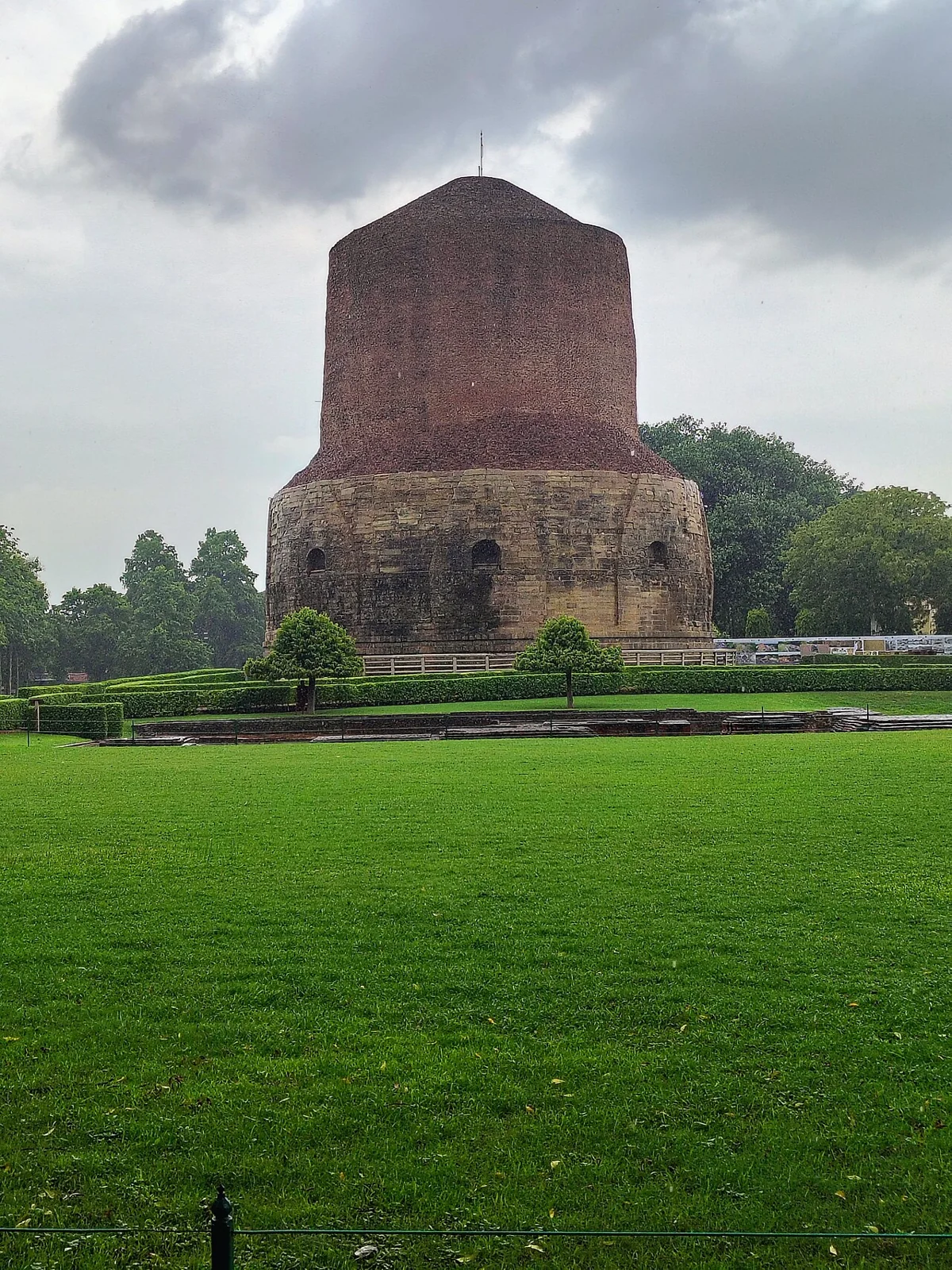
The Dhamek, also spelled Dhamekh, is the large cylindrical stupa that dominates the archaeological enclosure. Its mass of brick and decorated lower stonework make it the most recognisable monument at Sarnath. It is associated with the first-sermon sacred landscape, but the visible structure represents later building phases rather than a single untouched construction from the Buddha's lifetime.
Walk around it only on the permitted paths. The difference between the brick upper surface and the stonework below is worth noticing, as are the carved geometric and floral patterns. Those details reward a slower circuit instead of a quick photograph from the entrance side.
A stupa is not a viewing tower or a building visitors climb to enter a rooftop. Respect the protective boundaries and do not stand on historic masonry for a picture. The monument's scale can be appreciated without touching or ascending it.
You may see pilgrims praying or walking reverently nearby. Give them room, keep conversation low and ask before taking a close portrait. The archaeological setting and the living pilgrimage use coexist; neither needs to be pushed aside for the other.
Dharmarajika, the Ashokan pillar and the excavated remains
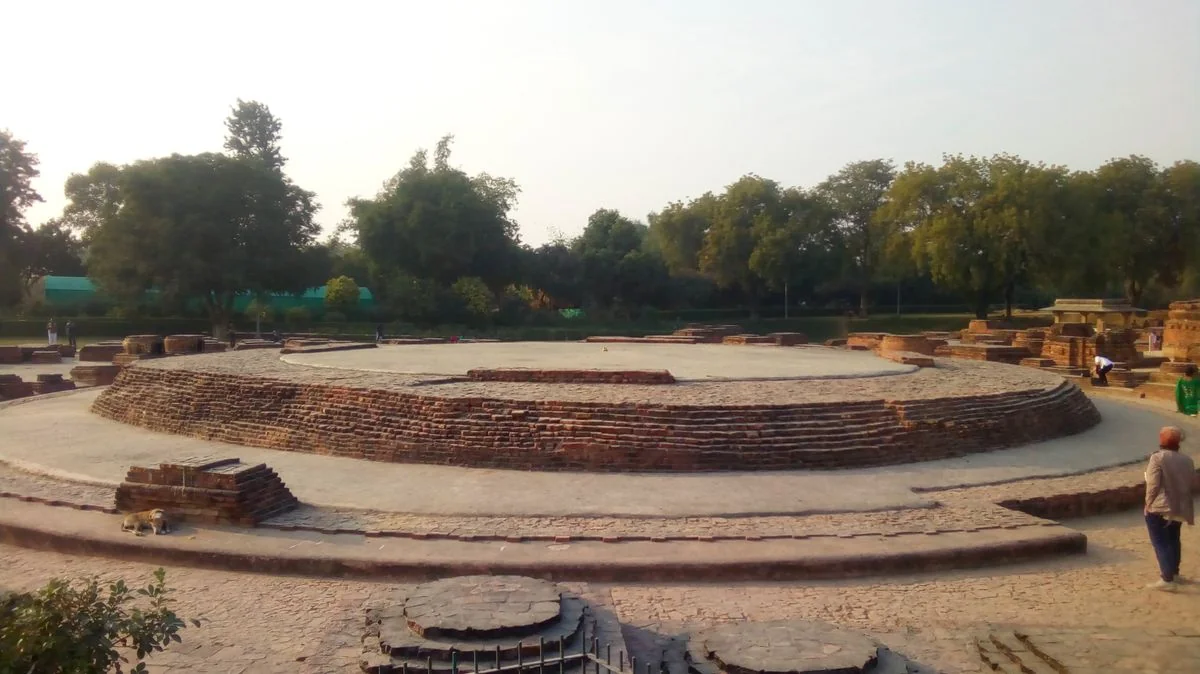
Beyond the dominant stupa, the lower remains help explain Sarnath as a larger religious establishment. The Dharmarajika survives as a much reduced circular structure, while monastery and shrine foundations show the organisation of spaces once used for residence, teaching and worship.
Use the site labels rather than identifying every circular foundation from memory. A low stupa base and the tall Dhamek are different structures. Photographs on this page are captioned accordingly; a general view of brick remains should not be mistaken for an image of the standing cylindrical monument.
The Ashokan pillar remains connect the enclosure with the museum. The celebrated Lion Capital is displayed indoors, rather than standing intact on top of the excavated shaft. Seeing the site first and the sculpture afterwards can make that relationship particularly clear.
An archaeological plan helps you imagine the whole without pretending every missing wall can be reconstructed with certainty. Ask a guide which features are identified through inscriptions, excavation or later interpretation. A good explanation will distinguish evidence from a memorable story and will leave uncertain details uncertain.
The museum: look beyond the national emblem
The Archaeological Museum contains objects recovered from Sarnath and is an essential complement to the outdoor site. Its best-known object is the Lion Capital of Ashoka, the ancient sculpture on which India's national emblem is based. Seeing the original gives a familiar symbol a physical scale and workmanship that a printed emblem cannot convey.
Look at the capital as sculpture as well as a national image. The lions, the abacus and the associated decorative forms belong to a particular historical object. Do not confuse the museum piece with a modern replica or assume the entire original pillar is standing in the gallery.
The museum also holds important Buddhist sculpture, including the seated Buddha associated with the teaching gesture. Notice how posture, hands and the treatment of the robe communicate meaning. You do not need specialist vocabulary to observe the difference between the forceful animal forms of the capital and the composed human figure of later Buddhist art.
Allow time for a few works rather than trying to read every label hurriedly. The museum's published visiting reference is 9:00 AM–5:00 PM, closed on Fridays, with a ₹5 entry reference. Confirm current admission, last-entry and belongings rules before travelling. Ask staff about photography; permission outdoors does not establish permission inside a gallery.
Chaukhandi: a separate monument with visible historical layers
Chaukhandi Stupa is a separate stop from the main archaeological enclosure. Buddhist tradition associates this area with the Buddha's meeting with his first companions. The monument's terraced brick form and the octagonal tower above it make its layered history visible even before you read a sign.
The tower is a later addition, associated with a sixteenth-century commemoration of Humayun's visit. It should not be described as part of a structure erected in the Buddha's lifetime. The contrast is one of the monument's most interesting features: different periods left their marks on the same remembered place.
Treat Chaukhandi as a stop with its own entrance, walking and admission questions. It may fit conveniently into your road journey, but that does not make it part of the same ticket or gate as every other Sarnath attraction.
If your time is limited, decide whether to visit rather than asking a driver to stop for an unclear “quick photo.” A proper short visit allows you to understand the terraced base and tower from the permitted route. Remain off the masonry and follow staff instructions about any area under conservation.
Mulagandhakuti Vihara and Sarnath's continuing religious life
The modern Mulagandhakuti Vihara is associated with the Maha Bodhi Society's work in reviving Buddhist pilgrimage at Sarnath. The Society records its opening on 11 November 1931. That date makes an important distinction: this is a modern active temple within an ancient sacred landscape.
It should not be confused with ancient remains bearing a related name in the archaeological site. When a guide says “Mulagandhakuti,” ask whether they mean the excavated structure or the modern temple. The answer changes what kind of building, evidence and visitor experience is being discussed.
At the active temple, follow the footwear and photography instructions and allow worshippers space. A place that looks quiet may still be in use for prayer. Ask before entering a room, joining a group or taking a close portrait of a monk.
Sarnath also contains temples and institutions associated with different Buddhist communities. Choose one additional visit if it interests you rather than treating them as interchangeable stops. Their separate custodians set their own opening and visitor arrangements. The historical Deer Park association is a sacred-geographical idea; it should not be reduced to whether you add a modern animal-park visit to the day.
Visiting information and what to prioritise
The museum and the outdoor archaeological enclosure are separate visitor components. Keep the museum's Friday closure in mind, and confirm the current ticket categories through the responsible counter or official channel. The ASI Sarnath Circle's visitor page publishes reference monument rates differentiated by visitor category and payment method, alongside the museum ticket; do not assume one payment covers every nearby site.
| Attraction | What it adds | Visiting consideration |
|---|---|---|
| Dhamek and the archaeological enclosure | Monument scale, carved stonework and the larger monastic landscape | Published outdoor reference is sunrise to sunset; verify last entry and current restrictions |
| Archaeological Museum | Lion Capital and sculpture that give the site material context | Published 9:00 AM–5:00 PM reference, closed Friday; confirm current arrangements |
| Chaukhandi Stupa | A separate monument with early sacred association and later tower | Check its entrance and ticket independently |
| Modern Mulagandhakuti Vihara | Living worship and twentieth-century Buddhist revival | Follow the institution's opening, footwear and photography rules |
| One additional temple | A particular community's religious and architectural tradition | Choose deliberately and confirm visitor access |
For a first visit, the archaeological enclosure and museum make the strongest pair. Add the modern vihara when you want to connect the excavated past with present worship. Chaukhandi deserves its own decision rather than being assumed to fit into the remaining ten minutes.
Protect the setting as you go. Do not scratch masonry, climb foundations or move a fragment for a photograph. Carry waste out to an appropriate bin, follow the paths and ask before using professional equipment. Sarnath is both a protected archaeological place and a pilgrimage destination; attentive visiting respects both identities.
Photograph sources and licences
Hero photograph: SpeakingArch / Wikimedia Commons; CC BY-SA 4.0. Source: https://commons.wikimedia.org/?curid=193706199. Licence: https://creativecommons.org/licenses/by-sa/4.0. Resized and converted to WebP; no generative editing.
Article photograph: Hardy Explorer / Wikimedia Commons; CC0. Source: https://commons.wikimedia.org/?curid=170144740. Licence: http://creativecommons.org/publicdomain/zero/1.0/deed.en. Resized and converted to WebP; no generative editing.
BEFORE YOU GO
Frequently asked questions
What is Sarnath famous for?
It is associated in Buddhist tradition with the Buddha's first teaching after enlightenment and the beginning of the early community of disciples. The visit also includes archaeological remains, the Dhamek Stupa and a museum holding the Lion Capital and important Buddhist sculpture.
Is the Lion Capital still on the pillar outside?
The original capital is displayed in the Archaeological Museum. Pillar remains are associated with the outdoor archaeological site. Visit both to understand the relationship, and distinguish the ancient sculpture from modern reproductions of India's national emblem.
Is Sarnath Museum open on Friday?
Its published visitor information lists Friday as the weekly closure, with a 9:00 AM–5:00 PM reference on open days. Confirm current notices and last admission before travelling. A museum closure does not automatically mean all outdoor monuments and active temples are closed.
Are Chaukhandi and Dhamek the same stupa?
No. Dhamek is the large cylindrical monument in the main archaeological enclosure. Chaukhandi is a separate site with a terraced brick form and a later octagonal tower. Plan its approach and admission separately rather than assuming the names refer to one attraction.
Is the present Mulagandhakuti Vihara ancient?
The modern active temple was opened in 1931, according to the Maha Bodhi Society. It belongs to the revival of Buddhist pilgrimage at an ancient sacred place. Distinguish it from the archaeological remains and from the much earlier event remembered in Buddhist tradition.
REFERENCE NOTES
Sources and practical updates
These primary sources support the factual background of this guide. For your travel dates, confirm the current arrangements with the responsible venue, property or service provider.
- Varanasi district administration: Sarnath location and Buddhist sacred association
- ASI Sarnath Circle: site brochure, map and monument context
- Ministry of Tourism, Incredible India: Dhamek Stupa
- ASI Sarnath Circle object record: third-century-BCE Lion Capital
- Sarnath Museum visitor page: published hours and Friday closure; reconfirm current notices
- Museum of India directory: Sarnath Museum, displays and visiting reference
- Maha Bodhi Society of India: Sarnath centre and the 1931 vihara opening
- UNESCO/ICOMOS 2026 nomination evaluation: historical layers at Sarnath and Chaukhandi; not cited as a World Heritage inscription decision