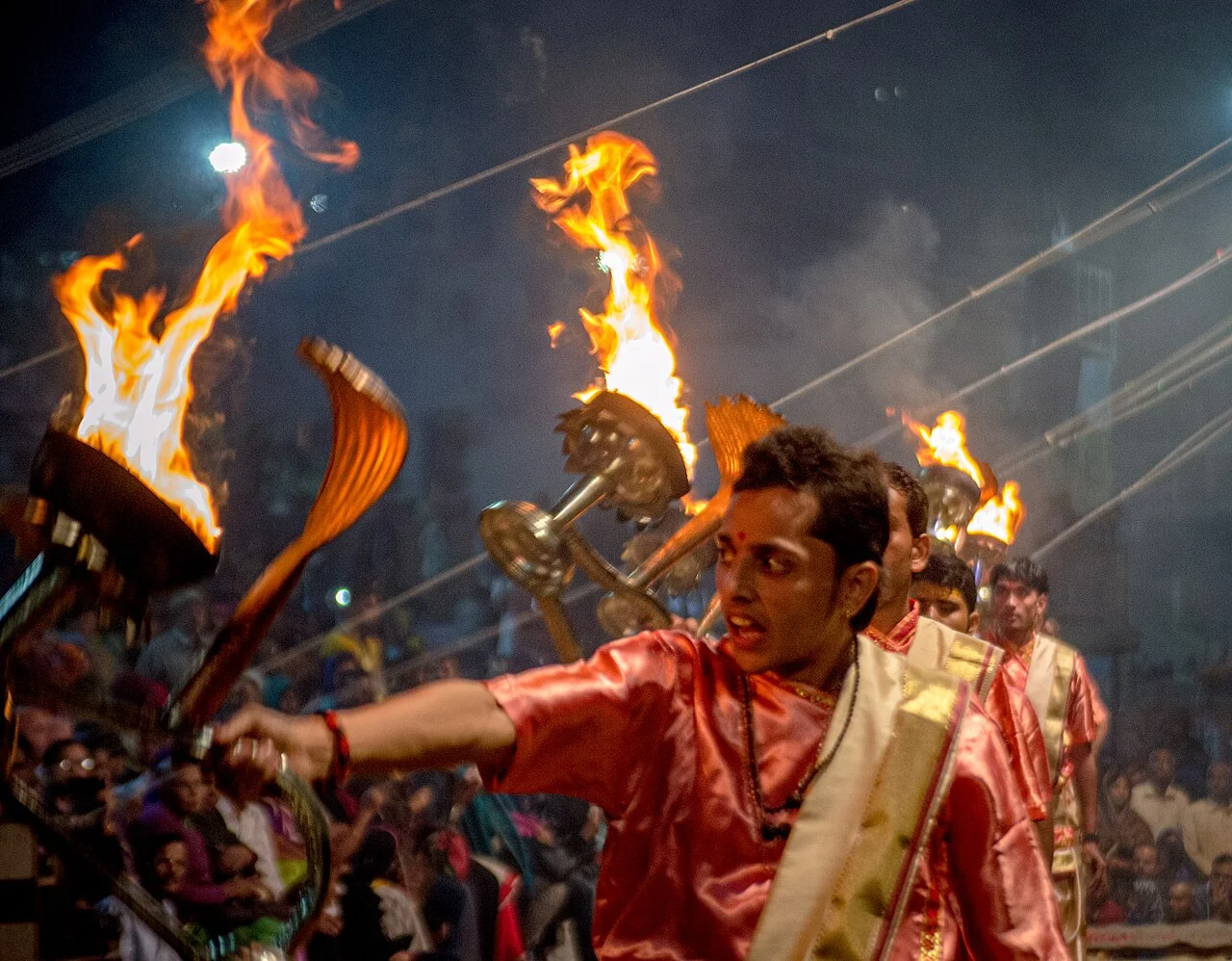
The brightest object at Ganga Aarti is often the hardest to photograph. A lamp moves through dark air, smoke crosses a face, and a crowd shifts just as you press the shutter. The answer is usually a better position and a simpler intention, rather than more equipment.
Decide whether you want a wide record of the gathering, a study of the lamps or a few pictures to remember your visit. Then choose a permitted place where you can remain without obstructing worship. This guide offers practical starting points for phones and cameras; it does not treat photography as a reason to enter a ritual platform, disturb a participant or keep moving through a seated audience.
Choose your position before choosing settings
A shore position gives you firm footing and the possibility of a closer view, but people may stand between you and the platforms. A boat provides a different angle and introduces movement beneath the camera. A terrace may offer a wider perspective, with stairs, railings or other viewers affecting the frame.
There is no universally best angle. Look for a clear line of sight from a stable permitted position, and consider whether you can leave without disrupting others. Arrive early enough to assess that choice in daylight rather than discovering an obstructed view after the lamps begin.
| Position | Useful photographs | Main limitation |
|---|---|---|
| Public shore, back from the main walkway | Ceremony and audience in one frame | Heads and raised phones may interrupt the view |
| A permitted side position | The line of priests and repeated lamp movements | Some ritual elements may be hidden by the angle |
| A boat | Platforms against the riverfront and reflected light | Boat movement makes long exposures difficult |
| A confirmed terrace | A broad scene showing the gathering's scale | Distance, railings, access stairs and venue conditions |
| Assi at dawn | Worship with gradually changing ambient light | The opening still occurs in low light; programme timing differs |
Use the ghat comparison guide to choose the location, then settle on the particular view. Changing ghats during the ceremony is unlikely to improve either your pictures or your experience.
Make a small photographic plan
Three kinds of image can tell the story without recording every moment: a wide view of the setting, a medium composition of the ritual and a detail of light or an offering where photography is permitted. That is enough variety for a personal album or a considered travel feature.
Take the establishing frame before the ceremony if the position is available. The remaining daylight can reveal the relationship between river, platforms and people more clearly than a photograph made after everything beyond the lamps has turned dark.
During worship, watch for repetition. Priests often repeat movements, giving you another opportunity without needing to rush or interrupt. Frame loosely enough to allow the lamp to move, and wait for a moment when smoke does not cover the subject completely.
Keep a few periods camera-free. Seeing the sequence helps you anticipate a photograph better than staring continuously at a screen. It also leaves space to understand the ceremony as worship, rather than reducing it to a series of technically difficult exposures.
Phone photography: protect the highlights and keep steady
Clean the lens before the ceremony. Smears from handling can create distracting streaks around flames and lights. Use the phone's main camera where practical; heavy digital zoom can make distant low-light details look soft without bringing you a genuinely closer view.
Tap the subject to focus and, if your phone allows it, lower exposure slightly when the flames become a featureless white patch. The aim is to preserve some detail in the light, not make the entire riverfront look as bright as midday. Check one frame, adjust and return your attention to the scene.
Night mode can work for a relatively still wide scene, but moving hands and lamps may blur or merge during its longer capture. Try a normal photo when movement is the subject. Brace your elbows against your body rather than leaning into another person or resting equipment on a ritual structure.
For video, choose short steady sequences instead of recording the whole ceremony with the phone held above your head. Keep the screen's brightness modest, turn off flash and avoid commentary during prayers. A clear thirty-second clip from a considerate position is often more useful than a long unstable recording that blocks someone's view.
Camera settings: start with movement, then balance the exposure
There is no single correct aarti setting. Lamp brightness, lens aperture, distance and camera performance differ. The following are editorial starting points to test from your own position, not exposure instructions guaranteed to work throughout the ceremony.
For moving hands or lamps, try a shutter around 1/160 to 1/320 second, then review sharpness. Use a wide aperture if your lens offers it, while remembering that a very shallow depth of field may leave part of a line of priests out of focus. Auto ISO can help as the light changes; an initial range around ISO 1600–6400 may be worth testing, depending on the camera.
If the shutter is too slow, a stabilised lens may reduce your hand movement but cannot stop the subject's motion. Conversely, raising ISO may introduce visible noise, yet a slightly noisy sharp image can be more useful than a clean blurred one. Manufacturer guidance explains the underlying balance between shutter duration, aperture and ISO; your test frames determine the appropriate compromise here.
Use a short burst selectively when a movement reaches its peak. Avoid continuous firing through the entire ritual. RAW capture, if available and familiar to you, can offer more flexibility for later tonal adjustments, but it cannot recover every clipped flame or correct an obstructed view.
Smoke, boats, tripods and changing light
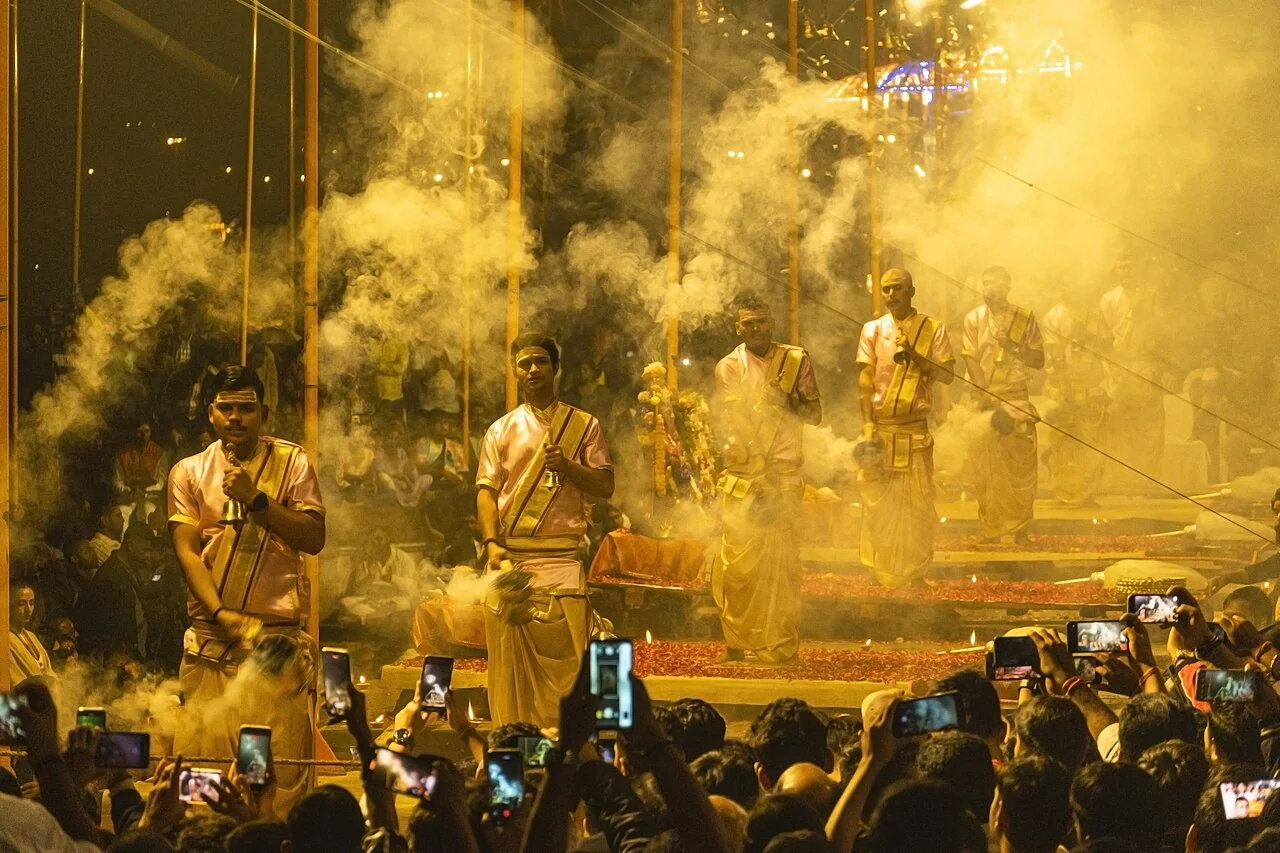
Smoke is part of the visual setting, not a fault you must remove from every frame. Backlit smoke can reveal the atmosphere of worship, while a completely obscured face may simply call for patience. Do not move into a priest's space to escape it.
From a boat, favour shutter speeds that account for both subject and vessel movement. Avoid leaning over the side or standing abruptly for an angle. Keep your equipment secured and follow the operator's seating instructions. A camera bag should not occupy space needed by another passenger or interfere with a life jacket.
A tripod may suit a quiet landscape, but a busy aarti approach is often unsuitable for spread legs. Obtain any necessary permission and use one only where it is allowed without blocking movement. A monopod, gimbal or selfie stick can also obstruct people; smaller equipment does not automatically make it appropriate.
The light will change. A setting that worked during preparation may fail once a bright lamp enters the frame. Review briefly at a sensible interval, make one adjustment and continue. Repeatedly checking every image can distract you from the next moment and from your footing on the steps.
Permissions, portraits and boundaries
General ceremony photography, a close portrait and a commercial production are different activities. Follow the organiser's and venue's instructions. A paid seat or boat ride does not itself grant rights to stage photographs, fly a drone or make a commercial shoot.
Ask before making close portraits of worshippers, workers or children. A person visible in a public gathering is not automatically comfortable becoming the main subject of your image. Avoid isolating someone praying or grieving simply because the light is striking.
Do not use flash towards priests or worshippers. Keep ritual platforms and access routes clear, and lower the camera immediately if asked. When a ceremony is in progress, a clear view for a person who came to worship deserves consideration alongside your photograph.
Never photograph bodies, pyres, mourners or funeral processions at Manikarnika or Harishchandra. Apply the same boundary from boats, rooftops and distant viewpoints. An aarti photography outing should not become a cremation photography excursion, and payment to an intermediary does not make an intrusive image appropriate.
Pack lightly, edit honestly and leave with the crowd in mind
Bring one practical camera setup rather than a collection that requires repeated lens changes in a crowded place. Check batteries and storage before leaving, keep straps secure and arrange a compact rain cover when appropriate. Do not place a bag on a stair where someone may trip over it.
If you also plan to enter Kashi Vishwanath, organise that visit separately. Public ghat camera use does not establish the temple's electronics policy. The mobile-rules guide explains why storage and collection may affect your schedule.
After the ceremony, let the departure plan take priority over reviewing pictures. Step into a suitable clear area before looking down at the screen. Keep your group together and meet the driver at the agreed reachable road point. Our arrival and return guide helps with that wider evening plan.
When editing, retain the character of the scene. Adjusting exposure or white balance is different from adding lamps, removing people to imply an empty ceremony or presenting a composite as a documentary photograph. Caption the actual ghat when you know it, and avoid claiming that an old image proves today's crowd or access conditions.
The real photographs accompanying this guide are credited archive images, selected for their subjects rather than claimed as photographs taken by our writer. That same honesty improves travel photography generally: show what you observed, identify what you know and leave the ceremony's meaning larger than the frame.
Photograph sources and licences
Hero photograph: Philip Nalangan / Wikimedia Commons; CC BY-SA 4.0. Source: https://commons.wikimedia.org/?curid=185193105. Licence: https://creativecommons.org/licenses/by-sa/4.0. Resized and converted to WebP; no generative editing.
Article photograph: Vimalinarc / Wikimedia Commons; CC BY-SA 4.0. Source: https://commons.wikimedia.org/?curid=145136685. Licence: https://creativecommons.org/licenses/by-sa/4.0. Resized and converted to WebP; no generative editing.
BEFORE YOU GO
Frequently asked questions
Can I photograph Ganga Aarti with a phone?
Often, from a permitted public viewing position and subject to current instructions. Turn off flash, avoid blocking views and ask before close portraits. Use the main camera, steady your hands and test normal capture against night mode when the lamps and priests are moving.
What camera settings should I start with?
For movement, test roughly 1/160–1/320 second, a suitable wide aperture and ISO adjusted for the available light. These are starting points, not universal settings. Review sharpness and flame detail from your position, then change one variable rather than following a fixed recipe.
Is a tripod allowed during aarti?
Check with the organiser or venue. Even where equipment is permitted, tripod legs must not block stairs, walking routes or seated worshippers. A crowded ghat is often unsuitable. Do not assume a paid seat, private terrace or boat booking includes permission to use support equipment.
Is a boat better for photography?
It offers a different perspective but adds motion, distance and boarding constraints. Long exposures are difficult from a moving vessel. Choose a suitable service, remain seated as directed and check life jackets; the desire for a photograph should not determine unsafe movement on the boat.
Can I photograph cremations while on a ghat tour?
Do not photograph bodies, pyres, mourners, funeral processions or cremation work. Keep that boundary from boats and distant viewpoints too. A general riverfront photography visit or a payment to someone nearby does not remove the privacy of families carrying out funeral rites.
REFERENCE NOTES
Sources and practical updates
These primary sources support the factual background of this guide. For your travel dates, confirm the current arrangements with the responsible venue, property or service provider.
- Nikon: exposure, aperture and shutter duration in low light
- Nikon: Auto ISO and the relationship between exposure variables
- Ganga Seva Nidhi: prayer with light, gratitude to the Ganga and evening worship
- Kashi government portal: aarti locations and the distinction between traditional worship and modern organisation