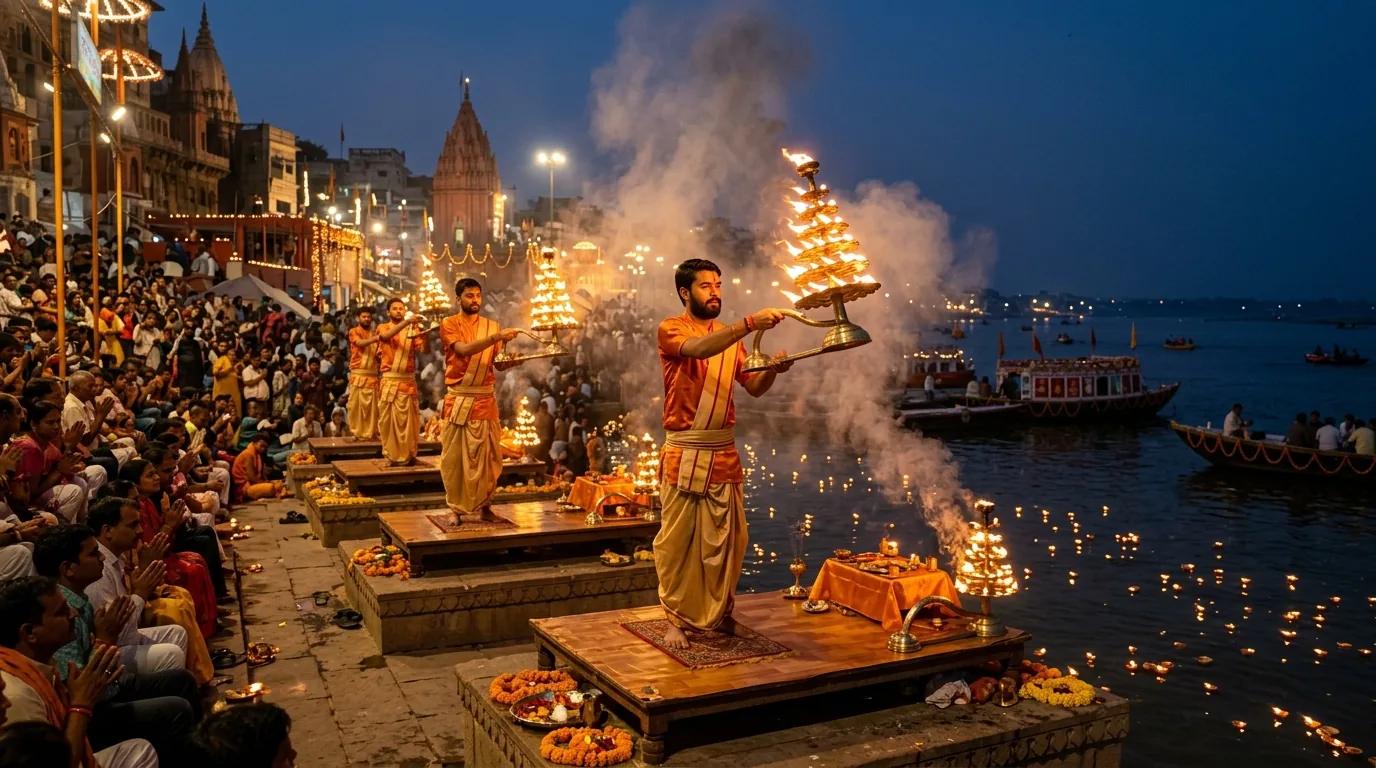
Your first Ganga Aarti may begin with uncertainty rather than a perfect photograph. Which platform should you face? Is the river the focus of worship? Do you need a ticket, and are visitors expected to join the prayers? A little preparation makes it easier to set those questions aside and pay attention.
Visitors can observe respectfully without knowing Sanskrit or following Hindu practice. The ceremony remains an act of worship for the people conducting and attending it. Approach it with the same consideration you would bring to a religious service at home, while planning for the particular realities of Varanasi: busy lanes, stone steps, changing light and a large crowd leaving together.
What the ceremony means and what you will see
Aarti is an offering of light in worship. At the riverfront, the Ganga is honoured as a goddess and a source of sustenance. Ganga Seva Nidhi describes its evening aarti as prayer with light and gratitude to Mother Ganga. That is a more useful starting point than thinking of the ceremony simply as a performance for cameras.
You may hear bells, conch shells, chanting and devotional music while priests make coordinated offerings with incense and lamps. The particular sequence and presentation vary between organisers and locations. You do not need to identify every gesture to follow the movement from preparation and invocation to the larger lamp offerings.
Religious beliefs about the river's purifying or liberating power should be understood as beliefs held by devotees. Observing the ceremony does not require you to adopt those beliefs, bathe in the river or make an offering. Quiet attention is a respectful form of participation.
Modern organised evening ceremonies should also be distinguished from the much older tradition of reverence for the Ganga. Avoid descriptions claiming that every detail of today's staged arrangement has continued unchanged for thousands of years. The setting carries ancient sacred associations, while the present organisation has its own more recent history.
Choose Dashashwamedh, Assi or a boat view
Dashashwamedh is a major central evening destination. Assi offers evening worship and the separate dawn Subah-e-Banaras programme. A boat changes the viewing angle, but it is a transport and viewing service rather than a requirement for attending worship.
| Option | What it offers | Practical question to resolve |
|---|---|---|
| Dashashwamedh public shore | The central evening gathering and a close sense of the crowd | Can you manage the approach, waiting and return walk? |
| A less central permitted shore position | A broader view with possible room to step back | Is the ceremony visible without blocking movement? |
| A booked terrace or chair | A specific private viewing arrangement when accurately described | What are the stairs, sightline, facilities and total charge? |
| Boat viewing | A view from the river | Where do you board, are suitable life jackets provided, and where do you return? |
| Assi dawn programme | Morning worship within a programme of recitation, music and yoga | Does the early start fit your sleep and transport plans? |
There is no single best choice for every visitor. Choose according to mobility, interest and comfort with crowds. Our viewing-place guide compares the broader experience.
Timings, duration and when to arrive
Confirm the specific ghat and same-day start through the organiser or a reliable current local contact. Ganga Seva Nidhi describes its evening ceremony as taking place after sunset. A time quoted for another season or another organisation should not become your fixed appointment.
As a broad evening budget, allow roughly 45–60 minutes for the ceremony itself, with additional time before and after. Gangotri Seva Samiti publishes that duration for its ceremony; other arrangements may differ. A tour's advertised length may also include a boat ride, walking or a separate puja.
For an ordinary evening shore view at Dashashwamedh, aiming to be settled about 60–90 minutes before the confirmed start is a useful editorial recommendation. This is not a reserved-entry rule. Add the road journey, final walk and a toilet stop before that target.
Boat and terrace bookings may have their own reporting time. Ask what the time means before paying. Festivals, particularly Dev Deepawali, require a fresh check of traffic, pedestrian and river arrangements. The arrival guide explains how to build a timetable rather than relying on a single generic hour.
Tickets, donations and paid services
Ordinary public viewing is different from buying a service. Gangotri Seva Samiti describes its Dashashwamedh ceremony as public, with free seating, and separates that from registration for a personal Ganga Pujan. That does not make every private terrace, chair arrangement, guided tour or boat free.
Before accepting a payment request, ask what it covers. Is it a boat ride, a guide, a reserved place at a named property, a puja or a voluntary donation? “VIP aarti” is not a sufficiently precise description. Request the operator's name, meeting point, inclusions, final price and cancellation terms in writing.
Foreign nationality alone is not a reason to assume you need a special public-aarti pass. If someone claims a compulsory charge, ask the responsible organiser or identified staff to explain it. A nearby temple or attraction may have separate admission rules, so do not transfer the public-viewing arrangement to every venue in the neighbourhood.
Donations are a personal choice. If you wish to contribute, use a clearly identified organiser or donation point and ask for a receipt where available. You can decline an unsolicited service politely without accepting a ritual first and arguing about the amount afterwards.
Etiquette: clothing, shoes, photography and participation
Wear modest, comfortable clothes suitable for a religious gathering and sitting on steps. Secure footwear helps on the approach. Follow signs or instructions about removing shoes at a ritual platform or shrine; do not assume every public ghat step has the same rule as a temple interior.
Observe where people are moving before choosing a place. Keep stairways and access routes clear, avoid the priests' working space and do not climb onto a platform for a better picture. During prayers, lower your voice and silence disruptive phone sounds.
General ceremony photographs may be possible where permitted, but use restraint. Avoid flash near worshippers, do not block someone's view with a raised phone for the entire ceremony, and ask before making a close portrait. If staff ask you to stop, put the camera away. Drone use should never be assumed to be permitted.
If invited to receive a blessing or take part in a rite, watch the instructions and ask quietly if unsure. Participation is optional. You need not repeat words you do not understand, purchase offerings or enter the river to be a respectful guest.
Keep cremation photography entirely separate from ordinary aarti photography. Do not film bodies, pyres, mourners or funeral processions at Manikarnika or Harishchandra, including from a boat. A riverside tour should respect that boundary even if an operator suggests otherwise.
Transport, boat checks and communication
For Dashashwamedh, ask your driver where the vehicle can actually stop. The final approach may be on foot through a pedestrian area. Save your accommodation address and a map offline, and carry the name in a form a local driver can recognise. A written address is useful if your phone loses power.
Agree the return pickup separately. After the ceremony, traffic restrictions and the departing crowd may make the outward stopping point unsuitable. Choose a named reachable place and confirm whether the driver is waiting or whether you are arranging a fresh ride.
For a boat, check the passenger number, vessel identification, boarding assistance and life jackets before boarding. Ask whether it is shared or private and whether the return is to the original ghat. If travelling with children, suitable child-sized equipment must be part of the decision, not an assumption.
Do not accept a boat that is overcrowded or operating against current restrictions. If permission or weather changes, use the agreed cancellation arrangement or choose a shore visit. Our boat guide and transport guide provide the practical questions to ask without depending on an unverified fixed fare.
Toilets, crowds and a comfortable return
Use a known toilet before settling into a dense viewing area. Ask your accommodation or a venue you are using about currently open facilities. Do not depend on a toilet immediately beside the steps or on a small viewing boat.
Carry water and keep valuables secured in a compact bag. On stairs, stop before using a camera or consulting a map. If you are uncomfortable with crowd density, step back while there is still room, choose another permitted position or return on a different evening. A closer view is not worth losing control of your route out.
For visitors with mobility needs, ask about the entire approach: road drop-off, walking surface, stair count where known, seating and return access. A property advertising a river view does not establish step-free entry. Make the arrangement concrete before paying.
After aarti, follow the pedestrian flow and allow the first rush to ease where you can wait without blocking circulation. Avoid scheduling a tight train or airport connection immediately afterwards. Leave time for dinner and the journey back instead of adding another long temple queue by default.
A successful first visit does not require a perfect front position or an elaborate package. Understanding what is being honoured, arriving with a clear plan and behaving considerately will give you a richer experience than spending the evening negotiating for an ever-closer photograph.
BEFORE YOU GO
Frequently asked questions
Can non-Hindu foreign visitors watch Ganga Aarti?
Visitors can respectfully observe the public riverfront ceremony without following Hindu practice or understanding Sanskrit. Participation, donations and offerings are personal choices. A nearby temple may have separate entry conditions, so confirm those independently rather than assuming public-aarti access applies everywhere.
Do foreign tourists need a special aarti ticket?
Do not assume nationality requires a special public-viewing pass. Public ceremony viewing and paid private services are different. If paying, identify the boat, venue, guide or ritual being purchased and confirm the total price and inclusions with the responsible provider.
Is Ganga Aarti a show or a religious service?
It is an act of worship honouring the Ganga, with offerings of light and other ritual elements. Its coordinated visual presentation also attracts travellers. Treat it as a religious gathering: keep access clear, respect worshippers and avoid entering the working ritual space for photographs.
Can I take photographs during aarti?
Follow local instructions and use restraint where general ceremony photography is permitted. Avoid flash, obstruction and unsolicited close portraits. Cremation photography is a separate matter: do not photograph bodies, pyres, mourners or funeral processions, whether from shore, a terrace or a boat.
Should I book a boat before arriving in Varanasi?
Advance booking can clarify a plan, but only when the provider, boarding point, price, equipment and cancellation terms are clear. Reconfirm operating permission and the meeting time near your visit. A boat is optional; you can choose a suitable permitted shore view instead.
REFERENCE NOTES
Sources and practical updates
These primary sources support the factual background of this guide. For your travel dates, confirm the current arrangements with the responsible venue, property or service provider.
- Ganga Seva Nidhi: evening worship after sunset and the meaning of Ganga Aarti
- Gangotri Seva Samiti: public viewing, separately registered pujan and ceremony duration
- Ministry of Tourism, Incredible India: Dashashwamedh and Assi visitor context
- Subah-e-Banaras organisers: programme elements and seasonal reference windows
- NDRF Aquatic Disaster Response training guidance: life-jacket checks and secure fitting, including children